Difference Between VLAN and Microsegmentation: Policy vs Broadcast Domains
VLANs isolate traffic at the network layer using hardware switches, while microsegmentation applies identity-based rules to individual workloads regardless of their network location.
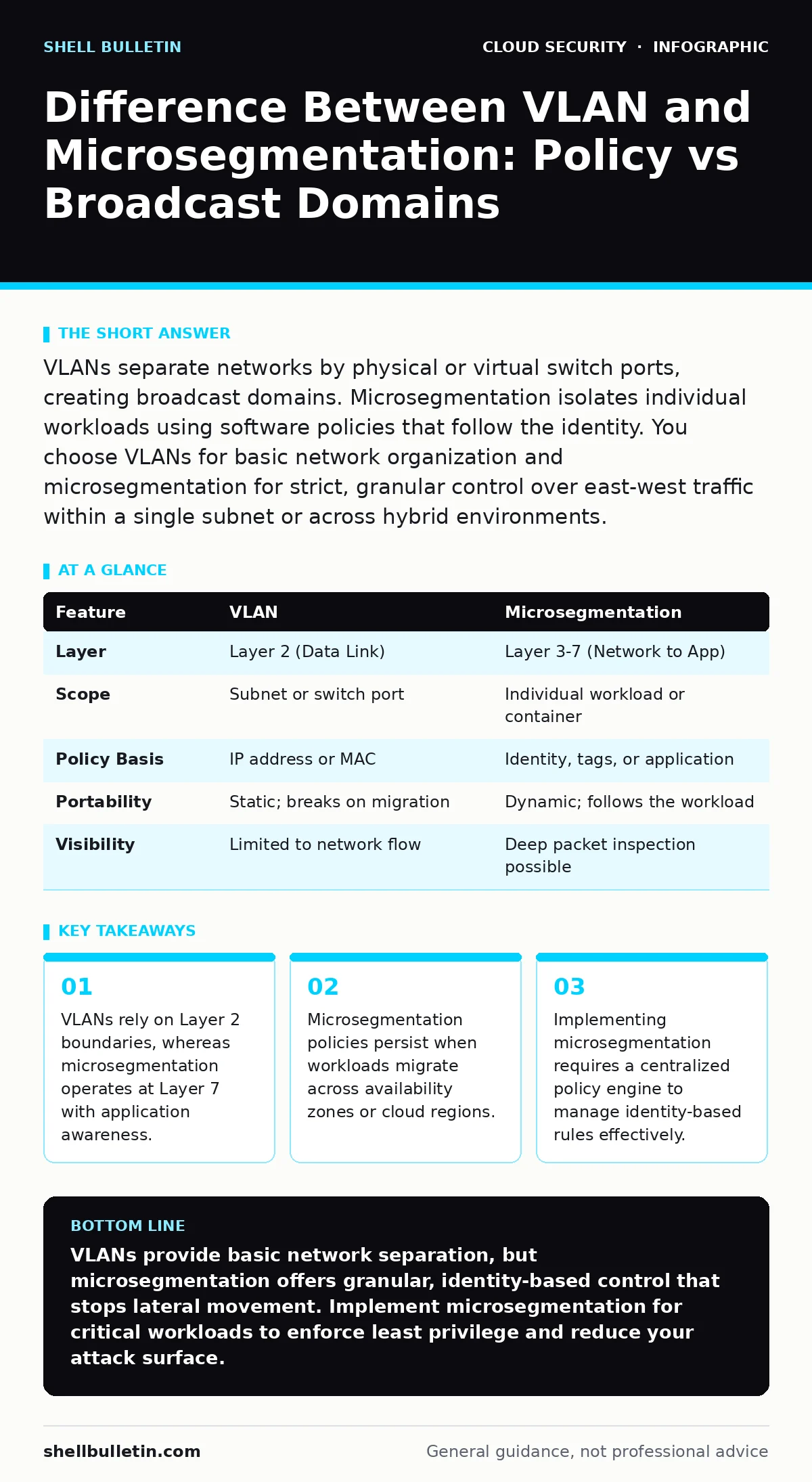
VLANs separate networks by physical or virtual switch ports, creating broadcast domains. Microsegmentation isolates individual workloads using software policies that follow the identity. You choose VLANs for basic network organization and microsegmentation for strict, granular control over east-west traffic within a single subnet or across hybrid environments.
What is the core difference between VLAN and microsegmentation?
VLANs create separate broadcast domains by tagging traffic at the network layer, while microsegmentation enforces security policies at the workload level using identity attributes. A VLAN groups devices into a logical network segment, typically managed by switches. Microsegmentation treats each server, container, or virtual machine as its own security zone. This distinction matters because VLANs cannot restrict traffic between two hosts that share the same subnet, whereas microsegmentation can block specific application ports between them.
How does traffic flow differ in each approach?
Traffic in a VLAN flows based on MAC addresses and IP subnets, relying on the switch to forward frames within the same segment. If two servers reside in the same VLAN, they can usually communicate freely unless an additional firewall sits between them. Microsegmentation intercepts traffic at the host or hypervisor level. The policy engine checks the identity of the sender and receiver before allowing the connection. This allows you to permit only specific ports and protocols, blocking all other lateral movement even within the same flat network.
When should you use VLANs instead of microsegmentation?
Use VLANs when you need to segment large groups of devices for broadcast control and basic administrative separation. VLANs are effective for separating office networks from guest Wi-Fi or isolating IoT devices from critical servers. They are simpler to configure on standard network hardware and require less overhead on the endpoints. If your infrastructure is static and your security requirements are limited to keeping distinct departments apart, VLANs provide sufficient isolation without the complexity of identity-based policy management.
Why do VLANs fail to stop lateral movement?
VLANs lack application context and identity awareness, making them blind to malicious activity within the same segment. Imagine a compromised server in a VLAN that contains 50 other application servers. The attacker can scan and exploit any of those servers because the VLAN allows free internal communication. Microsegmentation prevents this by enforcing least privilege in the cloud for each workload. It ensures that a web server can only talk to its database, blocking all other connections. This containment stops an attacker from moving sideways after gaining initial access.
How does identity-based segmentation improve security?
Identity-based segmentation ties security rules to the workload itself, not its IP address or network location. When a virtual machine migrates to a different host or subnet, the security policy moves with it. This eliminates the need to update firewall rules every time the infrastructure changes. It also prevents unauthorized access from workloads that happen to be on the same network but do not have the required identity tags. This approach reduces the risk of cloud misconfigurations that often leave ports open to unintended internal traffic.
See also: DevSecOps vs DevOps: How to Integrate Security Without Slowing Delivery · What Is Immutable Infrastructure: A Static Security Model
What are the operational costs of microsegmentation?
Microsegmentation requires a centralized policy engine and agents or virtual switches on every host to enforce rules. This adds computational overhead to your servers, which can impact performance if not tuned correctly. You must also manage the complexity of defining and testing hundreds of fine-grained policies. The initial setup involves mapping all legitimate traffic flows to avoid breaking applications. However, this cost is offset by reduced incident response time and smaller blast radius during a breach.
| Feature | VLAN | Microsegmentation |
|---|---|---|
| Layer | Layer 2 (Data Link) | Layer 3-7 (Network to App) |
| Scope | Subnet or switch port | Individual workload or container |
| Policy Basis | IP address or MAC | Identity, tags, or application |
| Portability | Static; breaks on migration | Dynamic; follows the workload |
| Visibility | Limited to network flow | Deep packet inspection possible |
How do you combine VLANs and microsegmentation effectively?
Use VLANs for broad network organization and microsegmentation for deep security within those segments. This hybrid approach leverages the simplicity of VLANs for broadcast control while adding granular protection for critical assets. For example, you might place all database servers in a dedicated VLAN, then use microsegmentation to ensure only specific application servers can query them. This layered defense reduces the attack surface and simplifies troubleshooting. You can also apply CIS Benchmarks to harden the underlying hosts, ensuring that the security policies have a stable foundation.
What challenges arise in hybrid cloud environments?
Hybrid environments mix on-premises hardware with cloud instances, creating inconsistent network topologies. VLANs often cannot extend seamlessly into public clouds without complex overlay networks. Microsegmentation solves this by abstracting the network layer. Policies defined on-premises can apply to cloud workloads if the policy engine supports both environments. This consistency is vital for maintaining security standards across data centers. It also supports DevSecOps practices by allowing security policies to be defined as code and deployed alongside infrastructure.
How does microsegmentation handle containerized workloads?
Containers are ephemeral and change IP addresses frequently, making traditional firewall rules ineffective. Microsegmentation identifies containers by their labels, namespaces, or orchestration metadata rather than static IPs. This allows you to enforce security policies that persist through container restarts and scaling events. You can restrict communication between microservices based on their role in the application stack. This integration with container runtime security ensures that even if a container is compromised, it cannot easily communicate with other services.
What is the long-term value of microsegmentation?
Microsegmentation provides continuous security adaptation as your infrastructure evolves. It reduces the dependency on perimeter defenses, which are increasingly ineffective against insider threats and compromised credentials. By enforcing strict access controls at the workload level, you minimize the impact of any single breach. This approach supports workload identity management, ensuring that services authenticate properly before communicating. It also aids in compliance by providing detailed logs of all internal traffic, proving that data residency requirements are met and unauthorized access is prevented.
Key takeaways
- VLANs rely on Layer 2 boundaries, whereas microsegmentation operates at Layer 7 with application awareness.
- Microsegmentation policies persist when workloads migrate across availability zones or cloud regions.
- Implementing microsegmentation requires a centralized policy engine to manage identity-based rules effectively.
VLANs provide basic network separation, but microsegmentation offers granular, identity-based control that stops lateral movement. Implement microsegmentation for critical workloads to enforce least privilege and reduce your attack surface.
Frequently asked questions
Can I use microsegmentation without VLANs?
Yes, microsegmentation works independently of VLANs and can secure traffic within a single flat network or across multiple subnets.
Does microsegmentation slow down network performance?
It adds minimal overhead, but improper policy configuration can cause latency. Optimize rules and use hardware acceleration where available.
How do I audit microsegmentation policies?
Use the policy engine’s reporting features to review allowed and denied connections. Regularly validate that policies match current application requirements.
Is microsegmentation only for cloud environments?
No, it applies to on-premises, hybrid, and multi-cloud environments, providing consistent security regardless of infrastructure location.
How this guide was produced: written by the Shell Bulletin editorial team with AI assistance, checked against the public references listed below, and reviewed when the facts change. See our editorial policy or report an error.