CIS Benchmarks Explained: Meaning, Origins, and Daily Use
These free configuration standards turn vague security goals into specific, auditable settings for your operating systems and cloud services.

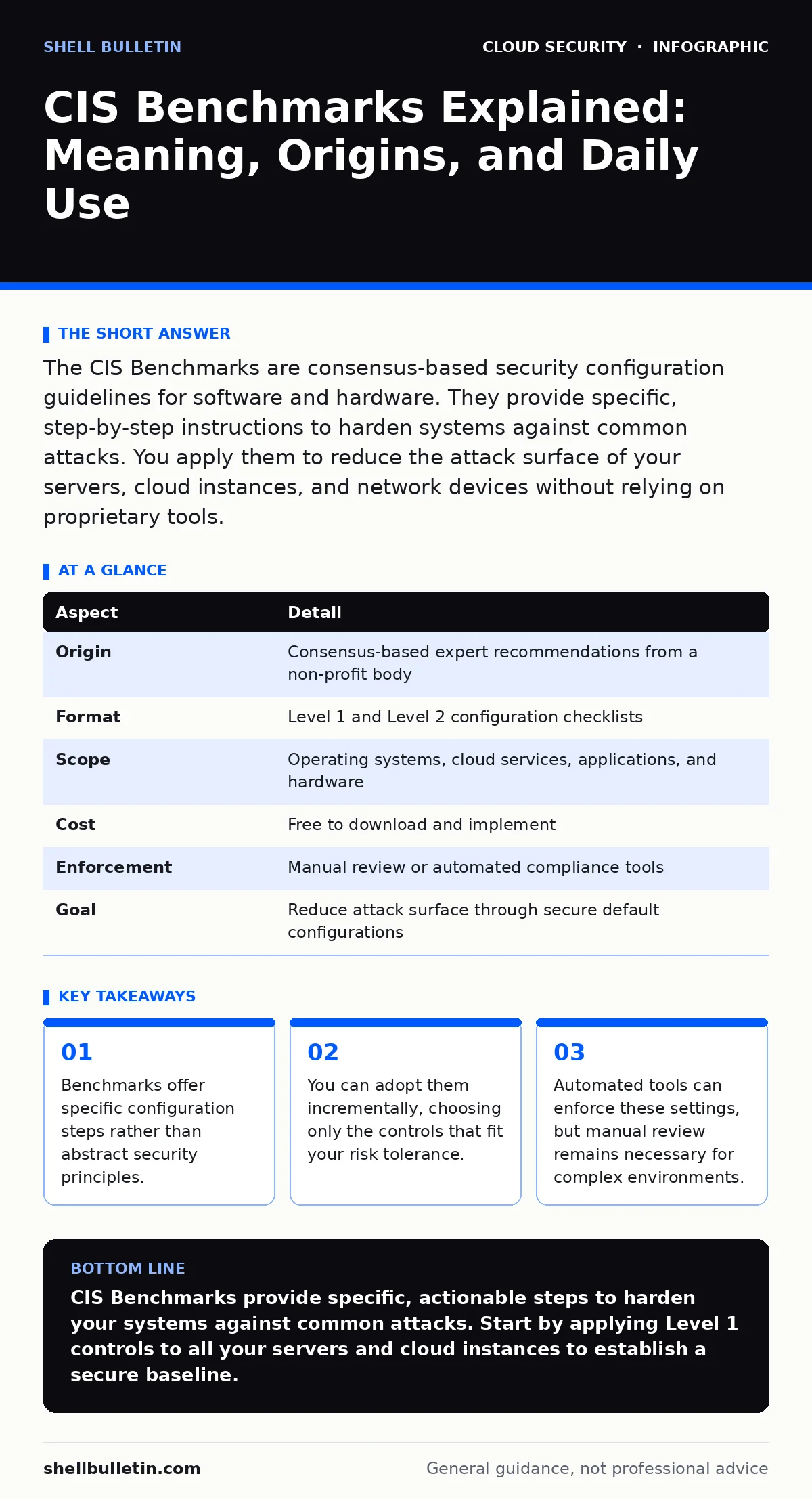
The CIS Benchmarks are consensus-based security configuration guidelines for software and hardware. They provide specific, step-by-step instructions to harden systems against common attacks. You apply them to reduce the attack surface of your servers, cloud instances, and network devices without relying on proprietary tools.
From Vague Advice to Specific Settings
Imagine a builder asking for "strong walls." The answer could mean thick concrete, reinforced steel, or layered brick. Each approach has different costs and strengths. Security advice often suffers from this same ambiguity. When a consultant tells you to "harden your servers," you may not know which settings to change or which risks they mitigate.
The CIS Benchmarks solve this ambiguity. They provide a detailed, step-by-step checklist for configuring specific software and hardware securely. Instead of general advice, you receive exact instructions for password policies, network ports, and user permissions. This clarity allows you to verify your security posture with precision.
These standards originate from the Center for Internet Security, a non-profit organization. This consensus model ensures the recommendations are practical and widely accepted. You do not need to guess which settings matter; the community has already identified them.
At a Glance
| Aspect | Detail |
|---|---|
| Origin | Consensus-based expert recommendations from a non-profit body |
| Format | Level 1 and Level 2 configuration checklists |
| Scope | Operating systems, cloud services, applications, and hardware |
| Cost | Free to download and implement |
| Enforcement | Manual review or automated compliance tools |
| Goal | Reduce attack surface through secure default configurations |
How Benchmarks Work in Practice
You use these benchmarks to establish a baseline for your systems. A baseline is a minimum set of security settings that all similar systems must meet. You start by downloading the relevant document for your operating system or cloud service. The document lists hundreds of individual controls, each with a description and implementation steps.
Most benchmarks are divided into two levels. Level 1 contains the most basic protections. These settings provide significant security with minimal impact on usability. You should apply Level 1 controls to every system in your environment. They stop the easiest attacks and require little maintenance.
Level 2 builds on Level 1 with stricter controls. These settings provide deeper protection but may interfere with certain applications or user workflows. You apply Level 2 controls where the risk justifies the complexity. For example, a public-facing web server needs stricter controls than an internal development machine.
The Hidden Cost of Blind Adoption
Many teams treat benchmarks as a binary pass-or-fail test. This approach creates a hidden cost. Not every control in the document applies to your specific use case. Some settings may break legitimate business applications. Others may be redundant because your network architecture already mitigates the risk.
Blindly applying every recommendation can destabilize your systems. You might disable a service that an application depends on. You might lock down permissions so tightly that automated backups fail. This friction leads to "alert fatigue" where teams ignore compliance warnings because they cause more problems than they solve.
You must evaluate each control against your business needs. Ask whether the setting addresses a real risk in your environment. If the risk is low, you can document an exception. This selective approach keeps your systems secure without sacrificing functionality. It also makes it easier to maintain compliance over time.
Integrating with Broader Security Strategies
Benchmarks work best when combined with other security measures. They configure your systems, but they do not monitor them. You need logging and monitoring to detect when someone changes these settings. You need incident response plans to react when a breach occurs despite your hardening efforts.
Consider how these standards fit into a zero trust network access strategy. Zero trust assumes no user or device is trusted by default. Benchmarks help you secure the individual devices that request access. Together, they reduce the chance that a compromised device can move laterally through your network.
You also need to address cloud misconfigurations proactively. Benchmarks provide the correct settings, but cloud environments change rapidly. New instances are created and deleted constantly. You need automated tools to ensure that every new instance matches your baseline. Without automation, manual checks will fall behind the pace of change.
See also: DevSecOps vs DevOps: How to Integrate Security Without Slowing Delivery · What Is Immutable Infrastructure: A Static Security Model
What People Usually Get Wrong
One common mistake is assuming that compliance equals security. Following a benchmark does not make your system immune to attack. It reduces the number of easy targets. Attackers still look for vulnerabilities in applications, logic flaws, or human error. You must continue to patch software and train users.
Another error is ignoring the context of the controls. Some benchmarks recommend disabling remote access. This is sensible for a database server that only talks to local applications. It is disastrous for a file server that users access from home. You must understand the purpose of each control before applying it.
Teams also often neglect to update their baselines. Benchmarks are revised regularly to address new threats and software changes. If you lock your configuration to an old version, you may miss critical improvements. You should review your baseline whenever you upgrade your operating system or cloud service.
Automating the Enforcement Process
Manual configuration is prone to human error. One missed setting can leave a system vulnerable. Automation reduces this risk by applying the same settings to every instance. You can use infrastructure-as-code tools to define your baseline in a script. This script ensures that every new server starts with the correct security settings.
Automated compliance scanners can also verify your current state. These tools compare your live systems against the benchmark. They generate reports showing which controls are passing and which are failing. You can use these reports to prioritize your remediation efforts. Focus on the highest-risk failures first.
Integration with ephemeral infrastructure is particularly important. In cloud environments, servers may exist for only a few hours. You cannot manually check these short-lived resources. You must bake the security controls into the image or template used to create them. This ensures that security is present from the moment the instance launches.
Moving Beyond Basic Hardening
Once you have applied the basic benchmarks, you can look at more advanced controls. Some benchmarks include recommendations for private endpoints. These endpoints allow your services to communicate over a private network, avoiding the public internet. This reduces the exposure of your services to external attackers.
You may also consider how workload identity fits into your strategy. Workload identity allows applications to authenticate themselves securely. This prevents attackers from using stolen credentials to access cloud resources. Combining identity management with system hardening creates a deeper defense.
For containerized environments, pay attention to exposed Kubernetes dashboards. These dashboards often provide powerful administrative access. If left unsecured, they can be a gateway to your entire cluster. The CIS Benchmark for Kubernetes includes specific controls to secure this interface. Ignoring them can lead to full cluster compromise.
Key takeaways
- Benchmarks offer specific configuration steps rather than abstract security principles.
- You can adopt them incrementally, choosing only the controls that fit your risk tolerance.
- Automated tools can enforce these settings, but manual review remains necessary for complex environments.
CIS Benchmarks provide specific, actionable steps to harden your systems against common attacks. Start by applying Level 1 controls to all your servers and cloud instances to establish a secure baseline.
Frequently asked questions
Are CIS Benchmarks legal requirements?
No, they are voluntary best practices. However, many industry regulations and insurance policies reference them as evidence of due care.
How often should I update my configurations?
You should review and update your configurations whenever your software is updated or when new benchmarks are released.
Can I use these benchmarks for on-premise servers?
Yes, the benchmarks cover physical and virtual servers running standard operating systems like Windows and Linux.
Do I need special tools to implement them?
No, you can implement them manually. However, automation tools make it easier to enforce them at scale and verify compliance.
How this guide was produced: written by the Shell Bulletin editorial team with AI assistance, checked against the public references listed below, and reviewed when the facts change. See our editorial policy or report an error.