Alert Fatigue Cybersecurity: How to Reduce Noise and Find Real Threats
Excessive notifications desensitize analysts to genuine threats, causing them to miss subtle indicators of compromise that require careful investigation.

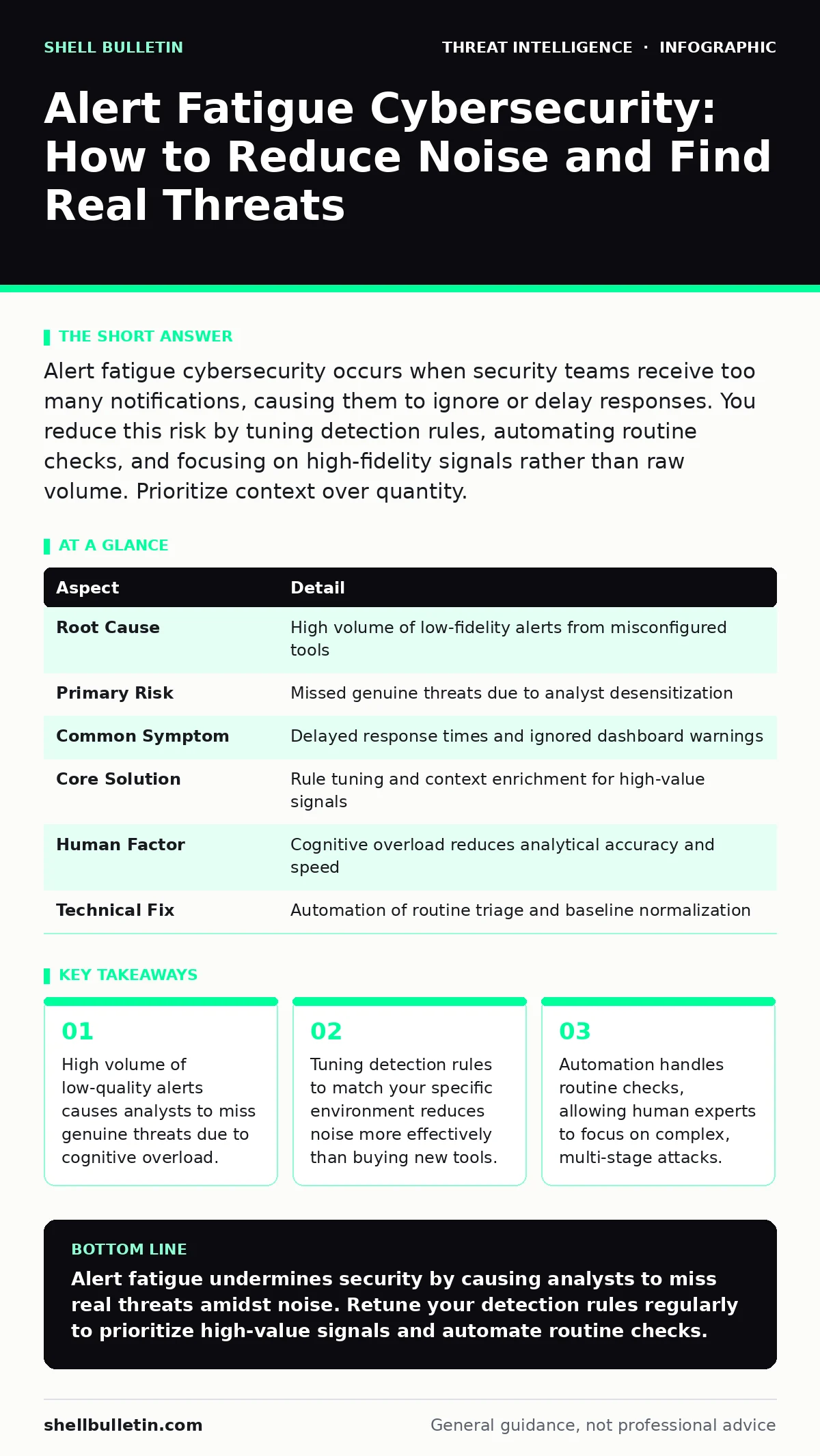
Alert fatigue cybersecurity occurs when security teams receive too many notifications, causing them to ignore or delay responses. You reduce this risk by tuning detection rules, automating routine checks, and focusing on high-fidelity signals rather than raw volume. Prioritize context over quantity.
Understanding the Psychology of Alert Fatigue Cybersecurity
Alert fatigue cybersecurity describes the state where security professionals become desensitized to warnings because they receive an overwhelming number of notifications. This condition leads to delayed responses or complete disregard for critical security events. The human brain adapts to constant stimuli by filtering them out as background noise. When every email trigger or login attempt generates a loud alarm, the signal-to-noise ratio collapses.
Analysts stop trusting the system because most alarms prove harmless. This erosion of trust creates a dangerous blind spot. Attackers exploit this blindness by hiding their activities among the thousands of false positives. The goal is not to eliminate all alerts but to restore the meaning of each one. You must treat attention as a finite resource that requires strict conservation.
| Aspect | Detail |
|---|---|
| Root Cause | High volume of low-fidelity alerts from misconfigured tools |
| Primary Risk | Missed genuine threats due to analyst desensitization |
| Common Symptom | Delayed response times and ignored dashboard warnings |
| Core Solution | Rule tuning and context enrichment for high-value signals |
| Human Factor | Cognitive overload reduces analytical accuracy and speed |
| Technical Fix | Automation of routine triage and baseline normalization |
How Detection Noise Overwhelms Your Team
Security tools generate alerts based on predefined rules. A rule might trigger if a user logs in from an unusual location. If your team travels frequently, this rule fires daily for legitimate activity. Each false positive consumes mental energy. Analysts must open the alert, check the details, determine it is safe, and close the ticket. This process repeats hundreds of times per day. The cognitive load accumulates.
Decision-making quality declines as fatigue sets in. You begin to skim details instead of reading them carefully. Subtle anomalies that indicate a breach slip past because they look like the thousands of benign events you just dismissed. The system works technically, but it fails operationally. The tool does not know your business context. It only knows the rule you gave it. Without context, every deviation looks like a threat.
Who Suffers Most From Notification Overload
Small and mid-sized organizations face the highest risk. These teams often lack dedicated security operations centers. One or two staff members handle all IT and security tasks. They cannot afford to ignore alerts, but they also cannot investigate every single one. The pressure to respond quickly leads to shortcuts. Large enterprises have more resources but suffer from tool sprawl. They use multiple vendors for different functions.
Each vendor sends its own alerts. The lack of integration creates silos. Analysts must switch between platforms to correlate data. This context switching increases error rates. Remote workers add another layer of complexity. Their network behavior differs from office users. Rules written for stationary desktops generate noise for mobile laptops. Every organization with active monitoring faces this challenge. The scale varies, but the mechanism remains the same.
What People Usually Get Wrong About Solutions
Many leaders believe buying a more advanced tool will solve the problem. They assume better technology means fewer false positives. This is rarely true. New tools often add more detection capabilities, which increases the total volume of alerts. The problem is not the tool; it is the configuration. Another common mistake is relying solely on automation. You might use SOAR (Security Orchestration, Automation, and Response) platforms to auto-close alerts.
If the logic is flawed, you auto-close real threats. Automation amplifies your existing processes. Bad processes become faster bad outcomes. Teams also ignore the importance of baseline data. You cannot define "unusual" without knowing "normal." Without a clear baseline, every minor deviation triggers an alarm. Fixing the root cause requires time and patience, not just a purchase order.
Tuning Rules to Restore Signal Clarity
Start by reviewing your highest-volume alerts. Identify the top 10 sources of noise. For each source, ask why it triggers. Is it a legitimate business process? If yes, create an exception or whitelist. If no, tighten the rule parameters. For example, instead of alerting on any login from a new country, alert only on logins to sensitive systems from new countries. This adds context and reduces volume. Review your endpoint telemetry settings.
Ensure you are collecting data that supports your specific use cases. Collecting everything creates storage bloat and processing delays. Focus on indicators that matter for your industry. Regularly revisit your rules. Business processes change. New applications get deployed. Old rules become obsolete. Schedule quarterly reviews to prune ineffective detections. This maintenance keeps your system aligned with reality.
See also: Implement Detection Use Cases: A Practical Step-by-Step Guide · OSINT tools for investigators explained: uncover public clues
Automating the Routine to Save Human Focus
Use automation to handle repetitive tasks. Routine password resets or known benign software installations do not need human eyes. Configure your system to auto-resolve these events. This frees analysts to focus on complex investigations. Look for patterns that indicate tactics, techniques and procedures (TTPs) of known threat actors. Automate the collection of context for these specific patterns.
When a high-fidelity alert fires, the system should already have gathered relevant logs and user details. This reduces the time spent on initial triage. You can then focus on the cyber kill chain stages that require creative thinking. Automation handles the "what" and "where." Humans handle the "why" and "how." This division of labor maximizes efficiency. It also reduces the chance of human error in routine checks.
Building a Culture of Continuous Improvement
Security is not a one-time setup. It is a continuous process of learning and adjustment. Encourage your team to report false positives. Create a simple channel for feedback. When an analyst dismisses an alert, they should note why. This data feeds back into rule tuning. Regularly review your SOC playbooks to ensure they reflect current threats.
Update procedures based on recent incidents or near-misses. Share lessons learned across the team. When one person learns to spot a specific type of noise, everyone benefits. This collective knowledge reduces overall fatigue. It also builds resilience against new attack methods. By focusing on quality over quantity, you create a sustainable security posture. You protect your organization without burning out your people.
Integrating Intelligence for Better Context
Raw alerts lack context. They tell you something happened, but not if it matters. Integrate threat intelligence feeds to enrich your data. If an IP address appears in a known bad list, flag it immediately. If it is a known benign service, ignore it. This contextual layer helps prioritize work. Look for command and control traffic patterns that indicate active exploitation.
These patterns are often subtle and require behavioral analysis. Combine this with user behavior analytics. Does the user normally access this file? Does the process typically run at this time? Context turns a data point into a story. Stories are easier for humans to process. They reduce the cognitive load required to make decisions. You move from reacting to noise to understanding intent.
Key takeaways
- High volume of low-quality alerts causes analysts to miss genuine threats due to cognitive overload.
- Tuning detection rules to match your specific environment reduces noise more effectively than buying new tools.
- Automation handles routine checks, allowing human experts to focus on complex, multi-stage attacks.
Alert fatigue undermines security by causing analysts to miss real threats amidst noise. Retune your detection rules regularly to prioritize high-value signals and automate routine checks.
Frequently asked questions
How many alerts per day are too many?
There is no fixed number. If analysts spend more time dismissing false positives than investigating genuine threats, the volume is too high for your team size.
Can AI completely solve alert fatigue?
AI can help prioritize and correlate data, but it requires accurate training. It cannot replace human judgment for complex, novel attacks.
Should we turn off less critical alerts?
Yes, if they consistently prove harmless. Focus resources on alerts that indicate potential compromise or policy violation with significant impact.
How do we measure improvement in alert handling?
Track the time from alert generation to resolution. A decreasing average time for genuine threats indicates improved efficiency and reduced fatigue.
How this guide was produced: written by the Shell Bulletin editorial team with AI assistance, checked against the public references listed below, and reviewed when the facts change. See our editorial policy or report an error.