OSINT tools for investigators explained: uncover public clues
Public data collection reveals digital footprints long before anyone inspects your private network perimeter or servers.

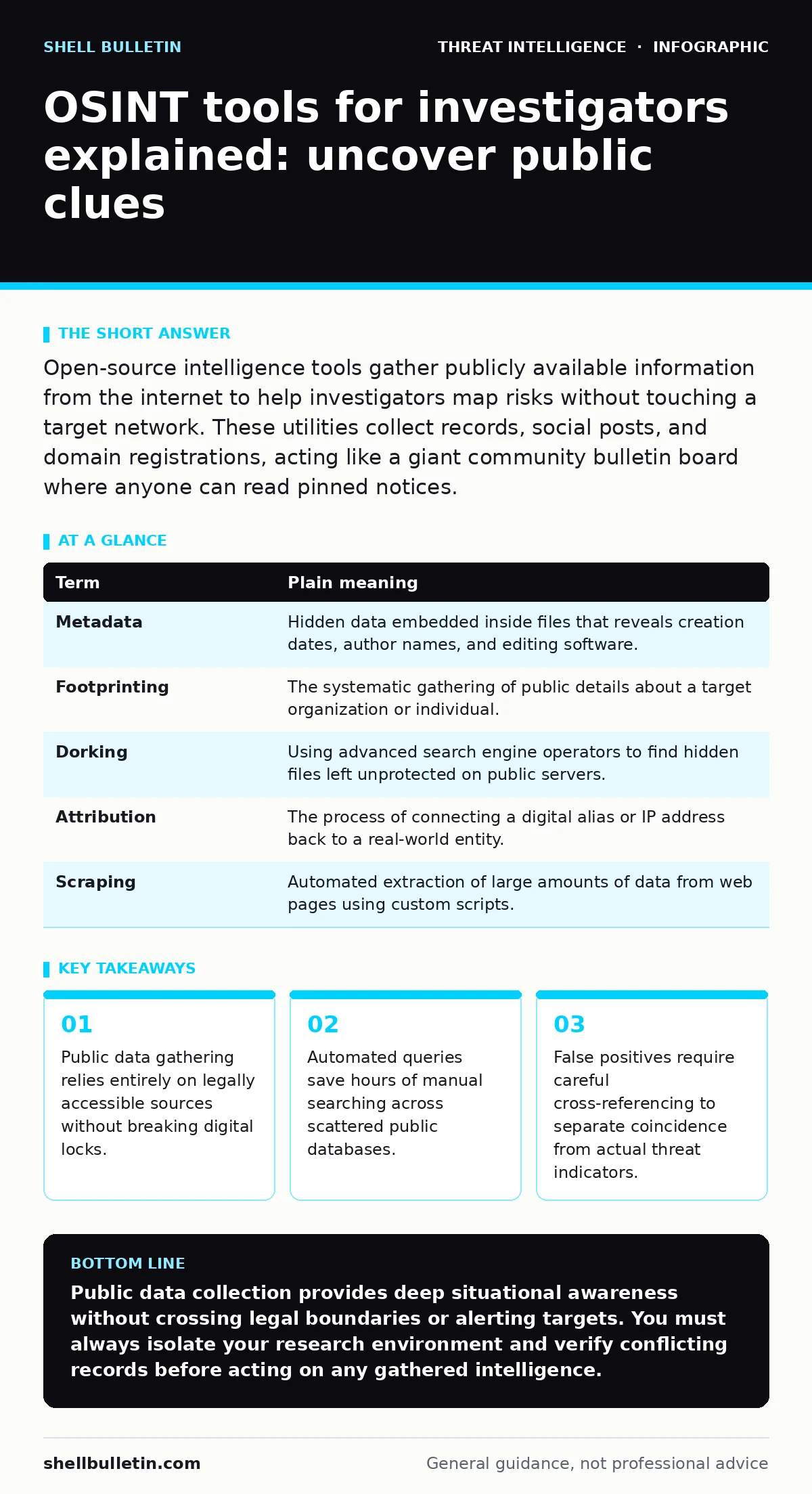
Open-source intelligence tools gather publicly available information from the internet to help investigators map risks without touching a target network. These utilities collect records, social posts, and domain registrations, acting like a giant community bulletin board where anyone can read pinned notices.
Understanding open-source intelligence collection
Open-source intelligence collection gathers publicly accessible data to answer specific investigative questions without alerting the subject. Public records, domain registries, and social media posts form the foundation of this practice, functioning exactly like a crowded community bulletin board in a town square where anyone can read posted notices. Investigators examine these public artifacts to understand adversary behavior, mapping out tactics, techniques and procedures (TTPs) long before an active intrusion occurs. Gathering this material requires zero intrusion into private systems, meaning your actions remain entirely outside the scope of traditional network alarms.
What makes a tool effective for beginners?
Tools become effective for beginners when they automate the tedious process of searching dozens of separate public databases simultaneously. Manual searching forces you to check every single registry and forum by hand, wasting valuable hours that could be spent analyzing actual risk indicators. Automated software queries multiple repositories at once, returning structured results in seconds.
Software speed creates a distinct trade-off because automated queries often trigger rate limits or flag your own IP address on third-party services, forcing you to manage your query volume carefully. Beginners often overestimate software capabilities, assuming automated programs can interpret context the way a human analyst can. In reality, software only aggregates raw text and numbers, leaving the critical thinking and contextual analysis entirely up to you.
Core terminology for beginners
| Term | Plain meaning |
|---|---|
| Metadata | Hidden data embedded inside files that reveals creation dates, author names, and editing software. |
| Footprinting | The systematic gathering of public details about a target organization or individual. |
| Dorking | Using advanced search engine operators to find hidden files left unprotected on public servers. |
| Attribution | The process of connecting a digital alias or IP address back to a real-world entity. |
| Scraping | Automated extraction of large amounts of data from web pages using custom scripts. |
How do you run your first public query safely?
Running your first public query safely involves following 3 distinct steps to protect your own digital footprint during the investigation process.
- Set up an isolated browser profile completely disconnected from your personal accounts, cookies, and saved passwords.
- Route your connection through a reputable virtual private network to mask your office location while querying public databases.
- Document every source URL immediately by taking a static screenshot rather than relying on live links that might change.
What are the hidden costs of automated gathering?
Automated gathering introduces significant hidden costs when software misinterprets stale records as active threats. Stale data appears frequently on public servers because websites rarely delete old files when employees leave or projects end. Relying blindly on automated alerts without manual verification leads investigators down blind alleys, wasting resources on non-existent dangers.
Professional analysts feed these raw public observations into threat intelligence platforms to correlate them with verified indicators, filtering out the noise generated by automated collection tools. The hidden financial cost involves subscription fees for premium databases that offer little advantage over free public registries when used correctly by trained personnel.
See also: Threat Intelligence Platforms: Real Value vs Operational Noise · Tactics, Techniques, and Procedures (TTPs) Explained for Beginners
How should you handle conflicting public data?
Handling conflicting public data requires checking the historical timeline of updates rather than trusting the most recent entry alone. Conflicting details occur when two different registries report contradictory ownership facts for the exact same domain name. Software tools often fail to weigh the credibility of conflicting sources, leaving human investigators responsible for judging which record reflects reality. This manual reconciliation step prevents costly missteps during active threat assessments.
What safety habits protect your investigators?
Safety habits protect your investigators by minimizing the digital exhaust your research team generates while examining public targets. Research teams often forget that targets monitor their own inbound web traffic logs to see who is viewing their public profiles or downloading documents. Using burner accounts and dedicated search environments stops targets from tracing your inquiries back to your actual organization. Blending your research traffic with normal web browsing habits prevents automated defenders from flagging your IP address as a hostile scanner.
Key takeaways
- Public data gathering relies entirely on legally accessible sources without breaking digital locks.
- Automated queries save hours of manual searching across scattered public databases.
- False positives require careful cross-referencing to separate coincidence from actual threat indicators.
Public data collection provides deep situational awareness without crossing legal boundaries or alerting targets. You must always isolate your research environment and verify conflicting records before acting on any gathered intelligence.
Frequently asked questions
Are open-source intelligence tools legal to use for small business security?
Yes, these tools are entirely legal because they only access information that has been intentionally published to the public internet. However, crossing into private networks or bypassing authentication walls remains illegal.
Do I need programming skills to operate public data collection software?
Most modern utilities feature graphical interfaces designed specifically for users without coding experience. Command-line options exist for advanced tasks, but beginner-friendly software handles standard web searches easily.
How often should my organization check public registries for leaked data?
Routine checks should occur on a monthly schedule to catch newly exposed documents or unauthorized domain registrations early. Major organizational changes should also trigger immediate ad-hoc reviews.
Can targets see when my business investigates their public profiles?
Targets can see your IP address or organizational identity in their web server logs if you visit their sites directly without protection. Using privacy-focused configurations prevents targets from tracking your research back to your office.
How this guide was produced: written by the Shell Bulletin editorial team with AI assistance, checked against the public references listed below, and reviewed when the facts change. See our editorial policy or report an error.