Threat Intelligence Platforms: Real Value vs Operational Noise
Most threat intelligence platforms create more work for your team by generating alerts you cannot act on without deeper context.
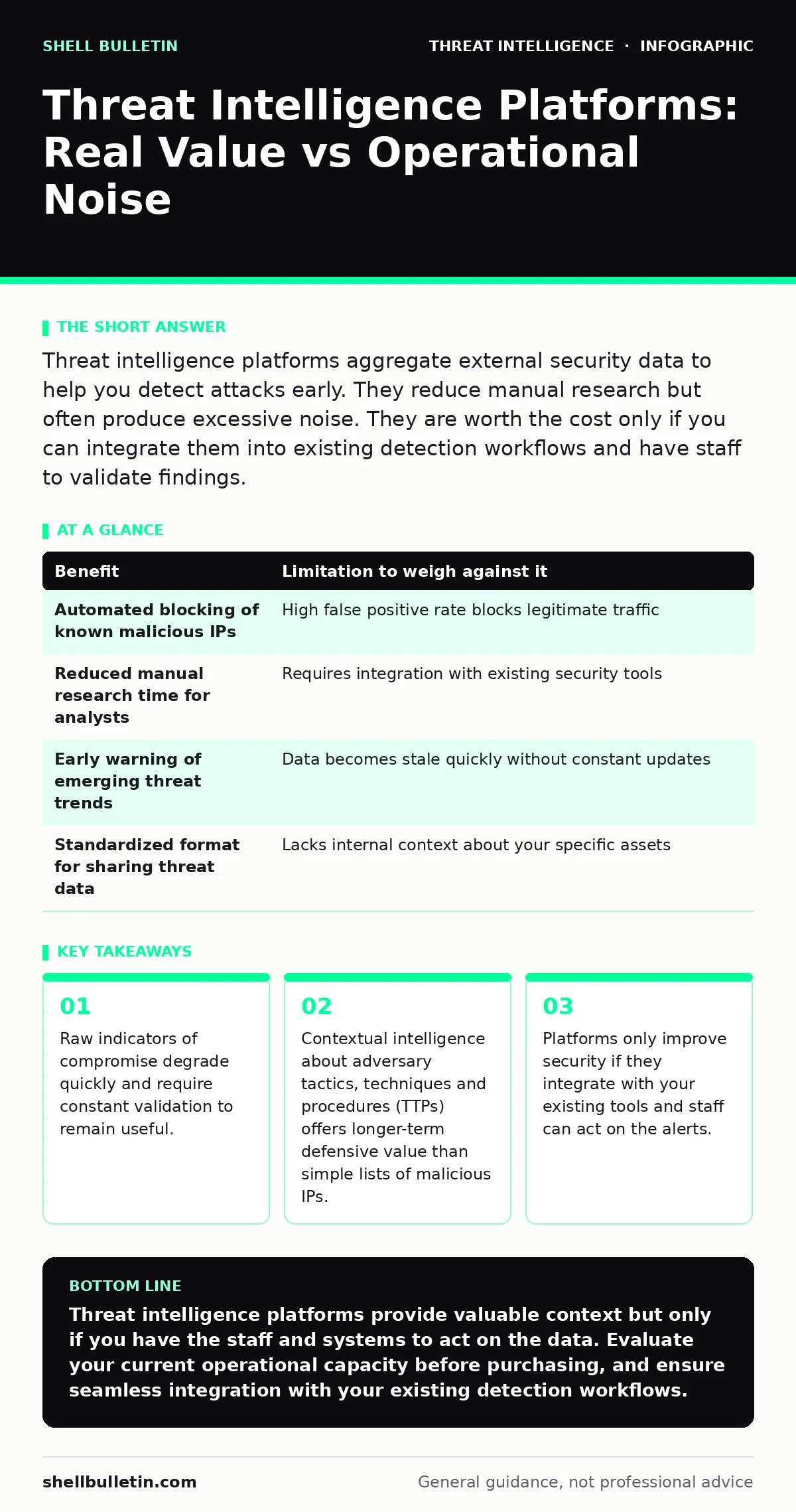
Threat intelligence platforms aggregate external security data to help you detect attacks early. They reduce manual research but often produce excessive noise. They are worth the cost only if you can integrate them into existing detection workflows and have staff to validate findings.
The Promise of External Data
Threat intelligence platforms aggregate data from multiple sources to identify malicious activity before it hits your network. You subscribe to feeds that provide indicators of compromise, such as known malicious IP addresses, domains, and file hashes. The goal is to block these known bad actors automatically. This shifts your security posture from reactive to proactive. You stop waiting for an incident to confirm a threat. Instead, you prevent the connection before it establishes.
However, the volume of data is overwhelming. Most platforms deliver thousands of new indicators daily. Your firewall or endpoint detection system must process this influx. If you lack the infrastructure to ingest and correlate this data, the platform becomes a liability. It generates alerts that your team cannot triage effectively. You end up chasing ghosts while real threats slip through the noise.
The Cost of Context
Raw indicators have a short shelf life. An IP address used for command and control traffic today may be clean tomorrow. Relying solely on these static markers creates a false sense of security. Adversaries rotate their infrastructure frequently to evade detection. Your platform must provide context, not just lists. It should explain why an indicator is malicious and how it fits into broader campaigns.
Without context, you cannot prioritize responses. A blocked IP might stop a minor scan, or it might halt a critical data exfiltration. The platform must help you distinguish between the two. This requires mapping indicators to specific adversary behaviors. It also requires understanding your own environment. If the platform does not know what is normal for your network, it cannot tell you what is dangerous.
| Benefit | Limitation to weigh against it |
|---|---|
| Automated blocking of known malicious IPs | High false positive rate blocks legitimate traffic |
| Reduced manual research time for analysts | Requires integration with existing security tools |
| Early warning of emerging threat trends | Data becomes stale quickly without constant updates |
| Standardized format for sharing threat data | Lacks internal context about your specific assets |
Integration Is the Bottleneck
A threat intelligence platform is useless if it sits in isolation. It must connect to your security information and event management system. It should also feed into your security orchestration, automation and response (SOAR) tools. Without these connections, your analysts must manually check every alert. This defeats the purpose of automation. You are not buying efficiency; you are buying more paperwork.
Integration requires technical effort. You must map the platform’s data fields to your internal schemas. You must ensure that alerts trigger the correct workflows. If the integration fails, the data remains silent. You pay for the subscription but gain no visibility. The platform becomes another dashboard you rarely open. This is a common failure mode for organizations that buy tools without planning the plumbing.
The Human Element
Technology cannot replace judgment. A platform can flag an anomaly, but it cannot decide if it is an attack. Your analysts must interpret the findings. They must determine if the threat is relevant to your industry and geography. They must decide if the risk justifies the operational disruption of blocking a service. This requires skilled personnel. If your team lacks the expertise, the platform’s output is meaningless.
You also face alert fatigue. When a platform generates hundreds of low-value alerts, your team stops paying attention. They begin to ignore all notifications, including the critical ones. This is a hidden cost of poor filtering. You must tune the platform to match your risk tolerance. You must define what constitutes a true positive for your environment. This tuning takes time and continuous effort.
When It Is Worth It
Invest in a threat intelligence platform if you have mature detection capabilities. You should already use SOC playbooks to guide your response to incidents. The platform adds value by enriching these playbooks with external data. It helps you identify new detection use cases before adversaries exploit them. This allows you to update your defenses proactively.
It is also worth it if you handle sensitive data or operate in a highly targeted sector. Adversaries often use initial access brokers to find entry points. These brokers research potential victims extensively. External intelligence can reveal if your organization is being targeted. It can show you the tactics, techniques and procedures (TTPs) the adversary is likely to use. This allows you to harden your defenses against specific methods.
See also: Threat Intelligence Programs: Definition, Purpose and Core Components · Tactics, Techniques, and Procedures (TTPs) Explained for Beginners
When It Is Not
Do not buy a platform if you lack basic security hygiene. If you are still struggling with password cracking attacks due to weak credentials, a threat intelligence platform will not help. It cannot fix misconfigurations or unpatched software. It cannot replace the need for strong access controls. You must secure your foundation first. Adding advanced tools on top of a weak base creates complexity without security.
It is also not worth it if you cannot staff the operation. If you do not have analysts to review alerts, the platform is a waste of money. The data will sit unused. The alerts will go untriaged. You will pay for a service you cannot consume. In these cases, focus on improving your core defenses. Ensure your monitoring covers port scanning and other common reconnaissance activities. Build your internal capabilities before adding external data.
The Long-Term View
Threat intelligence is not a product; it is a process. The value comes from how you use the data, not the data itself. You must continuously refine your filters. You must update your detection rules as adversary tactics evolve. You must train your staff to interpret the context. This requires a commitment to ongoing improvement.
The platform is a tool, not a solution. It provides information, not security. You must still make the decisions. You must still implement the controls. The platform helps you see the battlefield, but you still have to fight. Use it to enhance your existing practices, not to replace them. This balanced approach ensures you get value without drowning in noise.
Key takeaways
- Raw indicators of compromise degrade quickly and require constant validation to remain useful.
- Contextual intelligence about adversary tactics, techniques and procedures (TTPs) offers longer-term defensive value than simple lists of malicious IPs.
- Platforms only improve security if they integrate with your existing tools and staff can act on the alerts.
Threat intelligence platforms provide valuable context but only if you have the staff and systems to act on the data. Evaluate your current operational capacity before purchasing, and ensure seamless integration with your existing detection workflows.
Frequently asked questions
How do I measure the return on investment of a threat intelligence platform?
Track the reduction in mean time to detect and respond to incidents. Also measure the decrease in manual research hours for your analysts.
Can a threat intelligence platform replace my security operations center?
No, it supplements your operations center by providing external data. It does not replace the human analysts who interpret and act on that data.
What is the difference between commercial and open-source intelligence?
Commercial platforms offer curated, high-fidelity data with support. Open-source intelligence is free but requires more manual validation and integration effort.
How often should I update my threat intelligence feeds?
Update them as frequently as the platform allows, ideally in real-time. Stale data leads to missed detections and wasted resources.
How this guide was produced: written by the Shell Bulletin editorial team with AI assistance, checked against the public references listed below, and reviewed when the facts change. See our editorial policy or report an error.