Command and Control Traffic: Risks and Protection for Small Businesses
Hidden command and control channels often bypass standard firewalls by masquerading as legitimate DNS or HTTPS traffic, making detection difficult without specific monitoring.

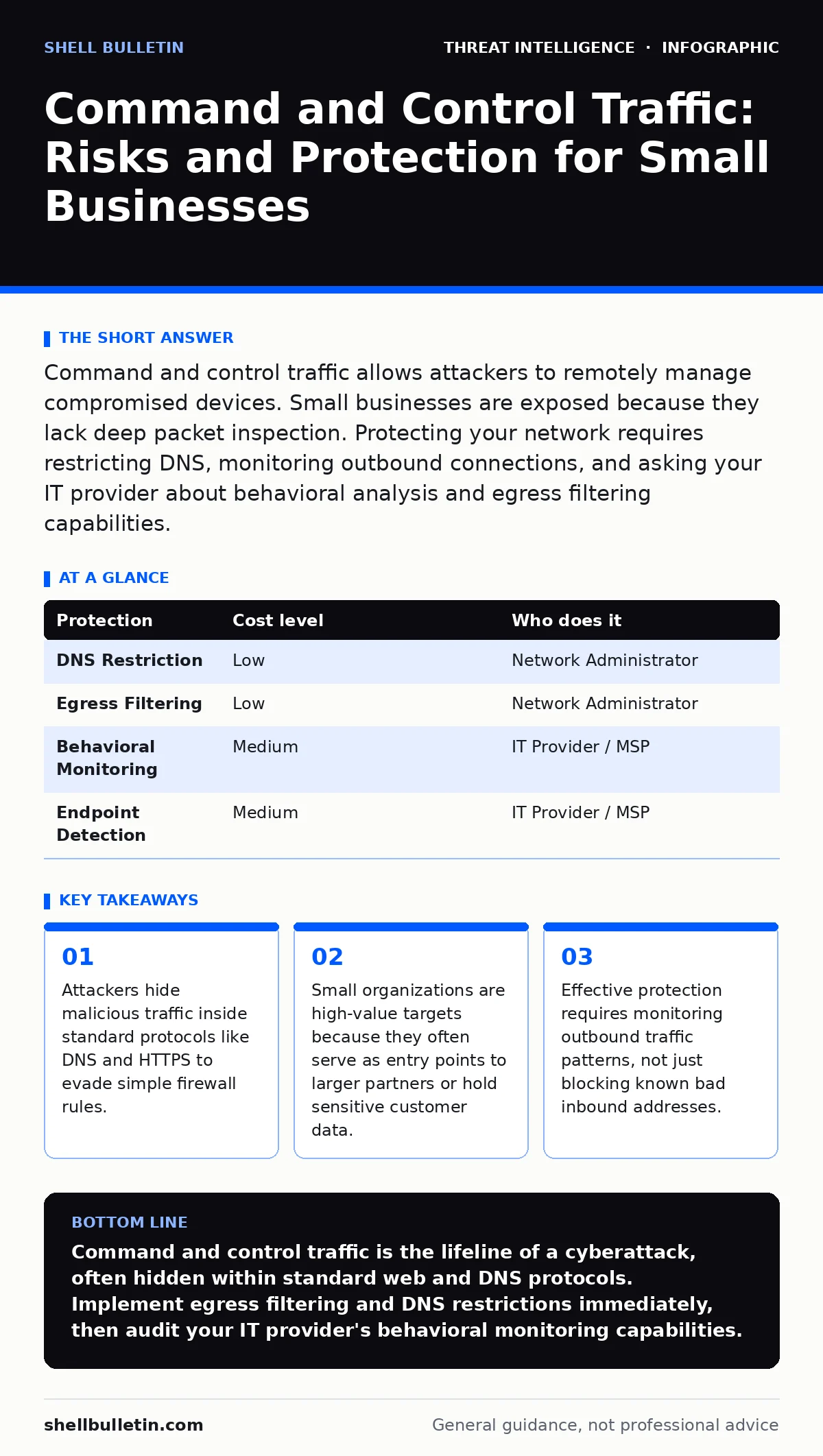
Command and control traffic allows attackers to remotely manage compromised devices. Small businesses are exposed because they lack deep packet inspection. Protecting your network requires restricting DNS, monitoring outbound connections, and asking your IT provider about behavioral analysis and egress filtering capabilities.
The Invisible Remote Control
Command and control, often abbreviated as C2, is the communication channel between a compromised device and the attacker managing it. Think of it as a remote control signal. Once an adversary gains initial access, they need a way to send instructions and receive results. This traffic often travels over protocols you use every day, such as HTTP, HTTPS, or DNS.
The danger lies in the camouflage. Modern C2 frameworks are designed to look like normal background noise. They might send small, periodic "heartbeat" signals to keep the connection alive. To a casual observer, or a basic firewall, this looks like a device checking for software updates. You do not see the malicious intent in the headers. You only see standard web traffic leaving your network.
Why Smaller Networks Are Vulnerable
Smaller organizations often assume they are invisible to sophisticated attackers. This assumption is incorrect. Attackers use automated tools to scan for weaknesses across the entire internet. They do not target specific companies initially. They target open ports, unpatched software, and misconfigured services.
When a small business is compromised, it often serves a strategic purpose. The attacker may use your network as a stepping stone to reach larger partners. This is known as supply chain compromise. Your network becomes a bridge. Alternatively, the attacker may install ransomware or cryptominers directly on your systems. The cost of remediation is high because you lack the internal resources to detect the intrusion early.
The Mechanics of Covert Channels
Attackers rarely use a dedicated, suspicious port for C2 traffic. They prefer to blend in. One common method is DNS tunneling. Domain Name System requests translate human-readable names into IP addresses. Attackers can encode their data inside these requests. A single DNS query can carry a payload of stolen data.
Another method involves HTTPS. Because most web browsing is encrypted, your firewall cannot inspect the content of the packets. It can only see the destination. If the attacker uses a legitimate-looking domain, your security tools may allow the traffic. This is why detection use cases based solely on IP reputation are insufficient. You must look at behavior, not just addresses.
Low-Cost Protections You Can Implement
You do not need an enterprise-grade security operations center to reduce risk. Several low-cost measures can significantly raise the barrier for attackers. The first step is restricting outbound DNS. Force all DNS queries through your own trusted resolver. Block external DNS servers. This prevents many DNS tunneling attempts.
Next, implement egress filtering. This means controlling what traffic is allowed to leave your network. Most small businesses focus on inbound protection. They forget that malware must send data out. Block unnecessary outbound ports. If your employees do not need to run personal email servers from their workstations, block port 25. This limits the attacker's ability to establish a reliable C2 channel.
| Protection | Cost level | Who does it |
|---|---|---|
| DNS Restriction | Low | Network Administrator |
| Egress Filtering | Low | Network Administrator |
| Behavioral Monitoring | Medium | IT Provider / MSP |
| Endpoint Detection | Medium | IT Provider / MSP |
What to Ask Your IT Provider
If you outsource your IT, your provider is your first line of defense. You need to verify that they monitor for C2 activity. Do not assume they do. Ask specific questions about their monitoring capabilities.
- Do you monitor outbound traffic for anomalous patterns, such as long idle connections or unusual data volumes?
- How do you detect living-off-the-land attacks where attackers use built-in system tools like PowerShell to communicate with C2 servers?
- What is your process for analyzing endpoint telemetry to identify suspicious process creation or network connections?
- Do you have SOC playbooks defined for responding to suspected C2 activity, or do you rely on manual investigation?
Understanding their threat intelligence program is also vital. Ask if they subscribe to feeds that identify known malicious domains and IPs. However, remember that new C2 servers appear constantly. Intelligence feeds are reactive. Behavioral analysis is proactive.
See also: Lateral Movement Meaning: How Attackers Spread Inside Your Network
The Hidden Cost of Complexity
Adding layers of security introduces complexity. Complex systems are harder to manage. If your firewall rules are too restrictive, legitimate business applications may break. This is the trade-off. You must balance security with usability.
A common mistake is relying on a single tool. A firewall blocks ports. An antivirus scans for known malware signatures. Neither detects a brand-new C2 channel using a legitimate protocol. You need a combination of controls. This is where security metrics become useful. You need to measure the time between an intrusion and your detection. If that time is weeks, your controls are failing.
Beyond Basic Defenses
As your organization grows, you must refine your approach. Implementing application whitelisting can help. This allows only approved applications to run on your devices. If an attacker tries to launch a custom C2 agent, the system will block it because it is not on the list.
You should also consider network segmentation. Divide your network into smaller zones. If a device in the guest Wi-Fi zone is compromised, the attacker cannot easily reach your financial servers. This limits the lateral movement. It does not prevent the initial compromise, but it contains the damage.
Review your tactics, techniques and procedures (TTPs) regularly. Understand how attackers operate in your industry. This knowledge helps you tune your detection rules. For example, if attackers in your sector frequently use email attachments for initial access, you should monitor for unusual email activity and subsequent network connections.
The Reality of Detection
No system is perfect. Attackers adapt. They use domain generation algorithms to create thousands of random domain names. Only one is active at a time. This makes blocking specific domains ineffective. You must detect the pattern of communication.
This is why endpoint telemetry is critical. You need to see what processes are communicating with the network. If a word processor suddenly starts making hundreds of small DNS requests, that is suspicious. Your security tools must flag this anomaly. Without this visibility, you are blind to the conversation happening inside your network.
Key takeaways
- Attackers hide malicious traffic inside standard protocols like DNS and HTTPS to evade simple firewall rules.
- Small organizations are high-value targets because they often serve as entry points to larger partners or hold sensitive customer data.
- Effective protection requires monitoring outbound traffic patterns, not just blocking known bad inbound addresses.
Command and control traffic is the lifeline of a cyberattack, often hidden within standard web and DNS protocols. Implement egress filtering and DNS restrictions immediately, then audit your IT provider's behavioral monitoring capabilities.
Frequently asked questions
Can a firewall stop command and control traffic?
A standard firewall can block traffic to known malicious IPs, but it often fails to stop C2 traffic that uses legitimate ports like 443 (HTTPS) or 53 (DNS). You need deep packet inspection or behavioral analysis for better protection.
What is DNS tunneling and why is it dangerous?
DNS tunneling hides data inside DNS queries and responses. It is dangerous because DNS traffic is rarely inspected deeply, allowing attackers to exfiltrate data or receive commands without triggering standard security alarms.
How do I know if my network has C2 activity?
Look for anomalies such as devices communicating with unknown external IPs at regular intervals, large amounts of outbound data from a single user, or processes making unexpected network connections.
Is encryption enough to protect my C2 traffic?
Encryption protects your legitimate data, but attackers also use encryption to hide their C2 traffic. You must assume encrypted traffic could be malicious and monitor for behavioral anomalies rather than relying on encryption alone.
How this guide was produced: written by the Shell Bulletin editorial team with AI assistance, checked against the public references listed below, and reviewed when the facts change. See our editorial policy or report an error.