Network Traffic Analysis: Definition, Purpose and Core Mechanics
Network traffic analysis reveals hidden lateral movement by mapping packet flows, exposing threats that endpoint sensors miss entirely.

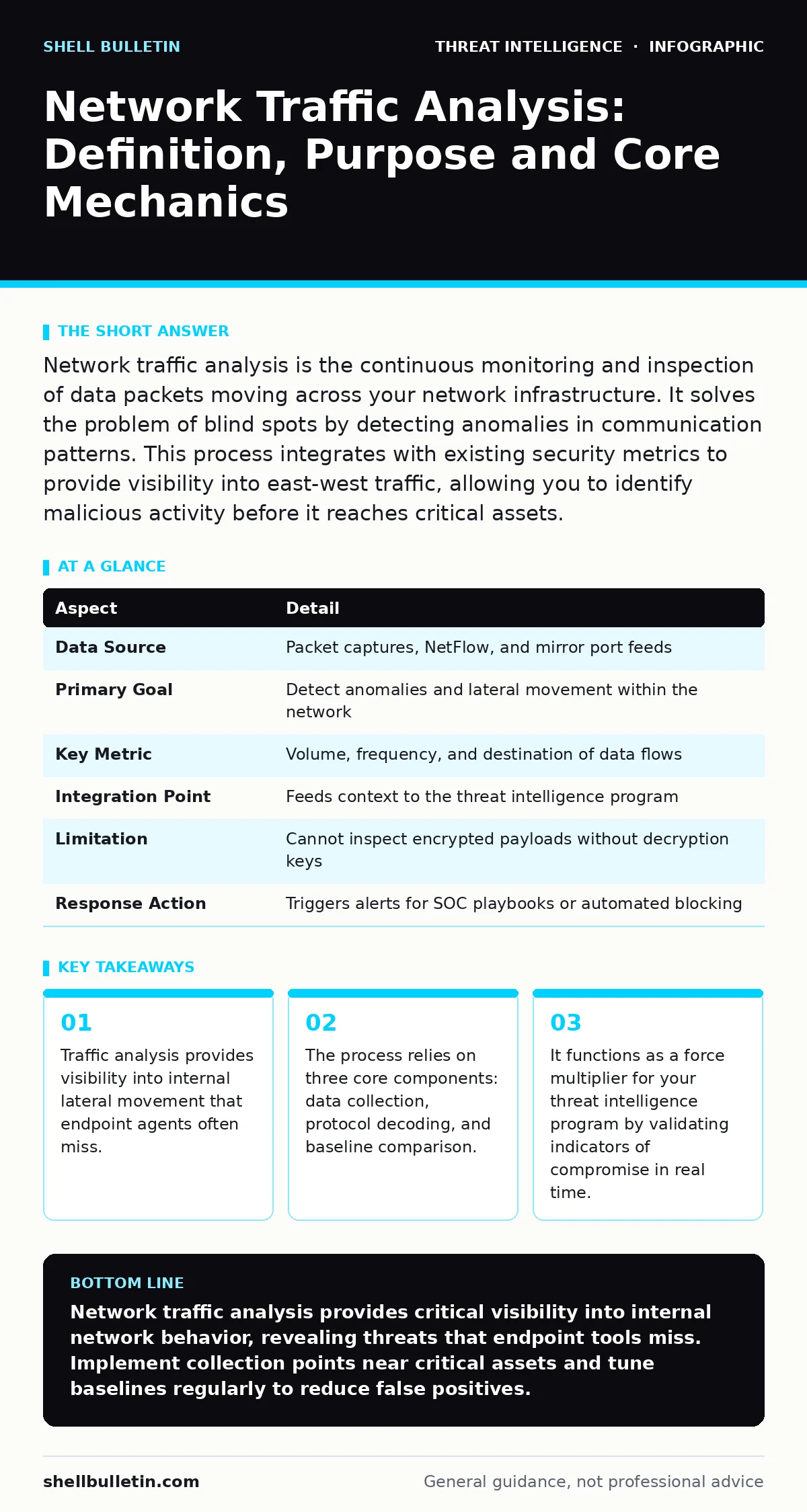
Network traffic analysis is the continuous monitoring and inspection of data packets moving across your network infrastructure. It solves the problem of blind spots by detecting anomalies in communication patterns. This process integrates with existing security metrics to provide visibility into east-west traffic, allowing you to identify malicious activity before it reaches critical assets.
Understanding the Core Mechanism
Network traffic analysis examines the flow of data between devices to establish a baseline of normal behavior. You capture packets, which are the discrete units of data transmitted over a network, and inspect their headers and payloads. This inspection reveals who is talking to whom, how much data is moving, and what protocols are in use. Without this visibility, you operate in a partial blind spot.
The primary purpose is anomaly detection. Standard security tools often focus on known signatures of malware. Traffic analysis looks for deviations from the expected norm. If a database server suddenly begins sending large volumes of encrypted traffic to an external IP address, that deviation triggers an alert. This approach catches novel threats that lack a known signature.
| Aspect | Detail |
|---|---|
| Data Source | Packet captures, NetFlow, and mirror port feeds |
| Primary Goal | Detect anomalies and lateral movement within the network |
| Key Metric | Volume, frequency, and destination of data flows |
| Integration Point | Feeds context to the threat intelligence program |
| Limitation | Cannot inspect encrypted payloads without decryption keys |
| Response Action | Triggers alerts for SOC playbooks or automated blocking |
The Problem of Blind Spots
Traditional endpoint protection relies on agents installed on individual devices. These agents report file changes and process executions. They fail to see what happens between devices. An attacker who compromises one workstation can move laterally to a file server without triggering endpoint alarms on the server itself. The attacker uses legitimate credentials and internal tools, making their activity look normal to local sensors.
Traffic analysis solves this by observing the conversation between systems. You see the handshake, the data transfer, and the termination of the connection. This external perspective reveals patterns that internal logs obscure. Suppose an attacker uses a command-line tool to exfiltrate data. The endpoint agent might not flag the tool if it is signed. However, the traffic analysis system sees an unusual volume of outbound data at an odd hour. This discrepancy highlights the threat.
Core Components of the Pipeline
Effective analysis requires a structured pipeline. The first component is collection. You must capture traffic at strategic points, such as network taps or span ports. These points ensure you see all traffic, including traffic that bypasses firewalls. The second component is normalization. Raw packets contain noise and fragmentation. You reconstruct sessions and decode protocols to create a readable stream of events.
The third component is analysis. This involves comparing current traffic against historical baselines. You look for statistical outliers in volume, timing, or destination. Machine learning models often assist here, identifying subtle shifts in behavior that rule-based systems miss. The final component is correlation. You map traffic anomalies to threat intelligence feeds. This step distinguishes between a benign spike in web traffic and a data exfiltration attempt.
Integration with Defensive Layers
Traffic analysis does not operate in isolation. It feeds into your broader security architecture. When an anomaly is detected, the system generates an alert. This alert triggers specific SOC playbooks. These playbooks define the steps an analyst takes to investigate and respond. Without clear playbooks, alerts become noise. Analysts suffer from fatigue and miss critical signals.
The system also integrates with security automation and orchestration platforms. Known as SOAR, these platforms can automatically block malicious IP addresses or isolate compromised hosts. This reduces response time from hours to seconds. However, automation requires high confidence. False positives can disrupt business operations. You must tune the system carefully to balance sensitivity with operational stability.
Common Misconceptions and Pitfalls
Many organizations assume that traffic analysis replaces other security controls. This is incorrect. It complements them. Endpoint detection provides deep visibility into host activity. Traffic analysis provides context for network behavior. Using one without the other leaves significant gaps. Another common mistake is ignoring encrypted traffic.
Modern applications use encryption heavily. You cannot inspect the payload of encrypted traffic without decrypting it. This creates a blind spot for content-based threats. However, you can still analyze metadata. Metadata includes packet size, timing, and destination. These indicators often reveal malicious activity even when the content is hidden. Relying solely on payload inspection leaves you vulnerable to encrypted command-and-control channels.
Another pitfall is neglecting baseline maintenance. Baselines drift over time. New applications change traffic patterns. If you do not update your baseline, you generate excessive false positives. You must regularly review and adjust your thresholds. This ensures that alerts remain relevant and actionable. Static baselines become obsolete quickly.
See also: Is DDoS Protection Worth It? The Real Cost of Silence
Strategic Value for Small Operations
Small organizations often lack dedicated security teams. Traffic analysis provides a force multiplier. It allows a single analyst to monitor the entire network perimeter and internal segments. By focusing on high-fidelity alerts, you reduce the workload. You spend less time chasing false positives and more time investigating real threats.
This approach also supports compliance requirements. Many regulations require monitoring of network traffic for unauthorized access. Traffic analysis provides the audit trail needed to demonstrate compliance. It records who accessed what data and when. This record is valuable for forensic investigations and legal proceedings. You retain evidence of activity even after the threat has been neutralized.
Enhancing Detection with Context
Raw traffic data is noisy. You need context to make it useful. Integrating with a threat intelligence program adds layers of meaning. You map observed traffic against known indicators of compromise. This includes malicious IP addresses, domains, and file hashes. When traffic matches these indicators, the alert priority increases.
You can also map traffic to the cyber kill chain. This model describes the stages of an attack. By identifying which stage the traffic corresponds to, you prioritize your response. Early-stage reconnaissance traffic may require less urgent action than late-stage exfiltration. Understanding the stage helps you allocate resources effectively. You focus on stopping the most dangerous activities first.
Limitations and Realistic Expectations
Traffic analysis has inherent limitations. It cannot see what happens inside an encrypted tunnel without decryption. It cannot detect threats that use legitimate, encrypted channels for communication. These channels mimic normal traffic patterns. Detecting them requires advanced behavioral analysis and machine learning. Even then, false positives remain a challenge.
You must also consider privacy implications. Monitoring network traffic may capture sensitive user data. Ensure your policies comply with local laws and regulations. Inform employees that network traffic is monitored. Transparency builds trust and reduces legal risk. Balance security needs with privacy rights.
Another limitation is resource intensity. Capturing and analyzing all traffic requires significant processing power and storage. You must invest in appropriate hardware and software. Poorly configured systems can drop packets, leading to missed threats. Ensure your infrastructure can handle peak traffic loads.
Next Steps for Implementation
Start by defining your critical assets. Identify which systems require the most protection. Place collection points near these assets. This ensures you capture the most important traffic. Begin with a pilot program. Test your analysis tools in a non-production environment. Tune your baselines and rules before deploying to production.
Train your staff on interpreting alerts. Provide clear documentation and training materials. Encourage a culture of continuous improvement. Regularly review and update your detection capabilities. Stay informed about emerging threats and techniques. Adapt your strategy to address new challenges. Security is an ongoing process, not a one-time project.
Key takeaways
- Traffic analysis provides visibility into internal lateral movement that endpoint agents often miss.
- The process relies on three core components: data collection, protocol decoding, and baseline comparison.
- It functions as a force multiplier for your threat intelligence program by validating indicators of compromise in real time.
Network traffic analysis provides critical visibility into internal network behavior, revealing threats that endpoint tools miss. Implement collection points near critical assets and tune baselines regularly to reduce false positives.
Frequently asked questions
Does traffic analysis work with encrypted traffic?
Yes, but only for metadata. You can analyze packet size, timing, and destination, but you cannot inspect the payload without decryption keys.
How does traffic analysis differ from endpoint detection?
Endpoint detection monitors activity on individual devices. Traffic analysis monitors communication between devices, providing a broader view of network behavior.
Can traffic analysis prevent data exfiltration?
It can detect data exfiltration by identifying unusual outbound traffic patterns. Prevention requires blocking the traffic or isolating the compromised host.
What is the role of baselines in traffic analysis?
Baselines define normal network behavior. Analysis tools compare current traffic against these baselines to identify anomalies and potential threats.
How this guide was produced: written by the Shell Bulletin editorial team with AI assistance, checked against the public references listed below, and reviewed when the facts change. See our editorial policy or report an error.