Is DDoS Protection Worth It? The Real Cost of Silence
DDoS protection buys time for your systems to fail gracefully, but it cannot stop attackers who exploit your own application logic flaws.

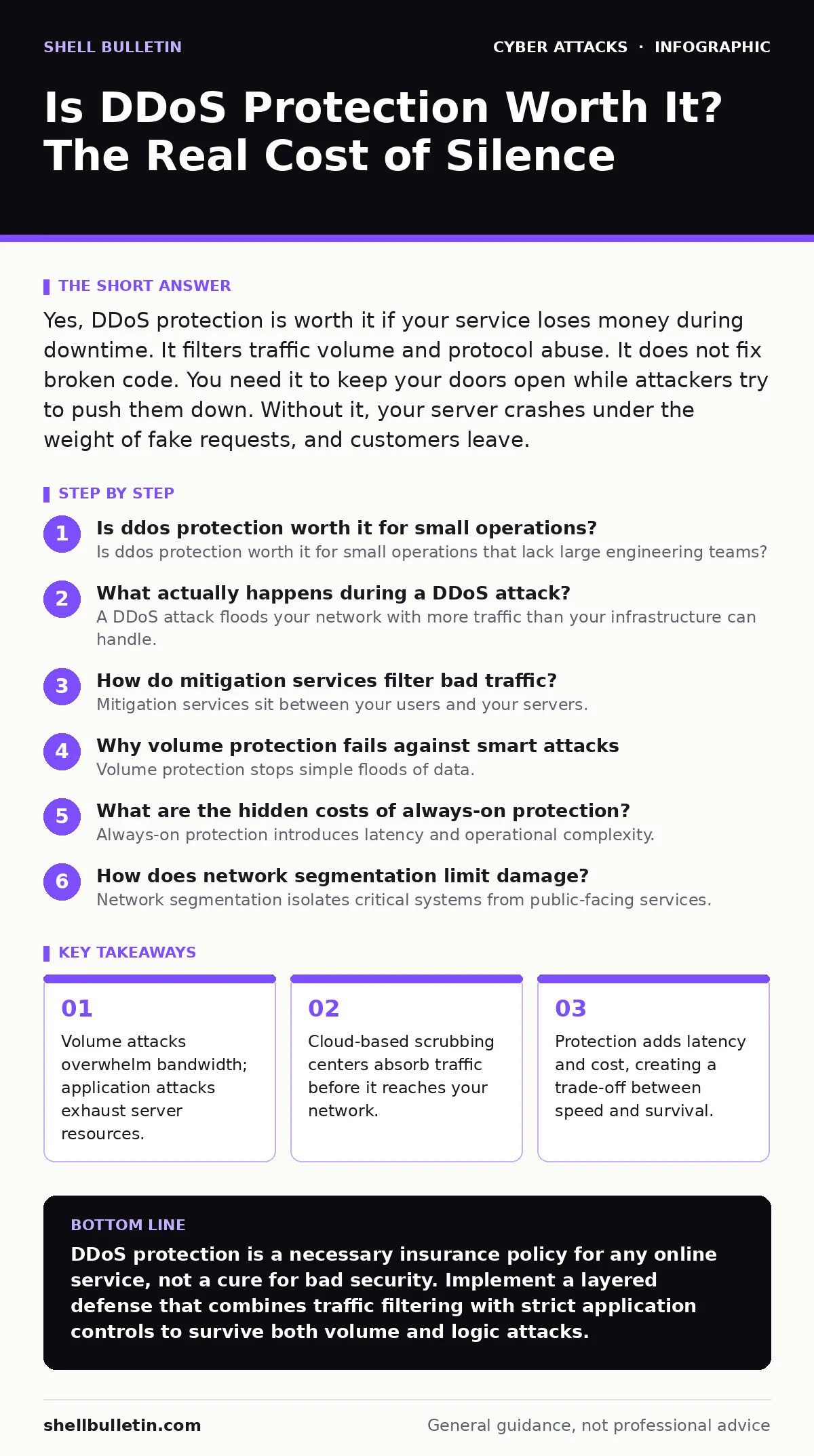
Yes, DDoS protection is worth it if your service loses money during downtime. It filters traffic volume and protocol abuse. It does not fix broken code. You need it to keep your doors open while attackers try to push them down. Without it, your server crashes under the weight of fake requests, and customers leave.
Is ddos protection worth it for small operations?
Is ddos protection worth it for small operations that lack large engineering teams? Yes, because small targets are often easier to knock offline than hardened enterprises. Attackers use automated tools that scan for vulnerable IP addresses. Your website stops responding when your connection saturates. This silence costs more than the monthly fee of a mitigation service. You lose customer trust and search engine ranking during every minute of downtime.
What actually happens during a DDoS attack?
A DDoS attack floods your network with more traffic than your infrastructure can handle. Imagine a highway where every lane is filled with empty trucks. Your servers cannot process legitimate requests because they are busy rejecting fake ones. The connection drops. Users see error messages. The attack stops your revenue stream. It does not necessarily steal data. It simply makes your service unavailable to anyone who wants to use it.
How do mitigation services filter bad traffic?
Mitigation services sit between your users and your servers. They analyze incoming data packets for anomalies. They drop packets that show signs of automation or spoofing. They keep requests that look like normal human behavior. This process happens in a cloud scrubbing center. Your traffic flows through this center before reaching your data center. The service absorbs the peak volume so your hardware does not crash.
| Attack Type | Mechanism | Primary Target | Typical Mitigation |
|---|---|---|---|
| Volumetric | Floods bandwidth with noise | Network links | Rate limiting and blackholing |
| Protocol | Exhausts connection tables | Firewalls and load balancers | State inspection and TCP validation |
| Application | Mimics valid user requests | Web servers and APIs | Behavioral analysis and CAPTCHAs |
Why volume protection fails against smart attacks
Volume protection stops simple floods of data. It fails against application-layer attacks that mimic real users. These attacks send small, valid requests that consume server processing power. They look like normal traffic to a firewall. Your server spends CPU cycles generating responses for each fake request. Eventually, the server runs out of memory or processing threads. This is why you need behavioral analysis, not just bandwidth filtering.
What are the hidden costs of always-on protection?
Always-on protection introduces latency and operational complexity. Every packet must be inspected before reaching your server. This inspection adds milliseconds to every page load. Users notice slower response times. You also pay for the service regardless of whether an attack occurs. The cost is not just financial. It is the loss of direct control over your traffic. You depend on a third party to decide what is legitimate.
See also: Lateral Movement Meaning: How Attackers Spread Inside Your Network
How does network segmentation limit damage?
Network segmentation isolates critical systems from public-facing services. If your web server is attacked, the database remains safe. The attacker cannot pivot from the flooded web server to your internal files. This containment reduces the blast radius. You keep core operations running even if the front door is blocked. This strategy works alongside DDoS protection to preserve business continuity.
Can you stop attacks that look like real users?
You cannot fully stop attacks that look like real users. Legitimate traffic and malicious traffic often share the same characteristics. Attackers use residential proxies that route traffic through real home networks. These requests have valid IP addresses and headers. Your mitigation service cannot easily distinguish them from actual customers. You must rely on behavioral patterns, such as request frequency, to identify abuse. This is where email filtering and email authentication help verify identity before granting access.
What should you do when the alerts start?
When alerts start, switch to mitigation mode immediately. Do not try to block IPs manually. The volume will be too high. Activate your cloud scrubbing service. Redirect traffic through the scrubbing center. Monitor your application logs for unusual patterns. Keep communication channels open with your customers. Silence creates panic. Transparency reduces the reputational damage. Have a plan that includes password managers for secure admin access during the crisis.
Does protection replace secure coding practices?
Protection does not replace secure coding practices. A DDoS service keeps your server online. It does not fix vulnerabilities in your code. Attackers may use DDoS as a smokescreen while they exploit other flaws. They distract your team while they attempt replay attacks or API abuse. You need strong input validation and rate limiting at the application level. Security is a layer cake. DDoS protection is just the bottom layer.
How do you verify your protection works?
You verify your protection by testing it in a controlled environment. Work with your provider to simulate attack traffic. Measure the impact on latency and availability. Check if legitimate users are blocked by false positives. Adjust your thresholds based on the results. Regular testing ensures your configuration matches your current traffic patterns. Static rules become obsolete as your business grows.
Key takeaways
- Volume attacks overwhelm bandwidth; application attacks exhaust server resources.
- Cloud-based scrubbing centers absorb traffic before it reaches your network.
- Protection adds latency and cost, creating a trade-off between speed and survival.
- No tool stops logic-based abuse that mimics legitimate user behavior.
DDoS protection is a necessary insurance policy for any online service, not a cure for bad security. Implement a layered defense that combines traffic filtering with strict application controls to survive both volume and logic attacks.
Frequently asked questions
How long does it take to set up DDoS protection?
Cloud-based services can be activated within hours by changing DNS records. On-premise hardware takes weeks to install and configure.
Can a DDoS attack steal my customer data?
DDoS attacks focus on availability, not data theft. However, attackers may use the distraction to launch other breaches.
Do I need protection if I use a CDN?
CDNs offer basic mitigation, but dedicated DDoS services provide deeper inspection and higher capacity for sustained attacks.
What is the difference between DDoS and hacking?
Hacking involves unauthorized access to systems. DDoS involves overwhelming systems with traffic to make them unavailable.
How this guide was produced: written by the Shell Bulletin editorial team with AI assistance, checked against the public references listed below, and reviewed when the facts change. See our editorial policy or report an error.