Lateral Movement Meaning: How Attackers Spread Inside Your Network
Attackers use lateral movement to bypass perimeter defenses by hopping between internal systems, making early detection the only effective countermeasure.

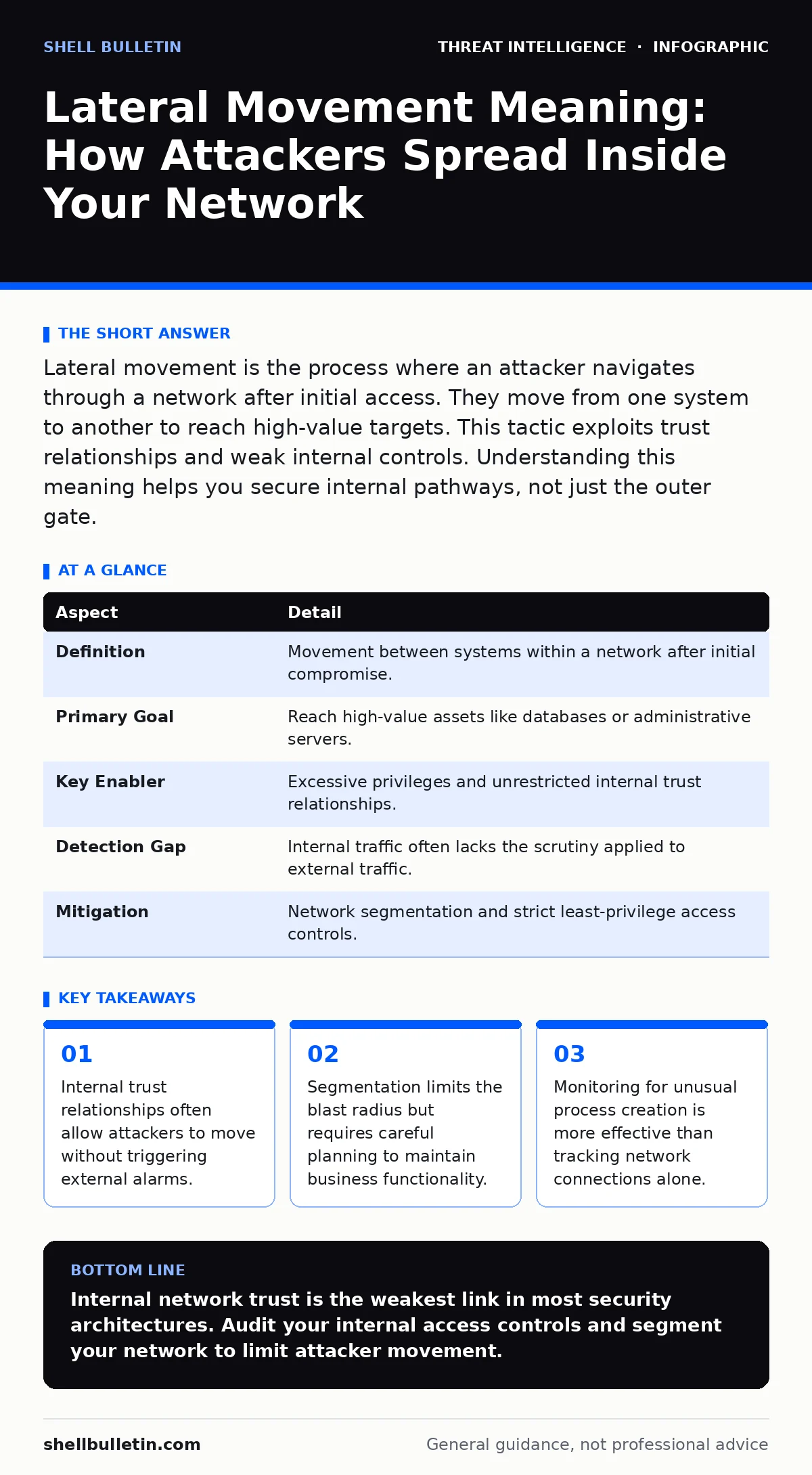
Lateral movement is the process where an attacker navigates through a network after initial access. They move from one system to another to reach high-value targets. This tactic exploits trust relationships and weak internal controls. Understanding this meaning helps you secure internal pathways, not just the outer gate.
Everyday Analogy for Network Access
Imagine a burglar breaking into a warehouse through a side door. The security system alerts the police, but the guard only checks the main entrance. The burglar walks past the open boxes of inventory and enters the manager’s office to steal the safe combination. The initial break-in was loud, but the theft happened quietly inside. Lateral movement is that quiet walk from the warehouse floor to the safe. It relies on the assumption that once inside, the perimeter is irrelevant.
At a Glance: Core Concepts
| Aspect | Detail |
|---|---|
| Definition | Movement between systems within a network after initial compromise. |
| Primary Goal | Reach high-value assets like databases or administrative servers. |
| Key Enabler | Excessive privileges and unrestricted internal trust relationships. |
| Detection Gap | Internal traffic often lacks the scrutiny applied to external traffic. |
| Mitigation | Network segmentation and strict least-privilege access controls. |
Lateral Movement Meaning Defined
Lateral movement is the horizontal traversal of a network by an attacker who has already gained a foothold. It differs from vertical escalation, which involves gaining higher privileges on a single machine. In lateral movement, the adversary shifts from a low-value endpoint to another endpoint, seeking a system with greater access or data. This tactic assumes that internal boundaries are weaker than the external firewall. You must treat every internal connection as a potential attack vector.
How Attackers Navigate Internal Networks
Attackers rely on legitimate administrative tools to move unseen. They use protocols designed for management, such as Remote Procedure Call or Secure Shell, to execute commands on remote machines. This approach blends malicious activity with normal administrative traffic. The attacker may copy credentials from memory or harvest cached tokens to authenticate on new systems. This method avoids downloading new malware, reducing the chance of detection by signature-based antivirus.
Who Is Affected by Internal Spread
Any organization with multiple connected systems faces this risk. Small businesses often suffer most because they lack dedicated security teams to monitor internal traffic. Large enterprises have more complex networks, which provide more hiding places for attackers. The size of the organization matters less than the configuration of trust. If any machine can talk to any other machine without restriction, the entire network is one large target. This reality makes internal architecture a primary defense layer.
See also: Network Traffic Analysis: Definition, Purpose and Core Mechanics
What People Usually Get Wrong
Many defenders focus exclusively on the perimeter. They invest heavily in firewalls and intrusion prevention systems while ignoring internal controls. This mindset fails because the initial breach is often inevitable. Phishing emails and software vulnerabilities provide easy entry points. The real failure occurs when the attacker moves from the entry point to the crown jewels. You must assume the perimeter will be breached. Design your network to contain the damage, not just prevent entry.
Another common error is assuming that antivirus software stops lateral movement. Most endpoint protection focuses on known malware signatures. Attackers using living-off-the-land attacks use built-in system tools like PowerShell or Windows Management Instrumentation. These tools are legitimate and trusted by the operating system. Antivirus software rarely flags them unless their behavior is clearly malicious. This blind spot allows attackers to operate for weeks undetected.
Practical Steps to Limit Movement
Implement strict network segmentation. Divide your network into smaller zones based on function. A guest Wi-Fi network should not access internal file servers. Production databases should not be reachable from user workstations. This limits the distance an attacker can travel. If a workstation is compromised, the attacker cannot reach the core servers. Segmentation adds complexity but reduces risk significantly.
Enforce the principle of least privilege. Users and service accounts should have only the permissions necessary for their specific tasks. Administrative rights should be rare and temporary. When an account has full access to multiple systems, it becomes a high-value target. If stolen, it grants the attacker immediate access to a large portion of the network. Regular audits of user permissions help identify and remove excessive access.
Monitor for anomalous behavior. Look for logins from unusual locations or at odd hours. Track processes that spawn child processes unexpectedly. For example, a web server spawning a command prompt is suspicious. Use detection use cases to identify these patterns. Automated response tools like SOAR can help isolate compromised machines quickly. This reduces the time an attacker has to move laterally.
Integrating Threat Intelligence
Threat intelligence platforms provide context on attacker behavior. They share information about tactics, techniques and procedures (TTPs) used by current adversaries. This knowledge helps you tune your detection rules. Instead of looking for specific malware, you look for specific behaviors. For instance, if a group frequently uses token theft to escalate privileges, you monitor for that specific activity. This proactive approach improves your defense posture.
Understanding the cyber kill chain helps you place defenses at the right stage. Lateral movement occurs in the middle of the chain. Defenses here are about detection and containment. You cannot stop the initial hack, but you can stop the spread. By focusing on this stage, you protect your most critical assets. This strategy acknowledges that perfect prevention is impossible.
Conclusion on Internal Defense
Securing the network requires a shift in perspective. The perimeter is just the first line of defense. The internal network is where the battle is won or lost. By limiting trust, segmenting systems, and monitoring behavior, you reduce the impact of a breach. Lateral movement is a predictable tactic. You can disrupt it by making internal navigation difficult for attackers. This approach protects your data even when the outer gate fails.
Key takeaways
- Internal trust relationships often allow attackers to move without triggering external alarms.
- Segmentation limits the blast radius but requires careful planning to maintain business functionality.
- Monitoring for unusual process creation is more effective than tracking network connections alone.
Internal network trust is the weakest link in most security architectures. Audit your internal access controls and segment your network to limit attacker movement.
Frequently asked questions
Can lateral movement happen on wireless networks?
Yes, wireless networks that share the same subnet as internal servers allow the same lateral movement risks. Segmentation is required for Wi-Fi too.
Does multi-factor authentication stop lateral movement?
MFA helps at the initial login but may not stop movement if the attacker steals a valid session token or credential from memory.
How do I detect lateral movement without expensive tools?
Focus on native logging. Review event logs for unusual logins, remote process creation, and account privilege changes on critical systems.
What is the difference between pivoting and lateral movement?
Pivoting involves using a compromised system as a proxy to reach other networks. Lateral movement is the direct traversal between systems within the same network.
How this guide was produced: written by the Shell Bulletin editorial team with AI assistance, checked against the public references listed below, and reviewed when the facts change. See our editorial policy or report an error.