Cyber Kill Chain: Practical Defense for Small Teams
Understanding attack phases reveals that most small businesses fail at detection, not prevention, leaving critical windows for silent data exfiltration.
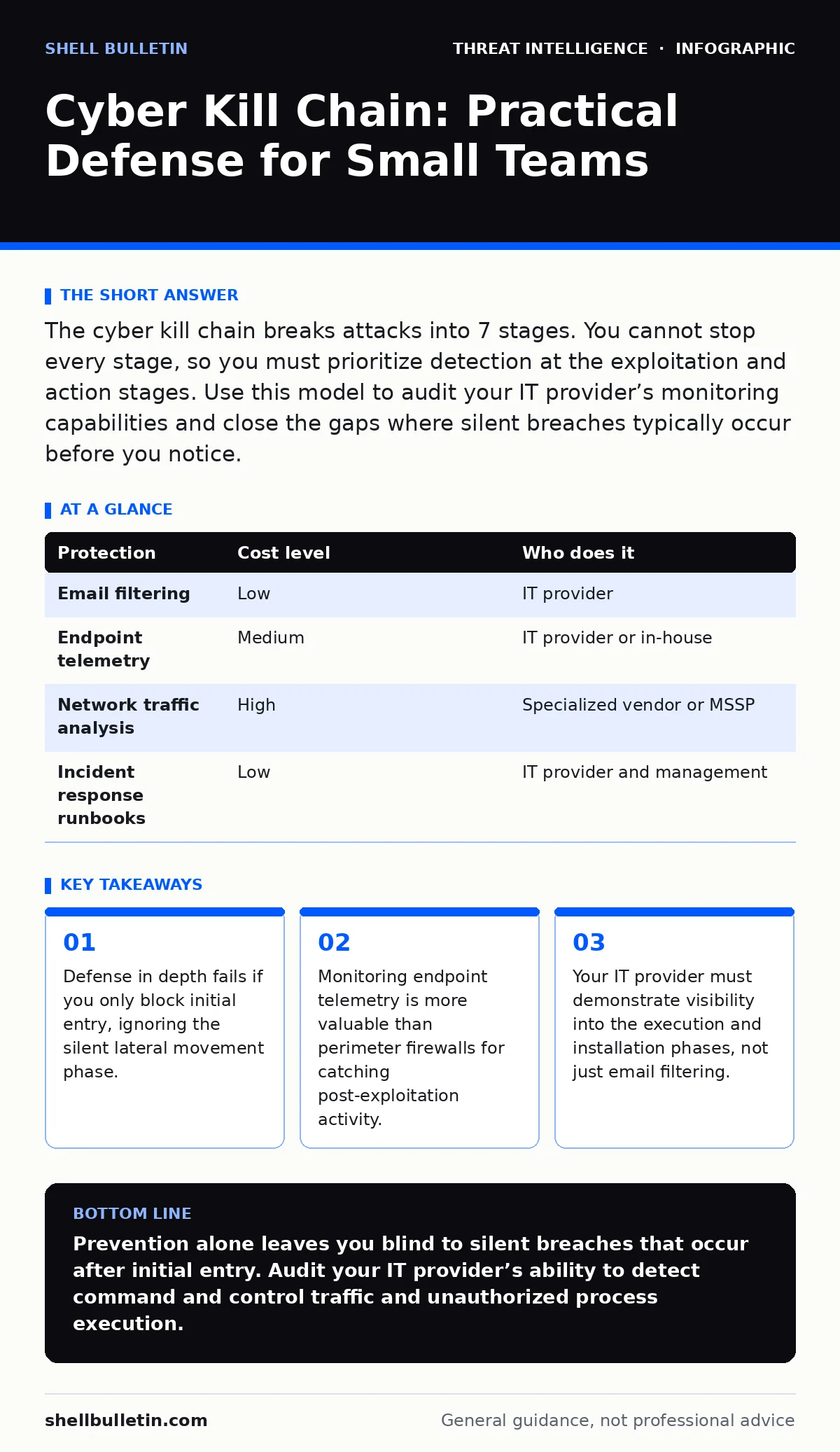
The cyber kill chain breaks attacks into 7 stages. You cannot stop every stage, so you must prioritize detection at the exploitation and action stages. Use this model to audit your IT provider’s monitoring capabilities and close the gaps where silent breaches typically occur before you notice.
Why the Model Matters at Small Scale
The cyber kill chain is a framework that describes the steps an attacker takes to compromise a system. It was originally designed for military operations, but it applies perfectly to small business environments. You might think you are too small to be a target, but automated scripts scan the entire internet for vulnerabilities. The model matters because it shifts your focus from preventing entry to detecting presence.
Most small businesses invest heavily in blocking the first stage, reconnaissance or weaponization. They ignore the middle stages where attackers move quietly. This creates a false sense of security. You believe you are safe because no attacks got in. In reality, attackers often get in and stay there for months. The kill chain helps you see that prevention is only one part of the equation. Detection is the other half. Without detection, a breach is just a matter of time.
The Seven Phases of Attack
Understanding the specific phases helps you identify where your defenses are weak. The chain starts with reconnaissance, where attackers gather information about your company. They look for employee names, software versions, and network structures. Next is weaponization, where they create a malicious payload. This might be a PDF file with hidden code or an image that exploits a browser flaw.
The third phase is delivery. This is the method used to send the weapon to you. It could be an email attachment, a compromised website, or a USB drive. Most small businesses focus heavily here. They install spam filters and web proxies. This is necessary, but it is not sufficient. If the delivery succeeds, the chain continues.
The fourth phase is exploitation. The malicious code runs and takes advantage of a software flaw. This might be an unpatched operating system or a browser vulnerability. The fifth phase is installation. The attacker installs malware on your computer. This malware gives them a foothold in your network.
The sixth phase is command and control. The malware contacts the attacker’s server to receive instructions. This communication is often hidden in normal-looking web traffic. The final phase is actions on objectives. The attacker steals data, encrypts files, or uses your system to attack others. Each phase offers a chance to detect the attack.
Where Small Defenses Usually Fail
Small businesses often fail at the command and control phase. You can block the initial email, but you might miss the silent communication that happens later. Attackers use techniques to mimic legitimate traffic. They might send data to a domain that looks like a standard cloud service. Your firewall sees this as normal web browsing. The attacker exfiltrates data slowly, avoiding detection thresholds. This is why network traffic analysis is so valuable.
It looks for patterns, not just known bad signatures. Another common failure is the exploitation phase. You might have strong passwords, but an unpatched server can still be compromised. If you do not have endpoint telemetry, you will not know when code executes unexpectedly. Telemetry records system activities, allowing you to see what programs run and when. Without this data, you are blind to the execution phase.
Practical Implementation for Limited Resources
You do not need a large security team to use the kill chain model. You need to prioritize monitoring. Start by ensuring you have visibility into your endpoints. Endpoint telemetry provides the data needed to detect the installation and execution phases. Look for tools that record process creation, file changes, and network connections. Next, focus on detecting command and control traffic. This requires network traffic analysis tools that can identify unusual outbound connections.
You should also implement incident response runbooks. These are step-by-step procedures for when you detect an attack. Having a plan reduces panic and speeds up recovery. Do not try to monitor everything. Focus on the phases that are hardest to prevent. Email filtering prevents delivery, but it does not stop an attacker who finds another way in. Monitoring execution and command and control catches attackers who bypass the perimeter.
| Protection | Cost level | Who does it |
|---|---|---|
| Email filtering | Low | IT provider |
| Endpoint telemetry | Medium | IT provider or in-house |
| Network traffic analysis | High | Specialized vendor or MSSP |
| Incident response runbooks | Low | IT provider and management |
What to Ask Your IT Provider
Your IT provider is your first line of defense. You need to know if they are monitoring the right things. Do not just ask if they have antivirus. Ask how they detect the later stages of the kill chain. You need to understand their visibility into your network. If they cannot show you logs of outbound traffic, they cannot detect command and control. If they cannot show you process execution logs, they cannot detect exploitation.
Ask specific questions about their monitoring capabilities. You need to know if they are looking for indicators of compromise or just known malware. Indicators of compromise are signs that a system has been breached. Known malware is software that security vendors have already identified. Modern attacks often use new malware that is not yet known. Behavioral detection is more effective than signature-based detection.
- Can you show me logs of outbound network connections that are blocked or flagged?
- Do you monitor for unauthorized process executions on our servers and workstations?
- How do you detect lateral movement between computers on our network?
- What is your response time when a command and control connection is detected?
- Do you perform regular tests to verify that your detection systems are working?
See also: Network Traffic Analysis: Definition, Purpose and Core Mechanics · What Is Endpoint Telemetry and How It Secures Your Devices
Hidden Costs and Trade-offs
Implementing deep monitoring has costs beyond the software price. The hidden cost is alert fatigue. If your tools generate too many alerts, your team will ignore them. You need to tune your systems to reduce false positives. This takes time and expertise. Another trade-off is performance. Endpoint telemetry can slow down computers if it records too much data. You must balance visibility with system performance.
Network monitoring can also impact bandwidth. You need to decide how much traffic to inspect. Inspecting all traffic is expensive and slow. Inspecting only suspicious traffic might miss hidden attacks. You also face the cost of false negatives. These are attacks that your tools miss. This is the most dangerous cost. You believe you are safe, but you are not. Regular testing helps identify these gaps.
Integrating with Broader Security
The kill chain model works best when integrated with other security practices. For example, password cracking protections are vital for the reconnaissance phase. If attackers can guess your passwords, they do not need to exploit software flaws. Using strong authentication reduces the risk of the delivery phase succeeding via credential theft. Token theft is another risk where attackers steal session cookies to bypass authentication.
Monitoring for unusual session activity can catch this. You should also consider threat intelligence platforms to stay informed about current attack trends. These platforms provide data on new weapons and tactics. This helps you tune your defenses before an attack happens. However, intelligence alone is not enough. You must have the tools to act on that intelligence.
Moving Forward with Confidence
You now understand the cyber kill chain and its application to small businesses. You know that prevention is not enough. Detection is equally important. You have a list of questions to ask your IT provider. You understand the trade-offs of monitoring. Use this knowledge to build a resilient security posture. Focus on the phases that are hardest to prevent. Monitor execution and command and control.
Ensure your IT provider has the right tools and expertise. Regular testing and tuning are necessary to maintain effectiveness. Security is not a product you buy. It is a process you manage. By understanding the kill chain, you take control of that process. You move from reactive panic to proactive management. This reduces your risk and protects your business.
Key takeaways
- Defense in depth fails if you only block initial entry, ignoring the silent lateral movement phase.
- Monitoring endpoint telemetry is more valuable than perimeter firewalls for catching post-exploitation activity.
- Your IT provider must demonstrate visibility into the execution and installation phases, not just email filtering.
Prevention alone leaves you blind to silent breaches that occur after initial entry. Audit your IT provider’s ability to detect command and control traffic and unauthorized process execution.
Frequently asked questions
Does the cyber kill chain apply to ransomware attacks?
Yes, ransomware follows the same stages. Attackers must gain access, install the malware, and then execute the encryption. Monitoring the installation and execution phases can stop ransomware before it encrypts files.
How often should I review my kill chain defenses?
You should review your defenses at least twice a year. Attack techniques change frequently. Regular reviews ensure your detection rules are current and effective against new threats.
Can I implement kill chain monitoring on my own?
You can implement basic monitoring, but advanced detection requires specialized tools and expertise. Most small businesses benefit from partnering with an IT provider who has experience with security operations.
What is the difference between prevention and detection?
Prevention stops an attack before it happens, like blocking a malicious email. Detection identifies an attack that has already occurred or is in progress, like spotting unusual network traffic. Both are necessary for full protection.
How this guide was produced: written by the Shell Bulletin editorial team with AI assistance, checked against the public references listed below, and reviewed when the facts change. See our editorial policy or report an error.