What Is Endpoint Telemetry and How It Secures Your Devices
Endpoint telemetry transforms raw device logs into actionable intelligence, allowing you to detect sophisticated threats that traditional antivirus software misses entirely.

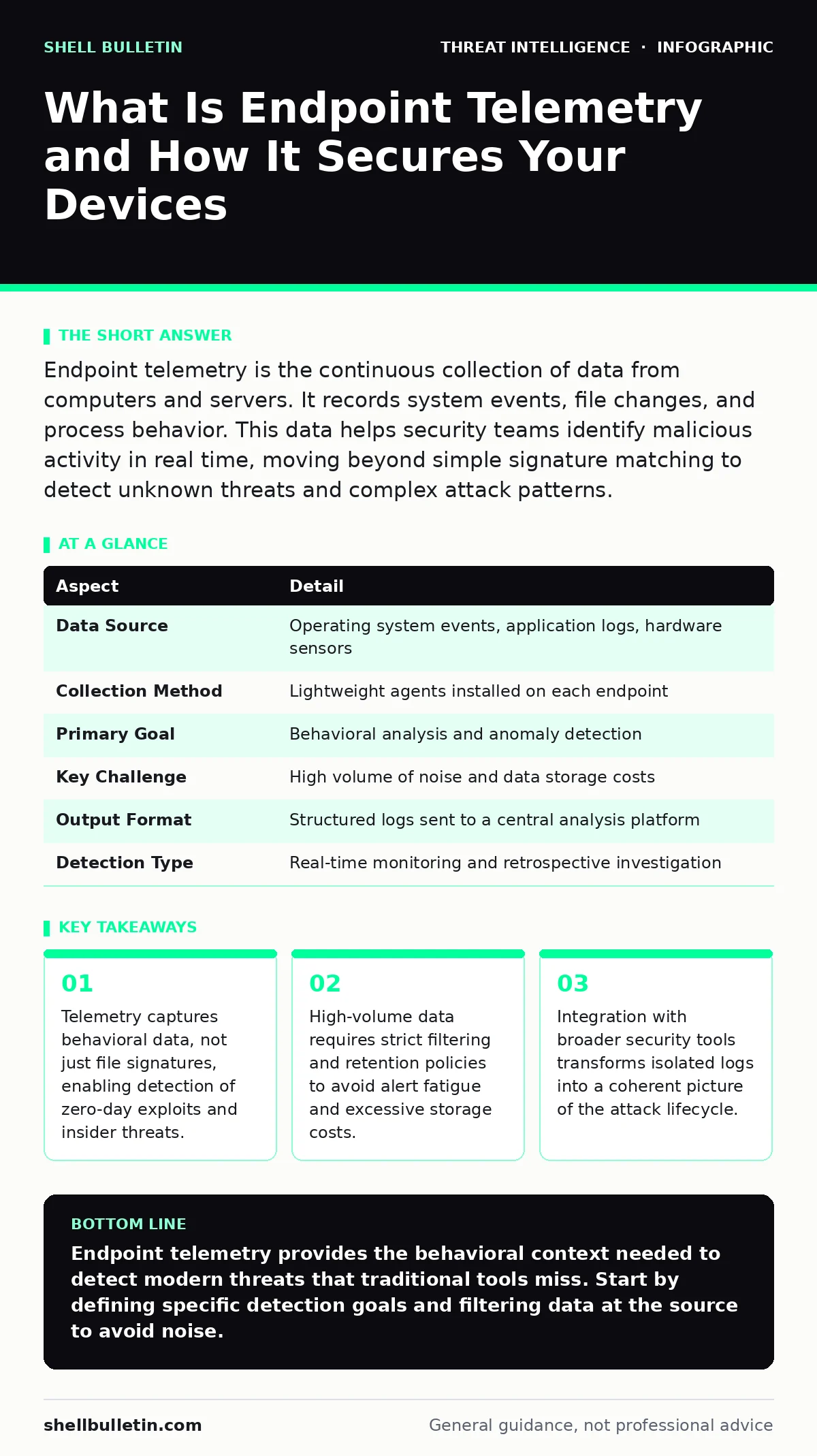
Endpoint telemetry is the continuous collection of data from computers and servers. It records system events, file changes, and process behavior. This data helps security teams identify malicious activity in real time, moving beyond simple signature matching to detect unknown threats and complex attack patterns.
The Mechanics of Digital Observation
Imagine a security guard who does not just check IDs at the door but records every movement inside the building. Endpoint telemetry works similarly for your digital infrastructure. It is the systematic collection of data points from endpoints, such as laptops, servers, and mobile devices. These data points include process creation, file modifications, registry changes, and network connections.
Traditional antivirus software relies on known signatures. It blocks files that match a database of previously identified malware. Endpoint telemetry goes further by recording behavior. It asks how an application acts rather than just what it is called. This shift allows defenders to spot anomalies that do not match any known threat profile.
| Aspect | Detail |
|---|---|
| Data Source | Operating system events, application logs, hardware sensors |
| Collection Method | Lightweight agents installed on each endpoint |
| Primary Goal | Behavioral analysis and anomaly detection |
| Key Challenge | High volume of noise and data storage costs |
| Output Format | Structured logs sent to a central analysis platform |
| Detection Type | Real-time monitoring and retrospective investigation |
What Is Endpoint Telemetry
What is endpoint telemetry? It is the raw data that powers modern detection systems. You collect this data using a small software agent running on each device. The agent monitors system calls and kernel events. It sends this information to a central server or cloud platform for analysis.
This process creates a timeline of activity for every device. You can see exactly what a process did, when it did it, and what it touched. This granularity is necessary because modern attackers rarely use simple viruses. They use scripts, legitimate system tools, and custom code that bypasses traditional scanners. Telemetry provides the evidence trail needed to catch these subtle intrusions.
Who Needs This Visibility
Every organization with connected devices generates endpoint telemetry. The data exists whether you collect it or not. The difference lies in who controls the narrative. If you do not collect and analyze this data, attackers control your environment. They move freely, exfiltrate data, and destroy evidence without leaving a trace you can read.
Small operations often assume they are too small to be targeted by advanced threats. This assumption is dangerous. Automated bots scan for vulnerabilities regardless of company size. Furthermore, insider threats do not care about revenue size. They care about access. Telemetry helps you monitor privileged accounts and detect unusual access patterns, such as a user logging in at 3 AM from a foreign country.
The Hidden Costs of Collection
Collecting data is easy. Storing and analyzing it is expensive. The most common mistake is enabling every possible event ID. This approach generates terabytes of useless noise. You will drown in alerts that have no security relevance, such as routine software updates or user login events.
You must filter at the source. Configure your agents to send only high-fidelity events. Focus on process creation with command-line arguments, network connections to external IPs, and script execution. This reduces storage costs and improves the signal-to-noise ratio. It also ensures your analysts focus on genuine threats rather than administrative clutter.
Integrating with Broader Security
Endpoint data is powerful, but it is incomplete on its own. An endpoint agent sees local activity but cannot see the broader network context. You must correlate endpoint telemetry with other data sources. For example, if an endpoint shows a new process connecting to an unknown IP, you need network traffic analysis to verify if that IP is malicious.
This correlation is the foundation of a mature threat intelligence program. It allows you to map attacks to the cyber kill chain. You can see if an initial access vector led to lateral movement or data exfiltration. Without this integration, you are looking at isolated incidents rather than coordinated campaigns. You miss the bigger picture of how an attacker moves through your environment.
See also: Fileless Malware: Why Traditional Antivirus Fails and How to Defend · Living Off The Land Attacks: Myths vs Reality for Detection
Common Misconceptions About Coverage
Many organizations believe that endpoint telemetry replaces other security controls. It does not. It complements them. You still need firewalls to block unauthorized access and email filters to stop phishing attempts. Telemetry helps you detect what gets through those perimeter defenses.
Another misconception is that telemetry guarantees detection. It does not. Attackers use techniques like living-off-the-land attacks to blend in with normal system activity. They use built-in tools like PowerShell or WMI to execute commands. These tools generate legitimate-looking telemetry. Detecting misuse requires sophisticated behavioral analysis and machine learning models, not just log collection.
Actionable Steps for Implementation
Start by defining your detection use cases. What are you trying to find? Are you looking for ransomware encryption, command-and-control communication, or token theft? Define these scenarios first. Then, configure your agents to collect the specific data needed to detect them.
Ensure your data flows into a platform that supports correlation. A simple log server is not enough. You need a system that can link endpoint events with network data and identity logs. This integration allows you to automate responses. For instance, if telemetry detects a known malicious process, the system can automatically isolate the device from the network. This reduces the time between detection and containment.
Future-Proofing Your Defenses
The volume of endpoint telemetry will continue to grow. As devices become more connected, the attack surface expands. You must plan for scalability. Choose solutions that can handle increased data loads without significant performance degradation.
Also, consider privacy implications. Endpoint telemetry can capture sensitive user data. Implement strict access controls and data retention policies. Ensure that only authorized personnel can view raw logs. Anonymize personal data where possible. This balance between security visibility and user privacy is critical for long-term success.
Key takeaways
- Telemetry captures behavioral data, not just file signatures, enabling detection of zero-day exploits and insider threats.
- High-volume data requires strict filtering and retention policies to avoid alert fatigue and excessive storage costs.
- Integration with broader security tools transforms isolated logs into a coherent picture of the attack lifecycle.
Endpoint telemetry provides the behavioral context needed to detect modern threats that traditional tools miss. Start by defining specific detection goals and filtering data at the source to avoid noise.
Frequently asked questions
Does endpoint telemetry slow down my computers?
Modern agents are designed to be lightweight. They consume minimal CPU and memory resources. Proper configuration ensures they do not impact user productivity or system performance.
How long should I keep endpoint telemetry data?
Retention periods depend on your compliance requirements and investigation needs. Most organizations keep raw data for 30 to 90 days. Aggregated or indexed data may be kept longer for historical analysis.
Can I use open-source tools for endpoint telemetry?
Yes, open-source solutions exist for collection and analysis. However, they require significant expertise to configure, maintain, and scale. Commercial platforms often provide easier integration and support.
Is endpoint telemetry enough for my security needs?
No, it is one layer of defense. You must combine it with network monitoring, identity management, and user training. A layered approach ensures that if one control fails, others can detect and stop the threat.
How this guide was produced: written by the Shell Bulletin editorial team with AI assistance, checked against the public references listed below, and reviewed when the facts change. See our editorial policy or report an error.