Threat Intelligence Programs: Definition, Purpose and Core Components
Effective threat intelligence transforms raw data into context, allowing you to predict attacker behavior rather than merely reacting to past events.

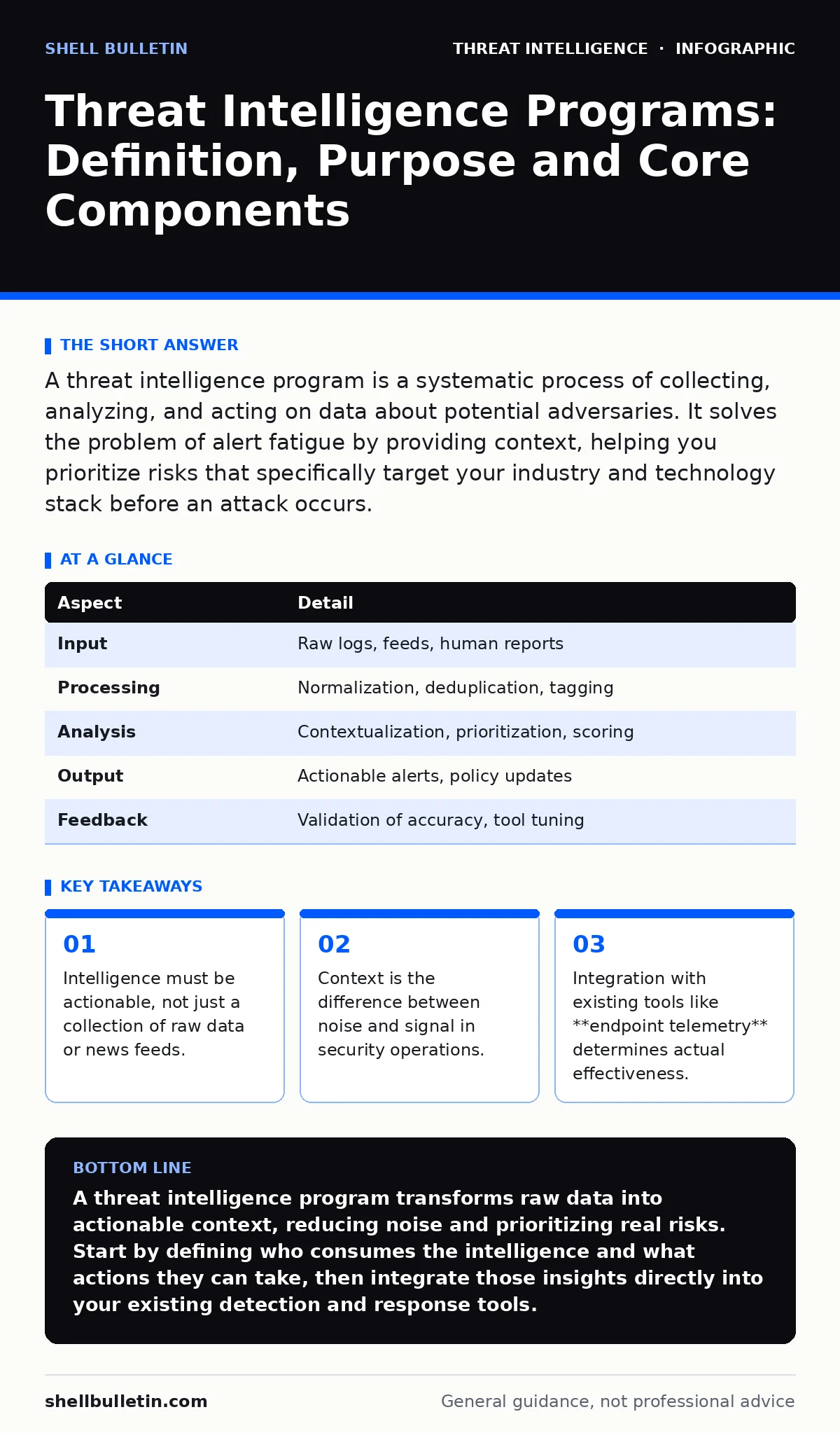
A threat intelligence program is a systematic process of collecting, analyzing, and acting on data about potential adversaries. It solves the problem of alert fatigue by providing context, helping you prioritize risks that specifically target your industry and technology stack before an attack occurs.
The Weather Forecast Analogy
Imagine you are a farmer. You can see the sky is grey, but you do not know if rain, hail, or a tornado is coming. Raw weather data gives you temperature and humidity numbers. A weather forecast interprets those numbers to tell you whether to bring in the harvest or reinforce the barn.
Threat intelligence works the same way for your network. Raw logs and alerts are like humidity readings. They show something is happening, but they do not tell you what it means for your business. A threat intelligence program interprets that data to tell you which doors to lock and which systems to isolate.
Without this interpretation, you are reacting to every grey cloud. With it, you prepare for the specific storm that threatens your crop. This distinction defines the value of the program.
The Problem of Context Deficit
The primary problem this program solves is the context deficit. Your security tools generate thousands of alerts daily. Most are false positives or low-risk events. If you investigate every alert, your team burns out. If you ignore them, you miss the real attack.
Context tells you which alerts matter. It answers the question: "Is this activity normal for us, or is it part of a known attack pattern?" It connects disparate dots, such as a strange login from a specific region combined with a known malicious file hash.
This connection reduces noise. It allows you to focus resources on threats that are actively targeting your sector or using tactics, techniques and procedures (TTPs) relevant to your infrastructure. You stop guessing and start prioritizing based on evidence.
Core Components of the Program
A functional program consists of four interconnected parts. Each part must work in sequence; a break in the chain renders the intelligence useless.
- Collection: Gathering raw data from internal logs, open-source feeds, and closed-source partners. This is the harvesting phase.
- Processing: Cleaning and normalizing the data. You must remove duplicates and format the information so your tools can read it.
- Analysis: Interpreting the processed data. Analysts determine the intent, capability, and origin of the threat. They ask "so what?"
- Dissemination: Delivering the final insight to the right person. A security engineer needs different details than a board member.
If you skip processing, you drown in bad data. If you skip analysis, you have opinions, not intelligence. If you skip dissemination, the intelligence sits in a report that no one reads.
| Aspect | Detail |
|---|---|
| Input | Raw logs, feeds, human reports |
| Processing | Normalization, deduplication, tagging |
| Analysis | Contextualization, prioritization, scoring |
| Output | Actionable alerts, policy updates |
| Feedback | Validation of accuracy, tool tuning |
Integration with Operational Defenses
Intelligence does not exist in a vacuum. It must feed directly into your defensive tools. If your intelligence program runs parallel to your security operations, it is wasted effort.
You need to integrate intelligence indicators into your detection use cases. For example, if intelligence reports a new phishing campaign, your email filter should automatically block associated domains. Your SOC playbooks should include steps that reference specific intelligence findings, ensuring responders know the attacker's likely next move.
This integration turns passive knowledge into active defense. It allows your endpoint telemetry systems to flag behavior that matches the described TTPs, even if the specific file hash is unknown. The intelligence provides the "why" and "how," while the tools provide the "what" and "when."
Strategic vs Tactical Intelligence
Not all intelligence serves the same purpose. You must distinguish between strategic, operational, and tactical levels.
Strategic intelligence informs long-term decisions. It helps leadership understand emerging risks, such as a shift in criminal focus toward your industry. It guides budget and policy decisions.
Operational intelligence supports specific projects or campaigns. It helps you understand the capabilities of a specific adversary group. It is useful for planning red team exercises or hardening specific systems.
Tactical intelligence is immediate and actionable. It consists of indicators of compromise (IOCs) like IP addresses, file hashes, and URLs. It feeds directly into firewalls and intrusion prevention systems.
Most small organizations focus too heavily on tactical intelligence. They collect lists of bad IPs but ignore the strategic trends that explain why those IPs are attacking. A balanced program uses tactical data to stop today's attack and strategic insight to prevent tomorrow's.
See also: Threat Intelligence Platforms: Real Value vs Operational Noise · Tactics, Techniques, and Procedures (TTPs) Explained for Beginners
Common Implementation Pitfalls
Many organizations attempt to build a threat intelligence program and fail within the first year. The failure usually stems from a misunderstanding of what intelligence is.
One common error is treating a threat intelligence platform as a substitute for a program. A platform is a tool that stores and manages data. It does not analyze, interpret, or contextualize. Without human analysis and a defined process, the platform is just an expensive database.
Another pitfall is the "shelfware" effect. Analysts produce reports that no one reads. This happens when the output is not tailored to the consumer. Security engineers need technical details; executives need risk assessments. Sending the same report to everyone satisfies no one.
Finally, many programs lack a feedback loop. If an alert is raised, was it accurate? If a threat was missed, why? Without this feedback, the program cannot improve its accuracy or relevance over time.
Measuring Success
You cannot improve what you do not measure. However, traditional security metrics often fail to capture intelligence value.
Avoid measuring volume. The number of indicators collected or reports produced is a vanity metric. It does not tell you if you are safer.
Instead, measure impact. Track the time to detect and respond to threats identified by your intelligence. Measure the reduction in false positives after applying context. Evaluate how often intelligence prevents an incident before it starts.
These security metrics align the program with business goals. They prove that the intelligence is not just an academic exercise but a practical tool for risk reduction. They also highlight gaps in your collection or analysis processes, guiding future improvements.
Key takeaways
- Intelligence must be actionable, not just a collection of raw data or news feeds.
- Context is the difference between noise and signal in security operations.
- Integration with existing tools like **endpoint telemetry** determines actual effectiveness.
- Most programs fail because they lack a clear feedback loop with operational teams.
A threat intelligence program transforms raw data into actionable context, reducing noise and prioritizing real risks. Start by defining who consumes the intelligence and what actions they can take, then integrate those insights directly into your existing detection and response tools.
Frequently asked questions
What is the difference between threat intelligence and security monitoring?
Security monitoring observes current activity and alerts on anomalies. Threat intelligence provides context about who is attacking, why, and how, allowing you to anticipate future moves rather than just reacting to current events.
Do I need a large team to run a threat intelligence program?
No. A small team can run an effective program by focusing on high-value intelligence sources and integrating them with automated tools. The key is process and relevance, not headcount.
How do I start if I have no budget for commercial feeds?
Begin with open-source intelligence and community sharing groups. Focus on analyzing internal logs and correlating them with free, reputable data sources. Prioritize understanding your own environment before adding external noise.
Is threat intelligence only for preventing breaches?
No. It also helps in incident response by providing context during an attack, aids in post-incident review by identifying root causes, and supports strategic planning by highlighting emerging risks.
How this guide was produced: written by the Shell Bulletin editorial team with AI assistance, checked against the public references listed below, and reviewed when the facts change. See our editorial policy or report an error.