Dark Web Search Engines: How to Detect Local Access
Standard proxy logs miss dark web queries entirely because onion routing encapsulates destination headers inside multi-layered circuit encryption.

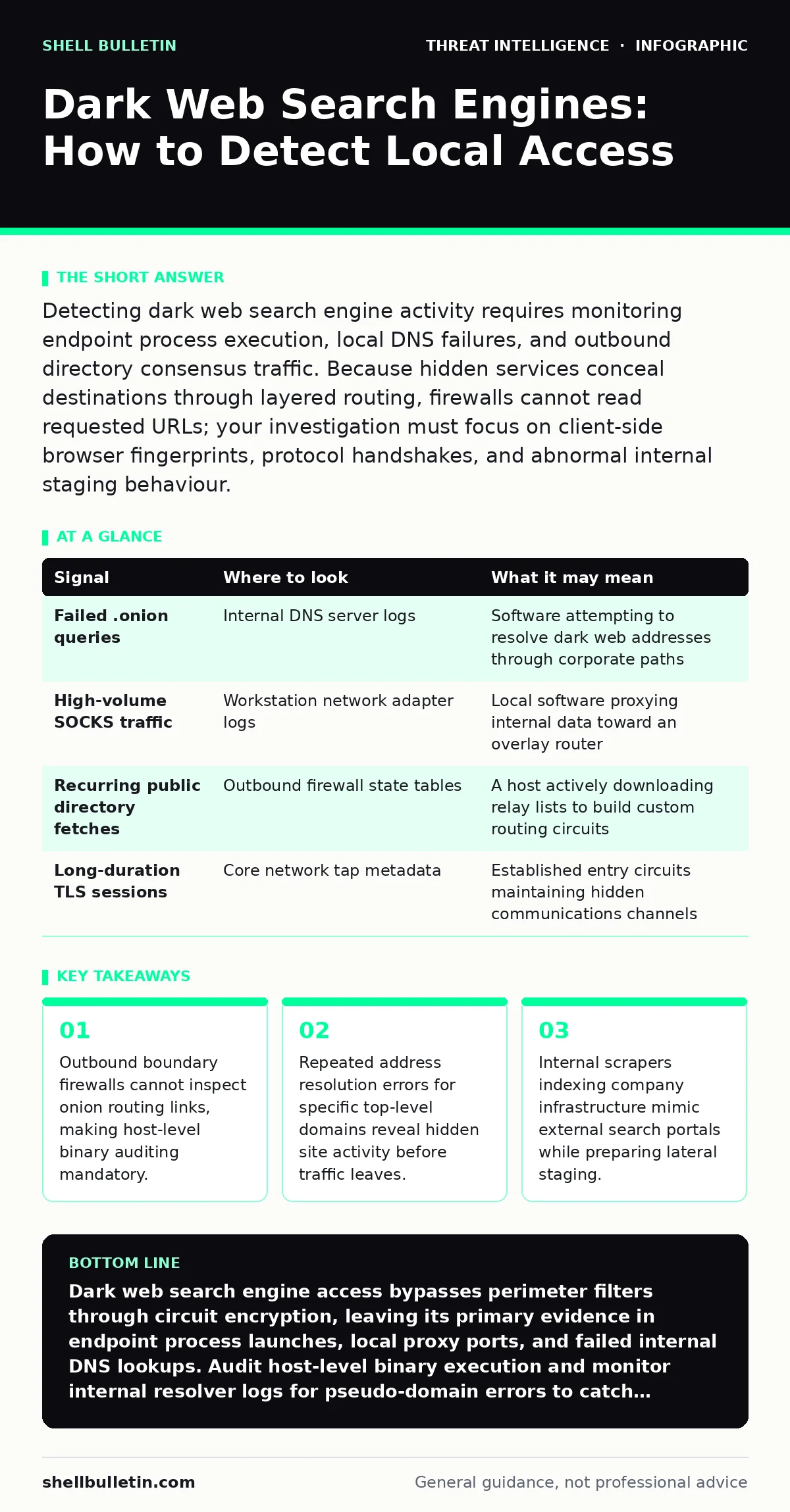
Detecting dark web search engine activity requires monitoring endpoint process execution, local DNS failures, and outbound directory consensus traffic. Because hidden services conceal destinations through layered routing, firewalls cannot read requested URLs; your investigation must focus on client-side browser fingerprints, protocol handshakes, and abnormal internal staging behaviour.
How Onion Routing Hides Search Engine Requests
Dark web search engines operate within overlay networks that use layered encryption to obscure physical hosting locations and client identities. When an internal user or automated process queries a hidden search index, client software encrypts the data packet in multiple concentric layers, comparable to the layers of an onion. The connection passes through a circuit of 3 distinct nodes: the guard node, the middle relay, and the exit or rendezvous point.
Network firewalls see only a continuous stream of encrypted traffic moving toward a single entry point. The destination index address never appears in the outer packet headers. Consequently, security teams cannot rely on uniform resource locator (URL) filtering, domain categorization engines, or traditional content scanners to flag hidden search queries at the perimeter. Detection must target how the operating system prepares the connection.
Endpoint Process Indicators and Artifacts
Client systems generate distinct operational signatures whenever an interactive user or automated script initializes an overlay routing client. Most users query dark web search platforms through modified open-source browser builds configured to route all traffic across a local proxy port. Security sensors should monitor process command lines for standalone proxy binaries, portable browser builds executing from user directories, and background communication over standard internal proxy ports.
- Inspect process execution logs for unsigned background networking binaries.
- Monitor execution events originating from temporary storage and user profile directories.
- Check operating system event records for temporary network service installations.
- Audit user workstation task managers for portable browser launch arguments.
Non-interactive access introduces unique endpoint anomalies. Automated indexing tools designed to scrape dark web search platforms often employ headless browser environments or custom scripting libraries. Defenders should audit developer workstations and administrative servers for unapproved Python or Go binaries initiating high-volume outbound socket connections without an accompanying interactive user session or graphical interface.
Network Traffic Analysis for Circuit Negotiation
Network traffic analysis reveals overlay network usage during initial circuit building, long before any search query reaches an index. The connection begins when an internal client contacts central authority servers to download a directory consensus document, which lists active public network relays. This consensus document download generates a predictable byte-size profile over standard transport layer security (TLS) connections that security teams can flag.
Directory lookups produce distinct timing patterns. Once the client receives the consensus file, it executes rapid, back-to-back TLS handshakes against multiple geographically distant IP addresses as it selects its guard and transit relays. These connections bypass internal corporate resolvers entirely, establishing long-lived Transmission Control Protocol (TCP) circuits that maintain keep-alive heartbeats even while the user is simply reading search engine results.
| Signal | Where to look | What it may mean |
|---|---|---|
Failed .onion queries | Internal DNS server logs | Software attempting to resolve dark web addresses through corporate paths |
| High-volume SOCKS traffic | Workstation network adapter logs | Local software proxying internal data toward an overlay router |
| Recurring public directory fetches | Outbound firewall state tables | A host actively downloading relay lists to build custom routing circuits |
| Long-duration TLS sessions | Core network tap metadata | Established entry circuits maintaining hidden communications channels |
Host Resolution Errors and Internal System Logs
Operating systems frequently leak dark web search attempts through standard name resolution services. Standard corporate workstations rely on local Domain Name System (DNS) servers to translate human-readable names into routable addresses. Dark web search engines use unique pseudo-top-level domain strings that public and corporate root servers cannot resolve.
When an unconfigured browser, script, or employee types a hidden search engine address into a standard corporate browser, the workstation queries internal corporate DNS servers. These queries fail immediately, producing Name Error (NXDOMAIN) status responses. A sudden cluster of failed resolution requests for pseudo-top-level domains provides definitive proof of intent to browse hidden networks, often indicating manual experimentation or misconfigured exfiltration scripts.
Investigating these events connects directly to your threat intelligence program. By analyzing which internal host generated the resolution error, security teams can pinpoint the specific machine attempting unauthorized access and verify whether the host has experienced staging behavior associated with lateral movement.
Tooling Approaches for Detecting Dark Web Queries
Traditional intrusion detection tools require specialized signatures to isolate dark web search activity from legitimate encrypted traffic. Endpoint Detection and Response (EDR) agents offer the most reliable detection mechanism by inspecting memory allocation, process trees, and local loopback adapters. Because dark web browsers establish local SOCKS5 proxy listeners, an EDR rule flagging non-standard listening ports quickly uncovers active routing software.
Open-source network protocol analyzers identify hidden network negotiation at the packet level. While payload inspection fails due to encryption, protocol decoders easily identify the self-signed certificates and specific cipher suites negotiated during the initial guard node handshake. Security systems can combine these protocol observations with tactics, techniques and procedures (TTPs) mapped to unauthorized software installation to automate alert prioritization.
Security incident response personnel must continuously calibrate these detection mechanisms. Unfiltered alerts triggered by transient software updaters or misconfigured telemetry can cause alert fatigue, leading analysts to dismiss the low-frequency, persistent signals that accompany serious operational compromises.
See also: Threat Intelligence Platforms: Real Value vs Operational Noise · Tactics, Techniques, and Procedures (TTPs) Explained for Beginners
Blind Spots in Dark Web Search Engine Detection
Standard detection architectures struggle when users route dark web search queries through external intermediate systems. If an insider or external adversary connects via commercial Virtual Private Networks (VPNs) or encrypted remote desktop protocols to an off-premise server, your local network captures none of the search indicators. The endpoint simply logs a single, authorized outbound encrypted tunnel, blinding your local network inspection tools entirely.
Bridged network connections present a second severe blind spot. Advanced overlay protocols employ obfuscated bridges that disguise connection handshakes as ordinary web browsing, video streaming, or voice-over-IP traffic. When software uses these pluggable transports, the packet sizes, handshakes, and timing metrics closely mirror harmless everyday services.
- Commercial VPN tunnels masking downstream overlay client handshakes.
- Encrypted container runtimes executing network processes isolated from host logging.
- Obfuscated transport plugins masquerading as internal voice or video protocols.
- Memory-only operating systems booted from external drives bypassing local disk agents.
Defenders also struggle when dark web search engines are queried indirectly through legitimate surface-web mirror portals. These clearnet proxy portals allow any standard browser to query hidden indexes through a normal website address. Network sensors see only an ordinary browsing session to an unclassified public domain, concealing the dark web search query within standard web traffic.
Verifying Internal Scraper and Indexer Behavior
Malicious actors who breach a corporate perimeter occasionally deploy dark web search engine architectures internally to catalog compromised assets. These custom search engines scrape local file shares, code repositories, and intranet databases, structuring sensitive files for future extortion demands or password cracking operations.
Detecting an internal indexer requires analyzing access rate metrics and data handling anomalies. Standard corporate users browse files sequentially, whereas automated indexing engines generate rapid, programmatic read requests across file servers during off-peak hours. Track access volumes through clear security metrics to catch these scrapers before they complete the indexing phase and package the collected data for outbound exfiltration.
Key takeaways
- Outbound boundary firewalls cannot inspect onion routing links, making host-level binary auditing mandatory.
- Repeated address resolution errors for specific top-level domains reveal hidden site activity before traffic leaves.
- Internal scrapers indexing company infrastructure mimic external search portals while preparing lateral staging.
Dark web search engine access bypasses perimeter filters through circuit encryption, leaving its primary evidence in endpoint process launches, local proxy ports, and failed internal DNS lookups. Audit host-level binary execution and monitor internal resolver logs for pseudo-domain errors to catch hidden network activity at the source.
Frequently asked questions
Can our edge firewall block dark web search engines using URL category filters?
Edge firewalls cannot block dark web search engines through URL filtering because the requested addresses are sealed inside multi-layered encryption before leaving the host. Firewalls see only encrypted connections to unclassified public IP addresses rather than the target domain.
Why do dark web search engine queries generate internal DNS log alerts?
Dark web search engine queries generate internal DNS alerts when software mistakenly asks standard corporate resolvers to locate pseudo-top-level domains like `.onion`. Corporate resolvers cannot translate these non-standard strings, generating immediate NXDOMAIN error codes that expose the host.
How do users access dark web search engines without triggering network alerts?
Users bypass network detection by routing their traffic through external encrypted tunnels, commercial VPN connections, or clearnet mirror portals that act as public web bridges. In these scenarios, perimeter sensors only observe regular web traffic directed toward a standard, benign-looking IP address.
Does detecting overlay network traffic prove an employee accessed illicit search engines?
Detecting overlay network traffic proves only that a workstation established an encrypted circuit across an anonymizing network, not the exact site visited. Because the payload remains encrypted across the circuit, you must inspect endpoint memory or browser cache artifacts to prove specific search activity.
How this guide was produced: written by the Shell Bulletin editorial team with AI assistance, checked against the public references listed below, and reviewed when the facts change. See our editorial policy or report an error.