What Is Incident Response: The Plan That Stops Digital Chaos
Incident response is not just a technical fix but a legal and operational framework that dictates how your organization survives and recovers from a security breach.

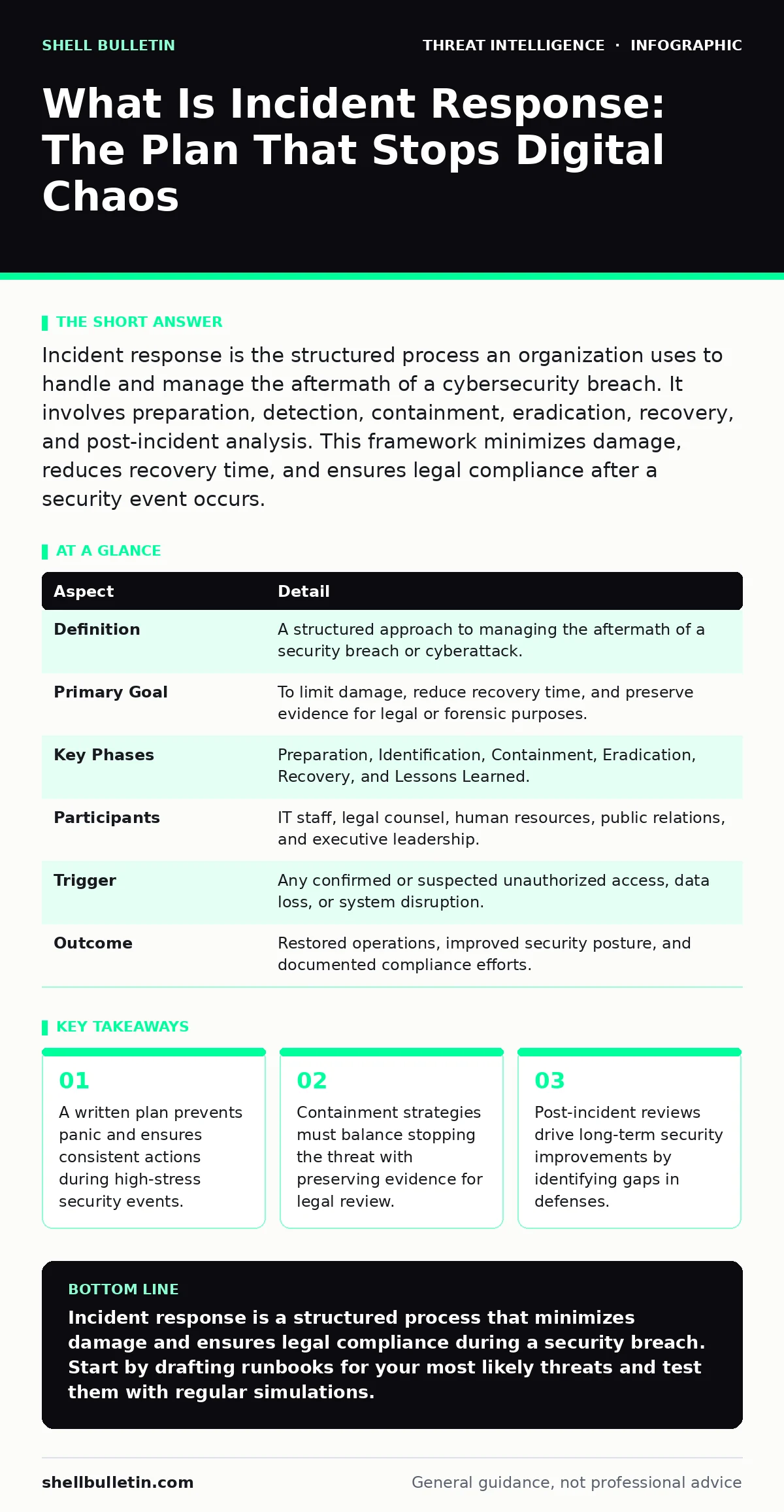
Incident response is the structured process an organization uses to handle and manage the aftermath of a cybersecurity breach. It involves preparation, detection, containment, eradication, recovery, and post-incident analysis. This framework minimizes damage, reduces recovery time, and ensures legal compliance after a security event occurs.
What Is Incident Response
Incident response is the coordinated set of procedures an organization executes when it detects a security breach. It is not merely a technical fix for a virus or a hacked account. The process defines who acts, what they do, and when they do it. This structure reduces the time between detection and resolution. Without a defined process, staff members act on instinct. Instinct leads to inconsistent actions and missed steps. Consistent actions preserve evidence and limit damage. The goal is to restore normal operations as quickly as possible while maintaining legal defensibility.
| Aspect | Detail |
|---|---|
| Definition | A structured approach to managing the aftermath of a security breach or cyberattack. |
| Primary Goal | To limit damage, reduce recovery time, and preserve evidence for legal or forensic purposes. |
| Key Phases | Preparation, Identification, Containment, Eradication, Recovery, and Lessons Learned. |
| Participants | IT staff, legal counsel, human resources, public relations, and executive leadership. |
| Trigger | Any confirmed or suspected unauthorized access, data loss, or system disruption. |
| Outcome | Restored operations, improved security posture, and documented compliance efforts. |
How The Framework Works
The framework operates in distinct phases that guide the team from detection to recovery. Preparation happens before any incident occurs. This phase includes creating policies, assembling teams, and testing tools. Identification follows when monitoring systems detect anomalies. The team must verify whether the anomaly is a true positive or a false alarm.
Containment comes next. The team isolates the affected systems to prevent the threat from spreading. Eradication removes the root cause of the incident. This might involve deleting malware or disabling compromised accounts. Recovery restores systems to normal operation. Finally, the team conducts a post-incident review to improve future responses.
Imagine a small business discovers that an employee’s laptop was left unattended at a coffee shop. The IT team finds that sensitive customer files were uploaded to a personal cloud drive. This is an incident. The response team does not just delete the files. They follow their runbook. They disable the employee’s access to company systems. They notify legal counsel about potential data breach laws. They change the passwords for the affected services. They then review why the employee had access to those files in the first place. This structured approach prevents a simple mistake from becoming a legal liability.
Who Bears The Responsibility
Incident response affects every department in an organization, not just the IT team. Technical staff handle the containment and eradication steps. They work with network traffic analysis tools to identify the scope of the breach. Legal counsel advises on notification requirements and liability. Human resources manages employee-related issues, such as disciplinary action or support for victims.
Public relations prepares statements for customers and the media. Executive leadership makes final decisions on resource allocation and business continuity. Each role has specific tasks defined in the plan. Ambiguity in roles causes delays. Delays increase damage. Clear role definitions ensure that every team member knows their exact duties during a crisis.
Common Misconceptions About Response
Many organizations misunderstand the scope and purpose of incident response. A common error is assuming that technology alone can solve the problem. Automation helps, but human judgment is required for complex decisions. Another mistake is focusing only on technical recovery. Organizations often neglect the legal and reputational aspects. This oversight can lead to fines and loss of customer trust. Some teams also fail to test their plans. A plan that has never been tested is likely to fail under pressure. Regular simulations reveal gaps in the process. These gaps must be addressed before a real incident occurs.
This view ignores the root cause analysis. If the malware entered through a phishing email, the team must also address the user’s training and email filtering rules. Simply removing the virus leaves the door open for the next attack. The process must close the vulnerability that allowed the breach.
Integrating Threat Intelligence
Effective response relies on accurate information. A threat intelligence program provides context about the attacker’s methods and tools. This context helps the team prioritize actions. For example, knowing that a specific group uses command and control traffic over unusual ports helps the team detect the breach faster. Threat intelligence also informs the containment strategy. If the attacker is known for lateral movement, the team must isolate network segments more aggressively. Integrating intelligence into the response plan makes the actions more precise. Precision reduces collateral damage to legitimate business operations.
See also: DNS Hijacking Response: Recovery Steps and Containment Plan · How Breach Notification Laws Work: A Step-by-Step Analysis
Building Your Runbook
A runbook is a step-by-step guide for specific types of incidents. It translates the high-level plan into actionable tasks. Each runbook should cover a specific scenario, such as ransomware, data exfiltration, or denial of service. The steps must be clear and unambiguous. Technical staff should be able to follow them without consulting an expert. Include contact information for all team members. Define escalation paths for decisions that require executive approval. Specify the tools and commands needed for each step. Test the runbook regularly. Update it when systems or threats change. A static runbook becomes outdated quickly. Outdated instructions lead to errors during a crisis.
The Hidden Cost Of Inaction
Failing to respond properly has consequences beyond immediate damage. Legal penalties for non-compliance can be severe. Regulatory bodies require proof that an organization took reasonable steps to protect data. A documented response plan demonstrates due care. Without it, an organization may face fines and lawsuits. Reputational damage is harder to quantify but equally damaging.
Customers lose trust when an organization appears disorganized during a breach. This loss of trust leads to churn and reduced revenue. The cost of building and maintaining a response capability is far lower than the cost of a failed response. Investing in preparation is a business imperative, not just a technical requirement.
These metrics help you identify trends and areas for improvement. They also provide data for reporting to stakeholders.
Preparing For The Unknown
No plan can cover every possible scenario. Attackers constantly evolve their tactics. Your response team must be flexible. Training and exercises build this flexibility. Simulations expose weaknesses in the plan. They also build muscle memory for the team. When a real incident occurs, the team reacts faster and more accurately. Regular updates to the plan keep it relevant. New technologies and threats require new procedures. Stay informed about emerging trends. Engage with the broader security community. Share lessons learned. Learning from others’ mistakes is a valuable part of preparation.
Conclusion And Next Steps
Incident response is a continuous process. It requires ongoing effort and attention. The goal is not just to react to breaches but to improve overall security. By following a structured approach, organizations can minimize damage and recover quickly. Start by assessing your current capabilities. Identify gaps in your plan. Build or update your runbooks. Train your team. Test your procedures. Repeat this cycle regularly. Preparation is the best defense against the chaos of a security breach.
Key takeaways
- A written plan prevents panic and ensures consistent actions during high-stress security events.
- Containment strategies must balance stopping the threat with preserving evidence for legal review.
- Post-incident reviews drive long-term security improvements by identifying gaps in defenses.
Incident response is a structured process that minimizes damage and ensures legal compliance during a security breach. Start by drafting runbooks for your most likely threats and test them with regular simulations.
Frequently asked questions
How often should we test our incident response plan?
Test your plan at least twice a year. More frequent testing is recommended if your environment changes rapidly or if new threats emerge.
Do we need a dedicated incident response team?
Small organizations may not need a full-time team. However, you must assign clear roles to existing staff. Ensure they receive regular training.
What is the difference between a playbook and a runbook?
A playbook is a high-level strategy for a type of incident. A runbook contains the specific, step-by-step technical instructions for executing that strategy.
How do we know if our response was successful?
Measure success by recovery time, data loss, and customer impact. Review these metrics after every incident to identify areas for improvement.
How this guide was produced: written by the Shell Bulletin editorial team with AI assistance, checked against the public references listed below, and reviewed when the facts change. See our editorial policy or report an error.