Fake event ticket websites: what to do next to secure your accounts and recover funds
Recovering from fraudulent ticket purchases requires immediate financial containment and rapid credential rotation across unrelated platforms.
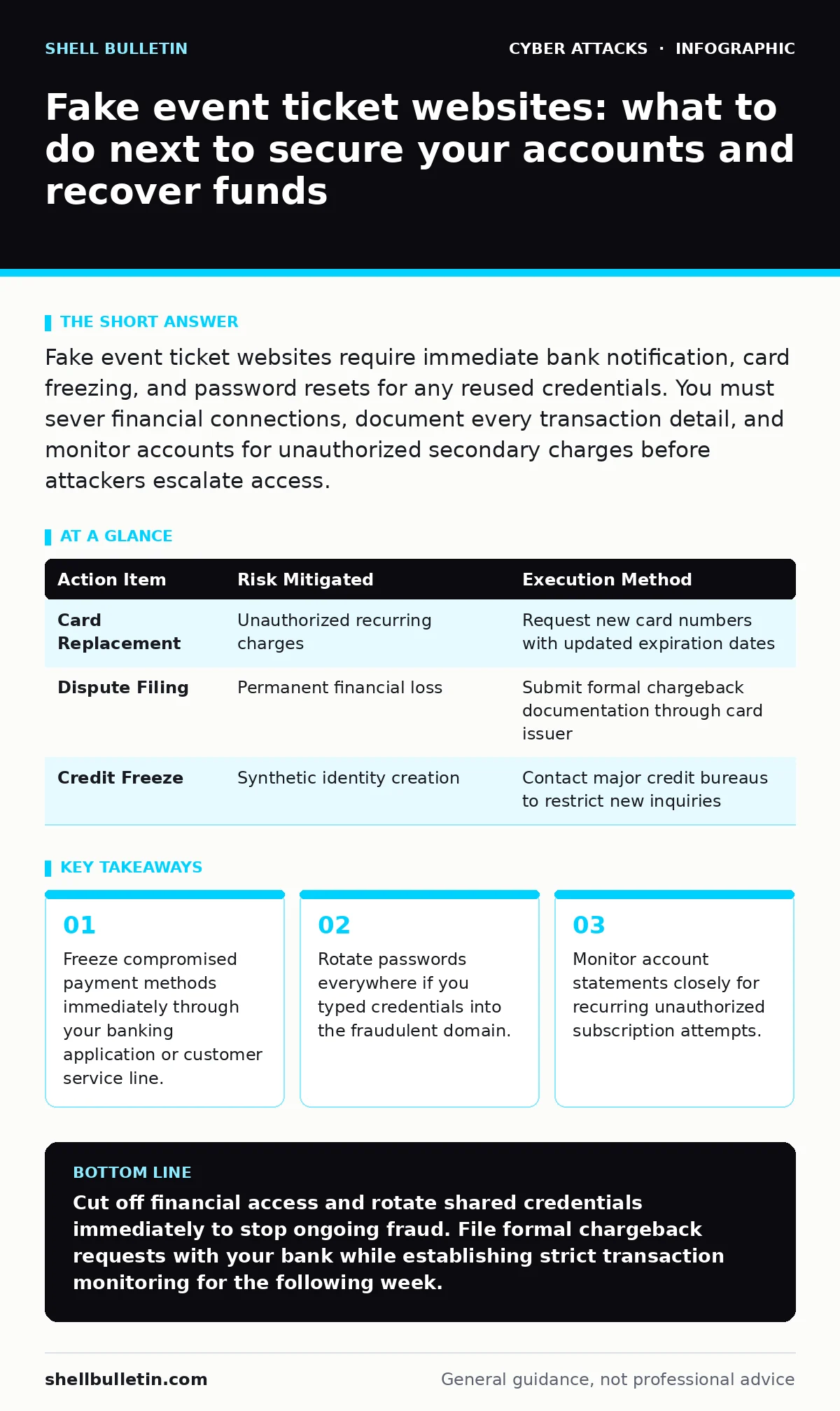
Fake event ticket websites require immediate bank notification, card freezing, and password resets for any reused credentials. You must sever financial connections, document every transaction detail, and monitor accounts for unauthorized secondary charges before attackers escalate access.
Anatomy of a fraudulent ticket transaction
Fraudulent ticket operations mimic legitimate box offices by using search engine optimization to display top results for high-demand events. Criminals build polished interfaces that accept payment details and account login credentials under the guise of creating a user profile. 3 distinct phases characterize these setups: traffic acquisition, credential harvesting, and fraudulent charging. Understanding this structure helps you isolate the damage before operators maximize their illicit gains.
Immediate containment in the first hour
The first hour demands decisive action to neutralize active payment authorization requests and secure your digital footprint. 2 primary vectors require attention: your financial instruments and your personal authentication data. Attackers often attempt rapid secondary charges or use harvested passwords on automated credential-stuffing tools before you notice the discrepancy.
- Contact your financial institution to freeze the specific card used for the transaction.
- Change the password on the email account associated with the ticket purchase.
- Revoke any third-party application permissions granted during the checkout flow.
- Document all transaction reference numbers, domain names, and communication logs.
Maintaining basic cyber hygiene across your personal devices prevents secondary malware infections that fraudulent domains sometimes attempt to deliver via drive-by downloads. You must disconnect compromised devices from local networks if the ticket portal prompted you to download a proprietary mobile application or document reader to access your mobile entry passes.
Financial containment on the first day
Financial containment extends past freezing a single card because sophisticated criminal networks often store tokenized payment authorizations for recurring billing. 3 distinct financial checks protect your assets during the initial twenty-four hours after exposure.
| Action Item | Risk Mitigated | Execution Method |
|---|---|---|
| Card Replacement | Unauthorized recurring charges | Request new card numbers with updated expiration dates |
| Dispute Filing | Permanent financial loss | Submit formal chargeback documentation through card issuer |
| Credit Freeze | Synthetic identity creation | Contact major credit bureaus to restrict new inquiries |
Unauthorized merchants frequently attempt small test transactions before initiating larger fraudulent withdrawals. Reviewing pending transactions hourly helps your bank intercept secondary charges before settlement occurs.
Digital recovery on the first day
Digital recovery requires mapping every instance where you reused the password typed into the fraudulent ticket platform. Criminal operators immediately test harvested credentials against major webmail providers, banking portals, and corporate login systems using automated scripts. 3 swift actions secure your accounts against widespread credential abuse.
- Generate unique passphrases for every financial and communication platform you regularly access.
- Enable hardware-backed multi-factor authentication on primary email accounts to block unauthorized access attempts.
- Review connected devices in your primary email settings to terminate active sessions originating from unknown geographic locations.
Robust email filtering prevents malicious password reset notifications from hiding in your spam folder while attackers attempt to lock you out of secondary accounts. You should inspect your email forwarding rules to ensure malicious actors have not established silent access to your incoming verification codes.
Long-term monitoring during the first week
Long-term monitoring guards against delayed exploitation attempts that surface days or weeks after your initial exposure to the fake storefront. Criminal networks frequently share harvested contact lists and payment profiles across underground marketplaces long after the specific event has passed. 3 specific monitoring habits protect your long-term security posture.
- Review bank statements daily for unfamiliar subscription charges disguised as routine service fees.
- Monitor credit monitoring alerts for sudden inquiries or newly opened accounts bearing your personal details.
- Inspect password manager logs for unauthorized export attempts or unrecognized shared vault entries.
Imagine finding an unauthorized subscription charge on your statement 5 days after the ticket purchase. This indicates the fraudulent site stored your billing profile for recurring automated withdrawals rather than a single one-time transaction.
See also: DNS Hijacking Response: Recovery Steps and Containment Plan · How Breach Notification Laws Work: A Step-by-Step Analysis
Who to notify beyond your financial institution
Official reporting channels help law enforcement agencies and consumer protection bodies map emerging fraud infrastructure across global hosting providers. 2 primary reporting pathways establish an official record of the fraud for future legal protection and identity theft recovery.
- File detailed complaints with national cyber crime reporting centers, including exact domain names and payment routing details.
- Notify consumer protection agencies to document the fraudulent merchant identity and associated merchant account processors.
Official reports rarely result in immediate recovery of funds, but they create essential documentation if attackers attempt to use your identity for subsequent financial fraud or unauthorized credit applications.
Stopping repeat exposures
Stopping repeat exposures requires altering how you discover and purchase event tickets in high-demand markets. Primary ticketing providers and authorized team box offices represent the only reliable defense against counterfeit entry passes and credential harvesting traps. 3 preventive rules eliminate future exposure to ticket fraud.
- Avoid purchasing tickets from social media marketplace links or search advertisements lacking official venue verification badges.
- Verify exact domain spellings in your browser address bar before entering payment card credentials or personal identification details.
- Use dedicated virtual payment cards with strict spending limits and single-merchant locks for online purchases.
Key takeaways
- Freeze compromised payment methods immediately through your banking application or customer service line.
- Rotate passwords everywhere if you typed credentials into the fraudulent domain.
- Monitor account statements closely for recurring unauthorized subscription attempts.
Cut off financial access and rotate shared credentials immediately to stop ongoing fraud. File formal chargeback requests with your bank while establishing strict transaction monitoring for the following week.
Frequently asked questions
How can you tell if a ticket website is completely fake before making a purchase?
Fake ticket websites often display generic stock imagery, lack official venue partnerships, and pressure visitors with countdown timers for high-demand events. They typically accept only cryptocurrency, wire transfers, or direct peer-to-peer payment methods instead of standard credit cards with fraud protection.
Will my bank automatically refund money lost on a fake ticket website?
Banks evaluate fraudulent ticket claims based on whether you authorized the transaction or if the merchant used deceptive misrepresentation. Filing a formal chargeback within the required timeframe significantly improves your chances of recovering the disputed funds.
What should you do if you entered your social security number on a fake ticket site?
Entering your social security number requires placing an immediate freeze on your credit reports with all major credit reporting bureaus. You must also file an identity theft report with consumer protection authorities to protect against synthetic loan creation.
Do fake ticket websites install malware on your computer or phone?
Fake ticket websites occasionally prompt visitors to download malicious mobile applications or document readers required for ticket delivery. These downloads often contain infostealer malware designed to harvest saved browser credentials and session cookies.
How this guide was produced: written by the Shell Bulletin editorial team with AI assistance, checked against the public references listed below, and reviewed when the facts change. See our editorial policy or report an error.