Vishing Explained: How Voice Phishing Works and How to Stop It
Voice phishing exploits the psychological weight of spoken urgency, bypassing the visual scrutiny you apply to written messages.

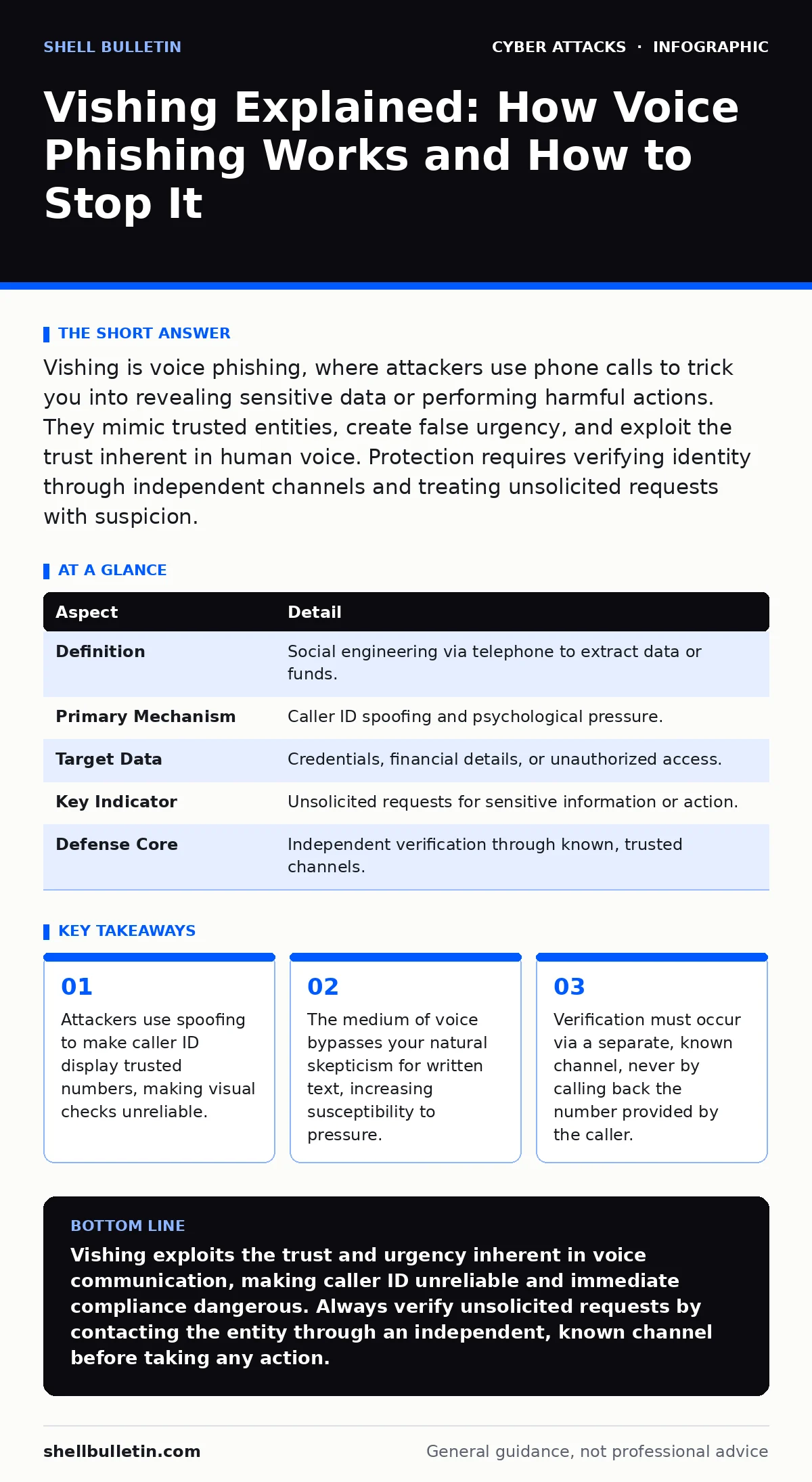
Vishing is voice phishing, where attackers use phone calls to trick you into revealing sensitive data or performing harmful actions. They mimic trusted entities, create false urgency, and exploit the trust inherent in human voice. Protection requires verifying identity through independent channels and treating unsolicited requests with suspicion.
The Trust Gap in Voice Communication
Imagine receiving a package with no return address. You inspect the label, check the weight, and look for tampering before opening it. Now imagine someone knocking on your door claiming to be from the delivery service. You likely open the door before thinking critically. This gap in scrutiny is the foundation of vishing, or voice phishing.
Written communication allows for pause and inspection. You can hover over a link, check the sender’s address, or search for similar scams online. A phone call demands immediate cognitive processing. The attacker controls the pace, the tone, and the narrative. They rely on your instinct to be polite and helpful, turning social norms into a security vulnerability.
| Aspect | Detail |
|---|---|
| Definition | Social engineering via telephone to extract data or funds. |
| Primary Mechanism | Caller ID spoofing and psychological pressure. |
| Target Data | Credentials, financial details, or unauthorized access. |
| Key Indicator | Unsolicited requests for sensitive information or action. |
| Defense Core | Independent verification through known, trusted channels. |
How the Attack Unfolds
The process begins with caller ID spoofing. This technique manipulates the signaling data that tells your phone who is calling. The attacker configures their system to display a number that matches your bank, a government agency, or your own IT department. You see a familiar number, so you answer.
Once connected, the attacker establishes a pretext. They claim there is an urgent issue: a failed payment, a security alert, or a compliance requirement. The goal is to induce anxiety. Anxiety narrows your focus. You stop asking questions and start looking for solutions. The attacker offers a simple solution that requires you to act immediately.
They may ask you to read a code from your phone, transfer funds to a "safe" account, or install remote access software. The request is always framed as necessary for your security or financial health. The attacker never waits for you to verify the claim. They fill the silence with instructions, preventing you from stepping back to assess the situation.
Common Forms of Voice Deception
Attackers adapt their scripts to current events and local concerns. One common form is the tech support scam. The caller claims to have detected a virus on your computer. They guide you through steps that actually install malware or give them remote control of your machine. This often targets individuals who are less familiar with technical troubleshooting.
Another form is the impersonation scam. The caller pretends to be from a tax authority, a utility company, or a law enforcement agency. They threaten legal action, service disconnection, or arrest if you do not pay immediately. They insist on payment via gift cards, cryptocurrency, or wire transfers, methods that are difficult to trace and reverse.
Pretexting involves building a detailed false narrative. The attacker may pretend to be a vendor, a partner, or a new employee. They gather information over multiple calls to build trust before making a large request. This form requires more effort but is highly effective against businesses that value long-term relationships.
What People Usually Get Wrong
Many assume that seeing a familiar number on caller ID proves the caller’s identity. This is incorrect. Caller ID spoofing is trivial to execute. The number you see is just data sent in the call setup. It can be changed by anyone with the right software. Trusting the display is like trusting a forged letterhead.
Another misconception is that vishing only targets individuals. Small businesses are frequent targets because they often have less formal verification processes. An attacker may call a finance department pretending to be the CEO, requesting an urgent wire transfer. This is a form of business email compromise executed over the phone. The lack of written trail makes it harder to audit later.
Some believe that ignoring unknown numbers is sufficient protection. While ignoring spam helps, attackers often spoof numbers from your recent contacts or local area codes. This increases the likelihood you will answer. Ignoring a call from your own office number is not a viable strategy.
The Hidden Cost of Verification
You might think that calling back the number provided by the attacker verifies their identity. This is a critical error. If the attacker controls the phone system, calling back connects you to them again. They have set up a loop to maintain the illusion.
True verification requires using a known, trusted source. If your bank calls you, hang up. Find the customer service number on the back of your card or on your official statement. Call that number. This breaks the attacker’s control. It takes extra time, but that friction is what stops the attack. The cost is a few minutes of your time; the alternative is financial loss or data breach.
This principle applies to internal communications as well. If an executive calls requesting sensitive data, verify through a secondary channel. Send a message via your company’s internal messaging system or call the executive’s known direct line. Do not rely on the call itself for validation.
Reducing Your Exposure
Implementing cyber hygiene practices reduces the surface area for vishing. Keep contact information private. Public directories often list personal and business phone numbers, providing attackers with targets. Remove your numbers from public listings where possible. Use a separate number for public-facing inquiries, keeping your primary line private.
Train your team to recognize the signs of urgency and pressure. Legitimate organizations rarely demand immediate action over the phone without prior notice. They do not ask for passwords or full financial details. Establish a policy that no financial transaction or data release occurs based solely on a phone call. Require written confirmation through a verified channel.
Consider integrating email filtering and email authentication protocols. While these protect against digital phishing, they often correlate with vishing campaigns. Attackers may email a phishing link to gather data, then call to harvest the remaining details. Strengthening your email defenses reduces the initial foothold attackers need to craft convincing voice scripts.
The Role of Technology and Policy
Technology alone cannot solve vishing. STIR/SHAKEN is a framework used by telecom providers to verify the origin of calls. It adds a digital signature to the call setup, making spoofing harder. However, it is not yet universal, and attackers can still bypass it. Do not rely on it as a sole defense.
Policy is your strongest tool. Define clear procedures for handling requests for funds, data, or access. Document the steps for verification. Ensure everyone in the organization knows the process. Regularly test these procedures with simulated scenarios. This builds muscle memory, so the correct response becomes automatic under pressure.
Be aware of related threats like smishing, which uses SMS text messages. The tactics are similar, but the medium changes the urgency. Combining defenses against voice and text phishing creates a more resilient posture. Treat all unsolicited communications with the same level of skepticism.
Key takeaways
- Attackers use spoofing to make caller ID display trusted numbers, making visual checks unreliable.
- The medium of voice bypasses your natural skepticism for written text, increasing susceptibility to pressure.
- Verification must occur via a separate, known channel, never by calling back the number provided by the caller.
Vishing exploits the trust and urgency inherent in voice communication, making caller ID unreliable and immediate compliance dangerous. Always verify unsolicited requests by contacting the entity through an independent, known channel before taking any action.
Frequently asked questions
Can blocking unknown calls stop vishing?
Blocking helps reduce nuisance calls, but attackers use spoofed numbers that may appear local or familiar. Blocking cannot filter out all malicious calls, so verification remains necessary.
What should I do if I accidentally gave information to a visher?
Immediately change your passwords and contact your financial institutions. Monitor your accounts for unauthorized activity and report the incident to your IT or security team.
Is vishing legal?
No, vishing is a form of fraud and identity theft. It violates laws regarding wire fraud and computer abuse in many jurisdictions. Perpetrators face significant legal penalties.
How do I verify a call from my boss?
Use a secondary, pre-established channel. Send a message via your company’s internal chat or call their known direct line. Do not rely on the initial call for validation of urgent requests.
How this guide was produced: written by the Shell Bulletin editorial team with AI assistance, checked against the public references listed below, and reviewed when the facts change. See our editorial policy or report an error.