Cloud Incident Response: 8 Critical Questions Answered
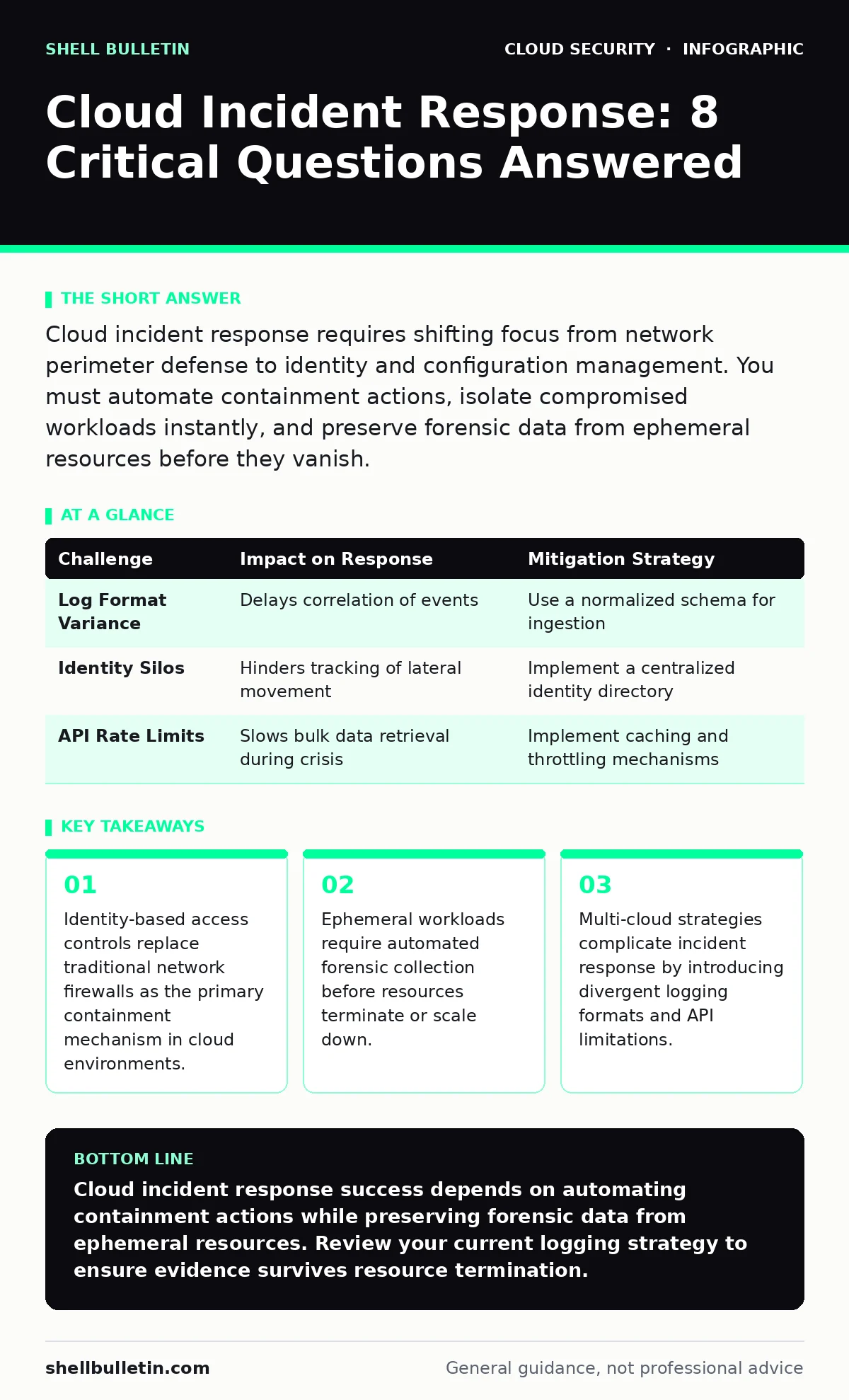
Cloud incident response differs from on-premise recovery because you lack physical control over the underlying infrastructure, requiring a shift toward identity-based containment.
Cloud incident response requires shifting focus from network perimeter defense to identity and configuration management. You must automate containment actions, isolate compromised workloads instantly, and preserve forensic data from ephemeral resources before they vanish.
Why does cloud incident response differ from on-premise recovery?
Cloud incident response differs from on-premise recovery because you lack physical control over the underlying infrastructure. In traditional data centers, you can pull a network cable to isolate a compromised server. In the cloud, you must rely on software-defined boundaries, Identity and Access Management policies, and API-driven containment. The cloud provider manages the hardware, so your response focuses on the configuration of your resources and the identities accessing them.
How do you contain a breach when you cannot shut down the network?
Containment in the cloud relies on revoking permissions rather than cutting network connections. When a service account or user identity is compromised, you must immediately disable that identity. This stops lateral movement across services that trust that credential. You can also isolate specific workloads by modifying security groups or network ACLs to deny all inbound and outbound traffic. This approach limits damage without disrupting healthy services that share the same underlying physical network.
What forensic data disappears when cloud resources are ephemeral?
Ephemeral resources, such as auto-scaling containers or spot instances, terminate frequently. When these resources shut down, their local storage and memory state vanish. You lose the ability to analyze running processes, open network connections, or temporary files. To preserve this evidence, you must configure automated logging to central storage before the resource ends. Without pre-configured collection, the forensic trail breaks the moment the workload scales down or crashes.
Which cloud-native tools replace traditional SIEM for real-time detection?
Cloud-native tools leverage provider-specific APIs to detect anomalies in identity usage and configuration drift. These tools analyze CloudTrail, Azure Activity Log, or GCP Audit Logs in real time. They identify unusual API calls, such as a user creating a new admin role from an unexpected geography. Traditional SIEMs often struggle with the volume and structure of these logs. Native tools provide context-aware alerts that reduce false positives and speed up initial triage.
How do you investigate a compromise without altering the evidence?
Investigating cloud environments requires non-destructive methods because changing a configuration can destroy evidence or alter behavior. You must create snapshots of affected volumes before modifying them. For compute instances, you should export memory dumps if possible, or analyze logs remotely. Avoid logging into the compromised instance directly, as this changes the last login timestamp and may trigger additional malicious scripts. Use read-only API access to gather state information without interacting with the running system.
See also: DevSecOps vs DevOps: How to Integrate Security Without Slowing Delivery · What Is Immutable Infrastructure: A Static Security Model
What are the unique challenges of multi-cloud incident response?
Multi-cloud environments introduce fragmentation in logging standards and investigation tools. Each provider uses different API structures, log formats, and identity management systems. An incident spanning AWS and Azure requires correlating data from two distinct ecosystems. You must build unified dashboards that normalize these logs. Without this abstraction, responders waste time translating formats instead of containing the threat. This complexity also increases the risk of missed detections due to inconsistent alert thresholds.
| Challenge | Impact on Response | Mitigation Strategy |
|---|---|---|
| Log Format Variance | Delays correlation of events | Use a normalized schema for ingestion |
| Identity Silos | Hinders tracking of lateral movement | Implement a centralized identity directory |
| API Rate Limits | Slows bulk data retrieval during crisis | Implement caching and throttling mechanisms |
How does infrastructure-as-code affect your recovery process?
Infrastructure-as-code allows you to rebuild clean environments rapidly after an incident. Instead of manually configuring a new server, you execute a script that provisions a known-good state. This reduces the time to recovery and minimizes human error. However, if the breach originated from a vulnerability in the code or a compromised secret within the repository, rebuilding simply recreates the threat. You must audit the code and rotate secrets before redeploying.
Can automation fully replace human decision-making in containment?
Automation handles repetitive containment tasks, such as revoking tokens or blocking IP addresses, but humans must validate the scope. Automated playbooks can act too aggressively, shutting down legitimate business-critical services. They also lack context regarding business impact. Human responders determine whether a detection is a true positive or a benign anomaly. You need a feedback loop where automated actions trigger human review for high-impact decisions. This hybrid approach balances speed with accuracy.
How do you verify that an incident is fully resolved?
Verification requires more than just stopping the immediate attack. You must scan for backdoors, persistent access methods, and compromised dependencies. Check for new user accounts, modified firewall rules, or scheduled tasks that were added during the breach. Review logs for any unusual activity that occurred before the initial detection. Ensure that all rotated credentials are no longer active. Only after confirming no residual access remains can you restore full operations.
What role does workload identity play in preventing future incidents?
Workload identity ties permissions to the service itself rather than a long-lived static key. This reduces the risk of credential theft. If a container is compromised, the attacker gains only the minimal permissions assigned to that specific workload. This concept aligns with least privilege in the cloud. You should review our separate guide on workload identity for implementation details. Using short-lived certificates or tokens ensures that stolen credentials expire quickly, limiting the window for exploitation.
How do you prepare for incidents that cross service boundaries?
Cross-service incidents require a map of dependencies between your cloud resources. When a database is breached, you must identify which applications query it and which identities have access. This dependency mapping allows you to contain the blast radius effectively. Without this visibility, you may miss secondary systems that rely on the compromised data. Regularly update your architecture diagrams to reflect changes in your deployment. This preparation speeds up containment and reduces the chance of missing affected assets.
Key takeaways
- Identity-based access controls replace traditional network firewalls as the primary containment mechanism in cloud environments.
- Ephemeral workloads require automated forensic collection before resources terminate or scale down.
- Multi-cloud strategies complicate incident response by introducing divergent logging formats and API limitations.
Cloud incident response success depends on automating containment actions while preserving forensic data from ephemeral resources. Review your current logging strategy to ensure evidence survives resource termination.
Frequently asked questions
How long should I keep cloud logs for incident response?
Retain logs for at least one year to support forensic investigations and compliance audits. Immutable storage prevents attackers from deleting evidence after a breach.
Can I use the same incident response plan for on-premise and cloud?
No, the plans must differ because containment methods and available tools vary significantly. Cloud response relies on API-driven actions and identity management, while on-premise response uses physical and network isolation.
What is the first step in a cloud security incident?
The first step is to confirm the scope of the incident by analyzing identity logs and API activity. Avoid immediate shutdowns until you understand which services are affected.
How does microsegmentation help during an incident?
Microsegmentation limits lateral movement by enforcing strict access controls between workloads. This contains breaches within small zones, reducing the overall impact. See our guide on **microsegmentation** for design principles.
How this guide was produced: written by the Shell Bulletin editorial team with AI assistance, checked against the public references listed below, and reviewed when the facts change. See our editorial policy or report an error.