Workload Identity: Secure Cloud Services Without Long-Lived Keys
Workload identity replaces static credentials with short-lived tokens, preventing attackers from hijacking services even if they breach your network perimeter.

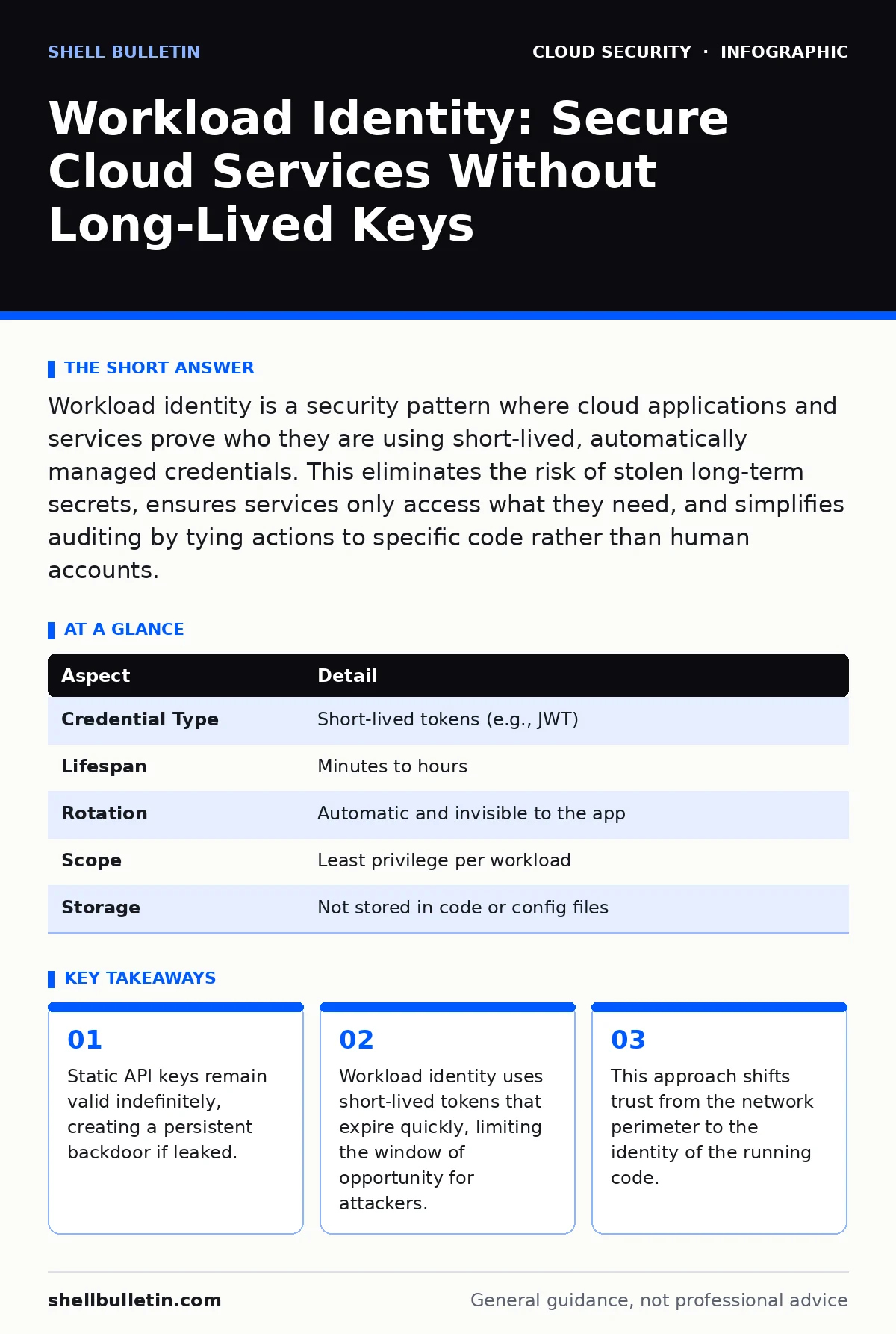
Workload identity is a security pattern where cloud applications and services prove who they are using short-lived, automatically managed credentials. This eliminates the risk of stolen long-term secrets, ensures services only access what they need, and simplifies auditing by tying actions to specific code rather than human accounts.
The Hotel Key Card Analogy
Imagine you hire a contractor to fix a leak in your office. You could hand them a master key to the building. They keep it forever. If they lose it, or if a thief steals it from their pocket, the attacker has entry to everything, every day, for years.
Now imagine you give them a temporary badge. It works only for the duration of the repair job. It opens only the specific room they need. When the job is done, the badge stops working. If someone steals it from their pocket, the badge is useless after an hour.
Workload identity operates on this second principle. It treats software processes like temporary contractors rather than permanent owners of the building.
The Problem With Static Secrets
For years, the standard way to let an application talk to a cloud database or another service was to hardcode a static secret. This might be an API key, a password, or a private key file. You paste this string into your code or an environment variable.
The problem is permanence. These secrets do not expire unless you manually rotate them. Most teams fail to rotate them. If an attacker breaches your system and finds that string, they have a permanent backdoor. They can use it from anywhere, at any time, long after you have patched the initial vulnerability.
This creates a hidden cost. You must build complex systems to store, rotate, and audit these secrets. Even then, a single leaked secret in a public code repository can compromise your entire infrastructure.
Defining Workload Identity
Workload identity is the practice of assigning a unique, machine-managed identity to a running service or application. Instead of sharing a static password, the service proves its identity to the cloud platform. The platform then issues a short-lived credential, often called a token.
This token grants access only for a short window, typically minutes or hours. It contains strict permissions, defining exactly what the service can do. When the token expires, the service must prove its identity again to get a new one.
This mechanism decouples access from the infrastructure. The identity travels with the code, not the server. If the server is compromised, the attacker gets a token that expires soon. They cannot easily escalate privileges or move laterally to other systems.
How The Mechanism Works
The process relies on a trusted broker. When your application starts, the runtime environment generates a request for credentials. This request includes proof that the code is authorized to run.
The broker validates this proof. If the code is legitimate, the broker issues a short-lived token. Your application uses this token to call other services. The receiving service checks the token with the broker to verify it is valid and has the correct permissions.
| Aspect | Detail |
|---|---|
| Credential Type | Short-lived tokens (e.g., JWT) |
| Lifespan | Minutes to hours |
| Rotation | Automatic and invisible to the app |
| Scope | Least privilege per workload |
| Storage | Not stored in code or config files |
This flow removes the need for your application to manage secrets. It does not store keys. It does not handle rotation logic. It simply asks for permission when it needs to act.
Integration With Zero Trust
Workload identity is a core component of a zero trust architecture. Traditional security assumes that anything inside your network is safe. Zero trust assumes nothing is safe, inside or out.
By verifying the identity of every service before granting access, you enforce verification at the point of use. This complements zero trust network access by securing the east-west traffic between services, not just north-south traffic from users.
This approach also addresses the risks of cloud misconfigurations. Even if you accidentally open a port to the internet, the attacker cannot do anything without a valid, short-lived token. The identity layer acts as a second lock on the door.
See also: DevSecOps vs DevOps: How to Integrate Security Without Slowing Delivery · What Is Immutable Infrastructure: A Static Security Model
Common Misconceptions
Many teams believe that workload identity replaces the need for strong secrets entirely. This is incorrect. You still need strong identities for the humans who manage the system. Workload identity secures the machines, not the people.
Another misconception is that it is too complex to implement. Modern cloud platforms provide built-in support for this pattern. You often just need to enable a feature and attach a policy to your service. It is simpler than building a custom secret rotation system.
Some assume that because tokens are short-lived, they cannot be stolen. This is false. Tokens can be intercepted. However, their short lifespan limits the damage. An attacker has a very small window to use a stolen token before it becomes worthless.
Managing Ephemeral Workloads
This pattern shines in environments using ephemeral infrastructure. In these setups, servers are created, used, and destroyed rapidly. They might exist for only a few hours.
Static credentials fail here. You cannot manually rotate keys for a server that dies every night. Workload identity handles this automatically. Each new instance gets its own identity and tokens. When the instance is destroyed, the identity and its tokens vanish with it.
This reduces the attack surface. There are fewer long-lived artifacts to secure. Auditing becomes easier because you can trace actions to specific instances rather than shared service accounts.
Putting It All Together
Implementing workload identity requires a shift in how you design access controls. You move from managing static files to managing policies. You define what each service is allowed to do, not how it stores its password.
This integrates well with CIS Benchmarks for cloud security. These benchmarks often recommend avoiding static credentials. Workload identity provides a practical way to meet those recommendations.
It also helps secure unsecured cloud databases. By ensuring that only authorized workloads can connect, you prevent accidental exposure. Even if the database port is open, the attacker cannot authenticate without a valid workload identity.
The transition reduces operational overhead. You spend less time managing keys and more time ensuring your policies are correct. It is a trade-off: easier credential management for stricter policy enforcement.
Key takeaways
- Static API keys remain valid indefinitely, creating a persistent backdoor if leaked.
- Workload identity uses short-lived tokens that expire quickly, limiting the window of opportunity for attackers.
- This approach shifts trust from the network perimeter to the identity of the running code.
Frequently asked questions
Does workload identity work with on-premises servers?
Yes, but it requires a compatible identity provider and agent. Many cloud providers offer agents for hybrid environments that allow on-prem workloads to use the same identity mechanisms as cloud instances.
How do I debug access issues with short-lived tokens?
Check the audit logs of your identity provider. These logs record who requested a token, when, and whether it was approved. Look for policy denials rather than trying to inspect the token itself, which may have already expired.
Can I use workload identity for third-party applications?
It depends on the application. If the app supports standard protocols like OAuth 2.0 or OpenID Connect, you can often integrate it. You may need to configure the app to use a specific identity provider instead of static keys.
What happens if the identity provider goes down?
Services that rely on workload identity may fail to refresh tokens. If a token is still valid, the service continues to work. If it expires and cannot reach the provider, the service stops functioning. Design your systems to handle this failure mode gracefully. BOTTOM LINE: Workload identity eliminates the risk of leaked static keys by using short-lived, automatic credentials for your services. Audit your current service accounts today and replace the first static key you find with a short-lived
How this guide was produced: written by the Shell Bulletin editorial team with AI assistance, checked against the public references listed below, and reviewed when the facts change. See our editorial policy or report an error.