Zero Trust Network Access: Definition, Mechanics, and Common Pitfalls
Zero trust network access shifts security from the network edge to the individual workload, ensuring that no connection is trusted by default regardless of its origin or destination.

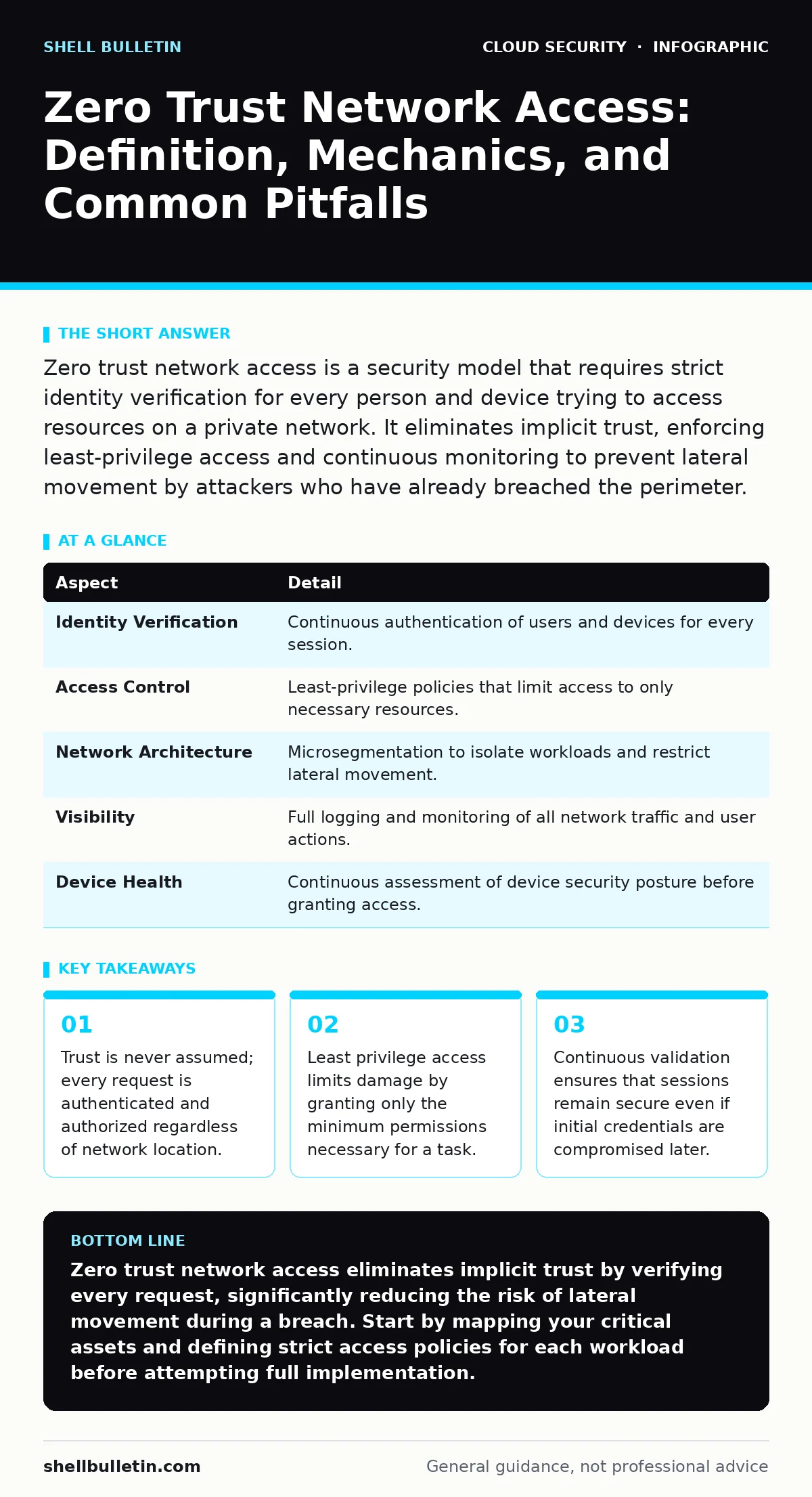
Zero trust network access is a security model that requires strict identity verification for every person and device trying to access resources on a private network. It eliminates implicit trust, enforcing least-privilege access and continuous monitoring to prevent lateral movement by attackers who have already breached the perimeter.
Moving Beyond the Castle Walls
Imagine a traditional office building with a single main entrance. Once you show your ID badge to the guard, you can walk anywhere inside. You can enter the server room, the executive suite, or the break room without further checks. This model assumes that everything inside the walls is safe. Zero trust network access dismantles this assumption. It treats every entry point as potentially hostile.
In a zero trust model, there is no "inside" or "outside" the network. Every connection request is treated as if it originates from an untrusted public network. You must prove your identity and your right to access specific data every time you make a request. This approach removes the security blanket of the network perimeter. It forces systems to verify each interaction individually.
The Core Problem It Solves
Traditional security relies on perimeter defenses like firewalls to keep threats out. This works until an attacker finds a way in. Once inside, the network assumes the attacker is a legitimate user. The attacker can then move laterally, accessing sensitive data and systems without raising alarms. This lateral movement is the primary cause of severe data breaches.
Zero trust network access solves this by limiting lateral movement. It ensures that even if an attacker gains access to one system, they cannot easily reach others. Each resource acts as its own security boundary. You isolate workloads from one another. This containment strategy reduces the blast radius of any single security failure. It turns a wide-open network into a series of small, isolated compartments.
Defining the Architectural Components
Zero trust network access is not a single product but a framework built on several components. The core mechanism is identity-centric security. This means the system focuses on who the user is and what device they are using. It verifies these details before granting any access.
Another critical component is microsegmentation. This process divides a network into smaller, distinct zones. Each zone has its own security policies. Traffic between these zones is strictly controlled. You define exactly which services can communicate with each other. This prevents unauthorized data flows between different parts of your infrastructure.
| Aspect | Detail |
|---|---|
| Identity Verification | Continuous authentication of users and devices for every session. |
| Access Control | Least-privilege policies that limit access to only necessary resources. |
| Network Architecture | Microsegmentation to isolate workloads and restrict lateral movement. |
| Visibility | Full logging and monitoring of all network traffic and user actions. |
| Device Health | Continuous assessment of device security posture before granting access. |
How Access Decisions Are Made
The system evaluates multiple signals before allowing a connection. It checks the user's identity, the device's health, and the context of the request. Context includes factors like time of day, location, and behavior patterns. If a user logs in from an unusual location at an odd hour, the system may deny access or require additional verification.
This dynamic evaluation happens in real-time. The system does not rely on a one-time login. It continuously monitors the session for anomalies. If a user starts downloading large amounts of data suddenly, the system can terminate the connection. This proactive stance prevents data exfiltration. It ensures that trust is earned continuously, not granted once and forgotten.
Integration With Other Security Measures
Zero trust network access does not replace other security controls. It works alongside them to create a layered defense. For instance, it complements efforts to prevent cloud misconfigurations. While zero trust controls access, proper configuration ensures the underlying services are secure.
It also aligns with the principles of CIS Benchmarks. These benchmarks provide standardized configurations for secure system settings. Implementing zero trust on top of hardened systems creates a stronger security posture. You address both how systems are configured and who can access them. This dual approach covers more attack vectors than either method alone.
You must also consider workload identity management. In cloud environments, applications and services need identities to communicate. Zero trust extends to these machine identities. You manage them with the same rigor as human users. This prevents compromised workloads from accessing other services.
See also: Cisco IOS XE Warning Signs: Detect Hidden Network Threats Early
Common Misconceptions and Pitfalls
Many organizations believe zero trust network access is a product they can buy and install. This is a fundamental error. It is a strategy that requires significant changes to network architecture and security policies. Trying to bolt it onto an existing legacy system often fails. You must redesign access controls from the ground up.
Another common mistake is assuming zero trust eliminates the need for other security measures. It reduces risk but does not remove it. Attackers still use phishing, malware, and social engineering. Zero trust limits the damage they can cause, but you still need to prevent the initial breach. You must maintain a holistic security program.
Implementing zero trust can introduce complexity. Managing thousands of micro-perimeters requires sophisticated automation. Manual policy management is not scalable. You must invest in tools that can automate policy enforcement and monitoring. Without automation, the administrative burden becomes unsustainable.
The Hidden Cost of Complexity
The shift to zero trust changes how you manage your infrastructure. It requires detailed visibility into all traffic and identities. You must map every interaction between users, devices, and applications. This discovery phase is time-consuming and resource-intensive. You cannot secure what you do not understand.
This complexity can slow down legitimate business operations if not implemented carefully. Overly restrictive policies can block necessary workflows. You must balance security with usability. Testing and gradual rollout are necessary to avoid disrupting business continuity. The cost is not just financial but also operational. Your team must adapt to new ways of working and monitoring.
Key takeaways
- Trust is never assumed; every request is authenticated and authorized regardless of network location.
- Least privilege access limits damage by granting only the minimum permissions necessary for a task.
- Continuous validation ensures that sessions remain secure even if initial credentials are compromised later.
Zero trust network access eliminates implicit trust by verifying every request, significantly reducing the risk of lateral movement during a breach. Start by mapping your critical assets and defining strict access policies for each workload before attempting full implementation.
Frequently asked questions
Does zero trust network access replace my firewall?
No, it complements it. Firewalls still filter traffic based on IP addresses and ports, while zero trust focuses on identity and least-privilege access at the application level.
Can I implement zero trust network access with legacy systems?
Implementation is difficult with legacy systems that lack modern authentication protocols. You may need to create secure bridges or wrappers to integrate them into a zero trust architecture.
How does zero trust network access affect user experience?
It can add friction if not implemented well, requiring frequent re-authentication. However, modern solutions use seamless background checks to minimize disruption to legitimate users.
Is zero trust network access only for cloud environments?
No, it applies to on-premises, hybrid, and cloud environments. The principles of verifying identity and limiting access are universal across all network types.
How this guide was produced: written by the Shell Bulletin editorial team with AI assistance, checked against the public references listed below, and reviewed when the facts change. See our editorial policy or report an error.