What Is Immutable Infrastructure: A Static Security Model
Replacing servers instead of patching them eliminates configuration drift and reduces the attack surface for persistent threats.

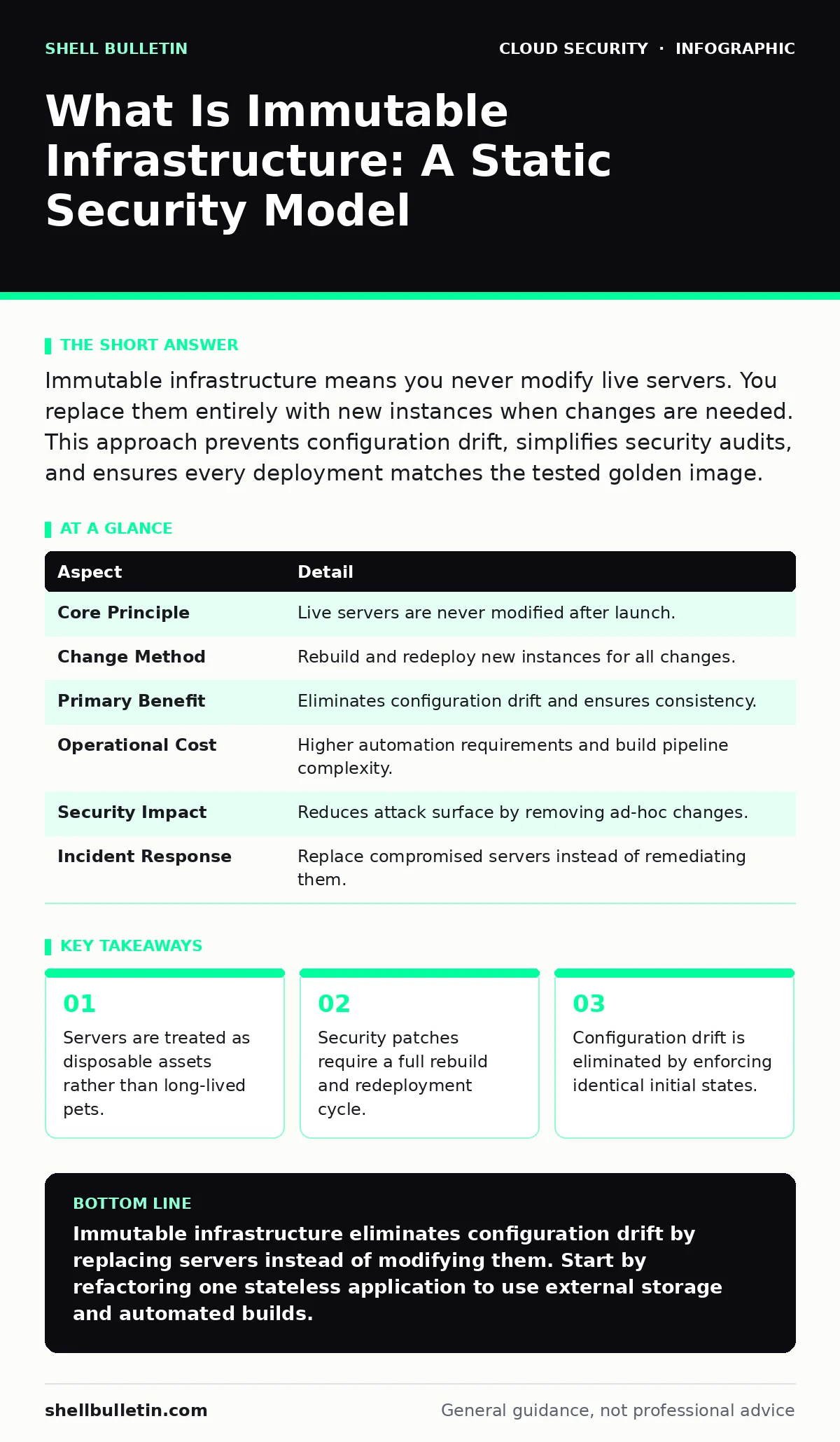
Immutable infrastructure means you never modify live servers. You replace them entirely with new instances when changes are needed. This approach prevents configuration drift, simplifies security audits, and ensures every deployment matches the tested golden image.
Everyday Analogy: The Fast Food Kitchen
Imagine a fast-food kitchen where cooks never wash the same cutting board. Instead, they use a fresh, sterile board for every single order. If a board gets contaminated, it is thrown away immediately. The kitchen never tries to sanitize a dirty board mid-service. This ensures every customer receives food prepared on a surface that was perfect at the start. The process is faster, cleaner, and easier to audit because the starting state is always known and identical.
This model contrasts with traditional IT, where administrators spend years patching and tweaking the same servers. Those servers accumulate hidden changes, unknown software versions, and undocumented configurations. Over time, the live environment diverges from the documented standard. This divergence is called configuration drift. It creates security gaps that are difficult to detect and even harder to fix.
What Is Immutable Infrastructure
What is immutable infrastructure in a practical sense? It is a deployment model where compute instances are never modified after they are launched. Any change, such as a security update or a code fix, requires building a new server image and deploying it. The old server is then terminated and removed from the network. This approach treats infrastructure as code, not as a managed state.
The core principle is that the running state is read-only. You cannot ssh into a production server to install a package. You cannot edit a configuration file on a live machine. If you need to change a setting, you update the definition file, rebuild the image, and launch a new instance. This ensures that every server in your fleet is identical to the last one. It removes the variability that causes many production failures.
Immutable infrastructure affects every team that manages cloud resources. Developers must write code that handles stateless restarts. Operations teams must master automation tools for rapid deployment. Security teams gain the ability to verify the exact state of every machine. The trade-off is increased complexity in the build pipeline. You must be able to recreate your entire environment quickly and reliably.
| Aspect | Detail |
|---|---|
| Core Principle | Live servers are never modified after launch. |
| Change Method | Rebuild and redeploy new instances for all changes. |
| Primary Benefit | Eliminates configuration drift and ensures consistency. |
| Operational Cost | Higher automation requirements and build pipeline complexity. |
| Security Impact | Reduces attack surface by removing ad-hoc changes. |
| Incident Response | Replace compromised servers instead of remediating them. |
How The Mechanism Works In Practice
The workflow begins with a definition file. This file describes the operating system, installed packages, and application code. It is stored in a version control system. When a change is needed, an engineer modifies this file. The change triggers an automated build process. This process creates a new virtual machine image or container image.
Before the new image goes live, it undergoes testing. Automated tests verify that the application works correctly. Security scans check for known vulnerabilities in the new packages. If the tests pass, the deployment system launches new servers using the updated image. These new servers join the load balancer. Traffic is gradually shifted from the old servers to the new ones.
Once the new servers are stable, the old servers are terminated. This process is often called a blue-green deployment or a rolling update. The key is that no data is written to the local disk of the server. All persistent data must live in external databases or object storage. This separation allows servers to be destroyed without losing business data.
Who This Model Affects And Why
This model shifts the burden from operations to engineering. Operations teams no longer spend hours patching individual servers. They focus on improving the build pipeline and deployment automation. Developers must ensure their applications can handle being stopped and started frequently. They must design for statelessness.
Security teams benefit from the predictability of immutable infrastructure. They know exactly what software is running on every server. There are no hidden packages installed by a tired administrator at 2 AM. This predictability makes compliance audits much easier. You can prove that every server matches the approved golden image.
The model also affects incident response. When a server is compromised, the traditional approach is to investigate and clean it. This is difficult and risky. With immutable infrastructure, you simply terminate the compromised server. You deploy a fresh one from the clean image. The investigation happens offline on the terminated instance. This speeds up recovery and reduces the window of exposure.
Common Misconceptions And Pitfalls
Many organizations assume immutable infrastructure means they do not need to patch. This is incorrect. You must still update the base images with security patches. The difference is how you apply them. You apply them in the build process, not on the live server. This requires a disciplined release cadence.
Another common mistake is storing data on local disks. If your application writes data to the server's local storage, you cannot terminate the server. You must move that data to a shared storage solution. This is a significant architectural change for legacy applications. It requires refactoring the application logic.
People also underestimate the speed of their build pipelines. If it takes four hours to build and test a new image, you cannot respond to urgent security patches quickly. You need to optimize your build process. Caching dependencies and parallelizing tests can reduce build times. Fast feedback is critical for this model to work.
See also: DevSecOps vs DevOps: How to Integrate Security Without Slowing Delivery · Cloud Incident Response: 8 Critical Questions Answered
Integration With Related Security Practices
Immutable infrastructure works best when combined with other security measures. For example, container runtime security adds another layer of protection for the lightweight images used in modern deployments. It monitors the behavior of containers at runtime, detecting anomalies that might indicate a compromise.
You should also consider data center resilience planning. Immutable infrastructure makes it easier to recover from disasters. You can rebuild your entire environment from code. However, you must ensure your build artifacts and source code are backed up securely. Without these, you cannot rebuild.
CIS Benchmarks provide a standard for hardening your base images. By applying these benchmarks during the build process, you ensure every new server starts in a secure state. This reduces the need for manual hardening steps. It also provides a clear audit trail for compliance requirements.
What To Do About It Next
Start by auditing your current server management practices. Identify how often you make ad-hoc changes to live servers. Measure the time it takes to patch a server. This baseline will help you understand the pain points that immutable infrastructure can solve.
Begin with a small, non-critical application. Refactor it to be stateless. Move its data to an external database. Create a build pipeline that produces a new image for every change. Deploy this application using the immutable model. Measure the improvement in consistency and security.
As you gain experience, expand the model to more applications. Invest in automation tools for building and testing. Train your teams on the new workflows. Remember that the goal is not just security. It is also reliability and predictability. Immutable infrastructure delivers both.
Final Thoughts On Adoption
Adopting immutable infrastructure is a cultural shift as much as a technical one. It requires trust in automation. It requires letting go of the desire to tweak live systems. The benefits are significant. You eliminate configuration drift. You simplify security audits. You speed up incident response.
The initial investment in automation and refactoring is high. But the long-term savings in operational overhead and risk reduction are substantial. Start small. Prove the concept. Then scale. This approach transforms your infrastructure from a fragile, manual process into a robust, automated system.
Key takeaways
- Servers are treated as disposable assets rather than long-lived pets.
- Security patches require a full rebuild and redeployment cycle.
- Configuration drift is eliminated by enforcing identical initial states.
- Incident response shifts from forensic investigation to instant replacement.
Immutable infrastructure eliminates configuration drift by replacing servers instead of modifying them. Start by refactoring one stateless application to use external storage and automated builds.
Frequently asked questions
Does immutable infrastructure prevent all security breaches?
No, it reduces the attack surface and simplifies recovery, but it does not prevent all breaches. You still need strong network security and access controls.
How does this differ from containerization?
Containers are a technology, immutability is a pattern. You can use containers in a mutable way. Immutable infrastructure often uses containers, but the key is the replace-never-modify approach.
Is immutable infrastructure suitable for on-premises data centers?
Yes, but it is harder to implement. Cloud platforms provide better tools for rapid provisioning and termination. On-premises requires significant automation infrastructure.
What happens to data when a server is replaced?
Data must be stored externally. The server itself should not hold persistent data. When replaced, the new server connects to the same external data source.
How this guide was produced: written by the Shell Bulletin editorial team with AI assistance, checked against the public references listed below, and reviewed when the facts change. See our editorial policy or report an error.