Data Center Resilience Planning: 9 Questions Answered for Cloud Operations
True resilience requires testing failure paths in production-like environments, not just relying on geographic redundancy that masks logical single points of failure.

Data center resilience planning ensures your systems survive hardware failures, network outages, and regional disasters. You achieve this by designing for failure, automating recovery processes, and validating configurations regularly. Without active testing, your backup plans remain theoretical and likely to fail when real incidents occur during peak demand periods.
What defines data center resilience in cloud operations?
Data center resilience is the ability of your infrastructure to maintain service continuity despite component failures, network disruptions, or regional outages. It differs from simple backup strategies because it focuses on immediate availability and automatic recovery rather than post-incident restoration. You build this by distributing workloads across multiple failure domains and ensuring no single component creates a bottleneck. Resilience requires that your systems degrade gracefully, keeping core functions online even when non-essential services disconnect or slow down significantly.
How does geographic redundancy differ from logical isolation?
Geographic redundancy places copies of your data and applications in different physical locations, such as separate cities or continents. Logical isolation separates components within the same data center so that a failure in one zone does not cascade to others. Geographic redundancy protects against natural disasters and regional power grid failures. Logical isolation protects against software bugs, misconfigurations, or internal network storms. You need both because a code error can corrupt data across all geographic locations if they share the same storage backend. Relying solely on distance leaves you vulnerable to logical single points of failure that span regions.
Why do standard failover mechanisms sometimes fail?
Standard failover mechanisms often fail due to state synchronization delays or split-brain scenarios where two systems believe they are the primary instance. If the secondary system lacks recent data, users experience data loss or inconsistency during the switch. Network latency between regions can cause the primary system to appear dead when it is merely slow, triggering an unnecessary and disruptive failover. You must define clear health checks that distinguish between transient network hiccups and actual system death. Without precise thresholds, your automation may oscillate between systems, causing more downtime than the original failure.
What role does automated recovery play in resilience?
Automated recovery eliminates human reaction time and reduces the risk of manual error during high-stress incidents. Scripts and orchestration tools can restart services, reroute traffic, and scale resources faster than any operations team. However, automation amplifies errors if the underlying logic is flawed. A misconfigured script can delete production data or create infinite loops of resource creation. You must treat recovery scripts as production code, subjecting them to the same review and testing standards as your application logic. Automation is only as reliable as the validation steps you build into its execution path.
How do you validate resilience without disrupting users?
You validate resilience by running controlled failure tests in environments that mirror production configurations. Chaos engineering involves intentionally injecting faults, such as killing processes or simulating network latency, to observe system behavior. You start with low-impact tests in staging environments before moving to production canaries. This approach reveals hidden dependencies and configuration drift that static reviews miss. Imagine a scenario where a cache server fails; your test shows whether your application handles the missing data gracefully or crashes. Regular testing ensures your theoretical resilience matches reality.
See also: DevSecOps vs DevOps: How to Integrate Security Without Slowing Delivery · What Is Immutable Infrastructure: A Static Security Model
Which dependencies create the highest risk?
External third-party services, shared libraries, and internal microservices create the highest risk when they become single points of failure. If your application depends on a specific API that goes down, your entire service may halt unless you implement circuit breakers. Circuit breakers stop calling a failing service after a threshold, allowing it to recover and preventing cascade failures. You must map all external dependencies and define fallback behaviors for each. For example, if a payment gateway is unavailable, your system should queue transactions rather than rejecting users outright. Identifying these weak links early prevents widespread outages.
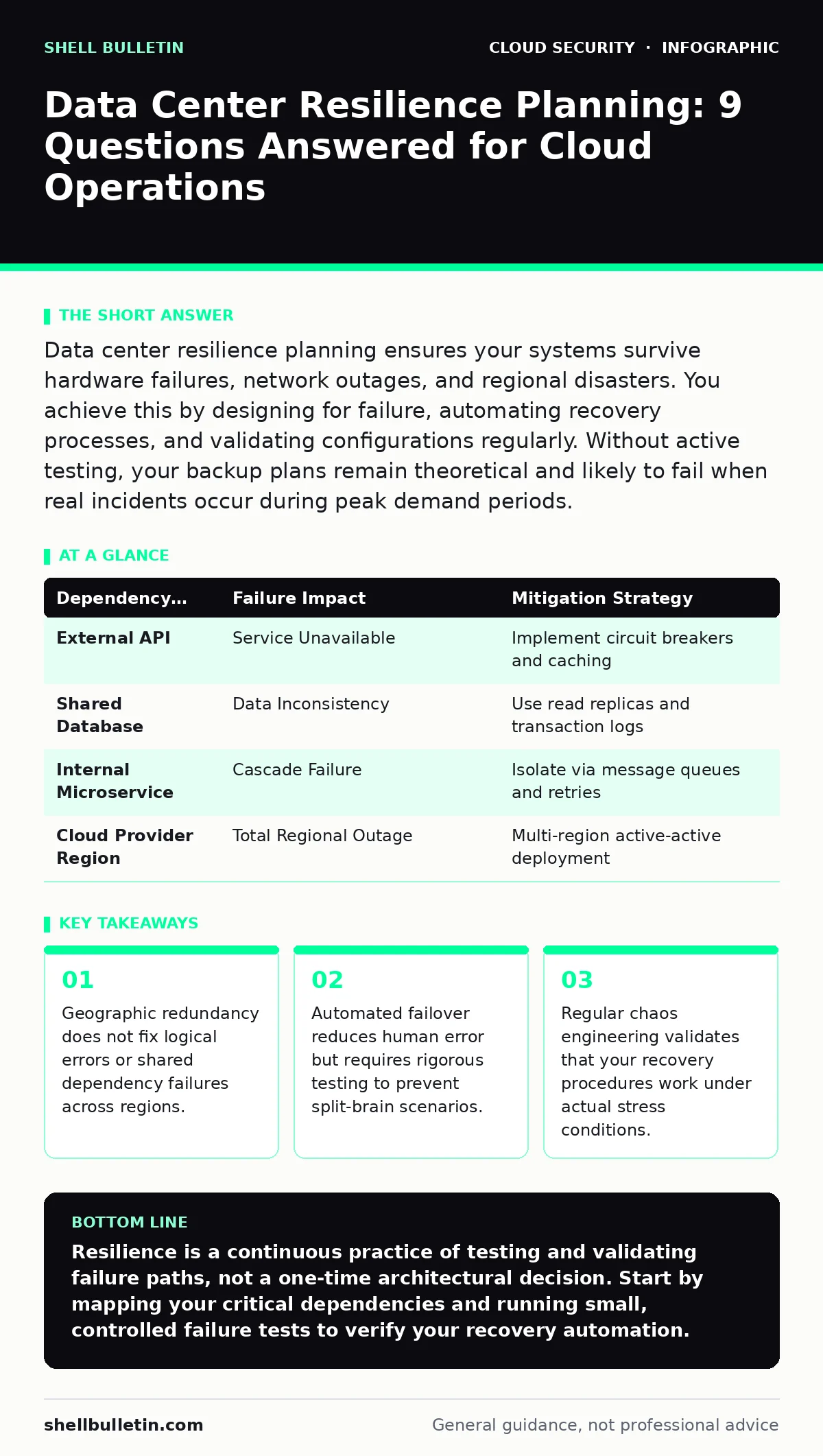
| Dependency Type | Failure Impact | Mitigation Strategy |
|---|---|---|
| External API | Service Unavailable | Implement circuit breakers and caching |
| Shared Database | Data Inconsistency | Use read replicas and transaction logs |
| Internal Microservice | Cascade Failure | Isolate via message queues and retries |
| Cloud Provider Region | Total Regional Outage | Multi-region active-active deployment |
How does configuration drift undermine resilience plans?
Configuration drift occurs when production environments diverge from your documented or tested baseline over time. Manual changes, emergency patches, and feature updates often bypass standard deployment pipelines, leaving hidden vulnerabilities. A resilience plan tested on a clean environment may fail in production because of these untracked changes. You mitigate drift by using infrastructure as code, which treats server configurations as version-controlled software. This ensures that every environment is reproducible and identical. Without this discipline, your recovery scripts may reference services or ports that no longer exist in the live system.
What is the cost of over-engineering resilience?
Over-engineering resilience leads to excessive complexity, higher operational costs, and longer deployment times. Adding redundant layers for every possible failure scenario creates a system that is difficult to debug and maintain. You may spend more on idle standby resources than the potential loss from rare outages. The goal is proportional resilience, matching the criticality of the service. A marketing blog does not need the same multi-region active-active setup as a financial transaction system. You must balance the mean time to recovery with the budget and engineering effort required to maintain the architecture.
How do you measure resilience effectiveness?
You measure resilience effectiveness using mean time to recovery and mean time between failures. These metrics track how quickly your systems return to normal operation and how often they fail. You also measure recovery point objective, which defines the maximum amount of data loss acceptable. Regular post-incident reviews help refine these metrics by identifying gaps in detection or response. Imagine a dashboard that tracks these values over time, showing trends rather than just current status. This data drives decisions on where to invest in additional redundancy or better monitoring tools.
How does this relate to broader security strategies?
Resilience intersects with security because many outages stem from attacks or misconfigurations. A resilient system can withstand distributed denial-of-service attacks by absorbing traffic spikes without failing. It also limits the blast radius of a security breach. For deeper insights on handling active threats, review our guide on cloud incident response. Understanding how to secure your environment against human error is equally important; see cloud misconfigurations for common pitfalls. Preventing unauthorized access to management consoles is critical, as covered in cloud account hijacking.
Key takeaways
- Geographic redundancy does not fix logical errors or shared dependency failures across regions.
- Automated failover reduces human error but requires rigorous testing to prevent split-brain scenarios.
- Regular chaos engineering validates that your recovery procedures work under actual stress conditions.
Resilience is a continuous practice of testing and validating failure paths, not a one-time architectural decision. Start by mapping your critical dependencies and running small, controlled failure tests to verify your recovery automation.
Frequently asked questions
Can I use serverless functions to improve resilience?
Yes, serverless functions abstract infrastructure management, allowing you to focus on application logic. They automatically scale and handle instance failures, but you must still design for external dependency failures and data consistency issues.
How often should I test my disaster recovery plan?
You should test your disaster recovery plan at least twice a year, or after any significant infrastructure change. More frequent testing of individual components via chaos engineering provides better confidence in overall system stability.
Does multi-cloud strategy improve resilience?
Multi-cloud can improve resilience by avoiding vendor-specific outages, but it adds significant complexity. You must ensure data consistency and identity management across providers, which often negates the benefits for smaller organizations.
What is the difference between high availability and resilience?
High availability focuses on minimizing downtime through redundancy, while resilience focuses on recovering from failures and maintaining functionality under stress. High availability prevents outages; resilience manages them when they inevitably occur.
How this guide was produced: written by the Shell Bulletin editorial team with AI assistance, checked against the public references listed below, and reviewed when the facts change. See our editorial policy or report an error.