How Breach Notification Laws Work: A Step-by-Step Analysis
Notification timing often depends on your internal investigation speed, not just the clock, creating a hidden compliance risk for small teams.

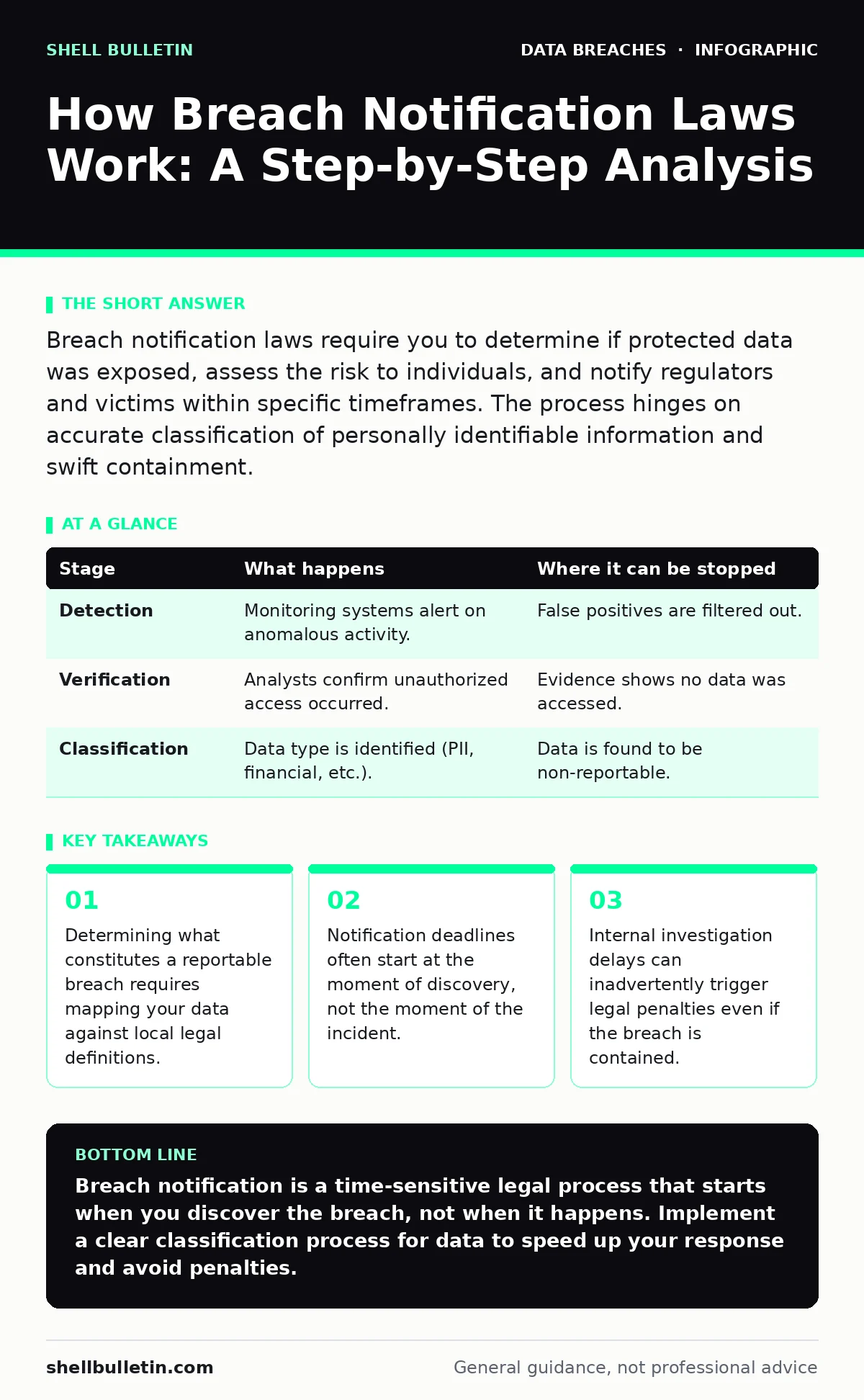
Breach notification laws require you to determine if protected data was exposed, assess the risk to individuals, and notify regulators and victims within specific timeframes. The process hinges on accurate classification of personally identifiable information and swift containment.
Defining the Reportable Event
Not every security incident triggers a legal obligation to notify authorities. The first step is determining whether the event qualifies as a breach under your jurisdiction's laws. Most regulations define a breach as the unauthorized acquisition of data that compromises the confidentiality of that information.
You must cross-reference your incident against the definition of personally identifiable information (PII). This term refers to data that can identify a specific individual, such as names, social security numbers, or medical records. If the exposed data lacks these identifiers, notification may not be required. However, some jurisdictions lower the threshold, requiring notification even for non-unique data if it is combined with other information.
The CIA triad (Confidentiality, Integrity, Availability) helps frame this. Breach laws primarily care about Confidentiality. If data was altered (Integrity) or deleted (Availability) but not viewed by an unauthorized party, it might not be a reportable breach. Check your local statutes for nuances regarding encrypted or truncated data.
Assessing Harm and Risk
Once you confirm PII was accessed, you must evaluate the likelihood of harm. Many laws allow you to delay or avoid notification if you can prove the data was unreadable or that the risk of harm is minimal. This is often called a "risk-based assessment."
You need to determine if the data was encrypted. Strong encryption at rest usually means the data is not considered "acquired" in a usable form. However, if the encryption keys were also compromised, the protection fails. You must document this assessment thoroughly. Regulators often ask for the methodology used to determine low risk.
Imagine you discover a server was accessed, but the files were encrypted and the keys remained secure. In many jurisdictions, you might not need to notify victims. But if you cannot prove the keys were secure, you must assume the data was readable and proceed to notification.
Calculating the Notification Clock
Timing is the most dangerous variable. The clock usually starts when you "reasonably determine" a breach has occurred. This is not the moment the attacker struck, but the moment your team confirmed the exposure. This distinction creates a hidden cost: the time spent investigating counts against your deadline.
Some laws mandate notification within a specific window, such as 72 hours or 60 days. Others require "immediate" or "prompt" notice, which is legally ambiguous. You must know the exact timeframe for your location and the location of the affected individuals. If your customers are in different states or countries, you may face multiple, conflicting deadlines.
Review your log retention practices now. You need logs to pinpoint the exact time of discovery. Without precise timestamps, you cannot accurately calculate when the clock started. This forces you to keep logs longer than you might think necessary for operational reasons alone.
Stage 1: Containment and Initial Triage
| Stage | What happens | Where it can be stopped |
|---|---|---|
| Detection | Monitoring systems alert on anomalous activity. | False positives are filtered out. |
| Verification | Analysts confirm unauthorized access occurred. | Evidence shows no data was accessed. |
| Classification | Data type is identified (PII, financial, etc.). | Data is found to be non-reportable. |
Preparing the Notification Content
The notification itself must contain specific elements. Laws typically require you to state what happened, what data was involved, what you are doing about it, and what the affected individual should do. You must also provide a contact method for questions.
Avoid vague language. Do not say "data may have been compromised." State clearly whether you believe the data was accessed or stolen. If you are unsure, consult legal counsel. Incorrect information in the initial notice can lead to additional penalties later.
You should also consider the medium. Some laws require written notice, while others allow email or telephone notification. For large breaches, some jurisdictions allow substitute notice, such as posting on your website and notifying major media outlets. This is usually a last resort when direct contact is impossible or too costly.
Managing External Communications
Once the notice goes out, you face public and regulatory scrutiny. You must coordinate with law enforcement if they are involved. Sometimes, law enforcement will ask you to delay notification to preserve an investigation. You must check if your local laws allow this exception.
Regulators may request additional details after the initial notice. Be prepared to provide a timeline, the scope of the breach, and the remediation steps taken. This is where your documentation proves valuable. If you skipped steps or acted hastily, the regulator will see it.
Consider the impact on PCI DSS compliance if payment card data was involved. A breach involving card data triggers separate requirements from the Payment Card Industry Security Standards Council. These are contractual obligations, not laws, but they carry heavy fines and loss of processing privileges.
Stage 2: Notification and Reporting
| Stage | What happens | Where it can be stopped |
|---|---|---|
| Drafting | Legal and technical teams write the notice. | Legal review halts due to uncertainty. |
| Distribution | Notices are sent to victims and regulators. | Delivery failures occur (bounced emails). |
| Follow-up | Regulators ask for additional info. | Investigation reveals no harm occurred. |
See also: Data Retention Policies: Step-by-Step Implementation Plan · Data Retention Policies Checklist: Keep Less, Protect More
Remediation and Post-Incident Review
Notification is not the end. You must fix the vulnerability that allowed the breach. This might involve patching software, changing access controls, or retraining staff. You should also review your data retention policies. Keeping data longer than necessary increases the blast radius of any future breach.
Conduct a post-incident review. Identify where the process failed. Was detection slow? Was the classification of data unclear? Use these insights to update your incident response plan. This continuous improvement is often a requirement for maintaining insurance coverage.
Navigating Multiple Jurisdictions
If you operate across borders, you face a patchwork of laws. A breach affecting customers in California, Europe, and Asia triggers different requirements. You must map your data flows to know where the data resides.
The GDPR (General Data Protection Regulation) in Europe has strict timelines and high fines. US states have varying laws. Some require notification within 72 hours, others within 60 days. You must prioritize the strictest deadlines to avoid penalties.
This complexity is why many organizations use a centralized incident response team. They track global obligations and ensure consistent handling. For smaller teams, this is a significant burden. You might need to outsource the legal analysis while keeping the technical response in-house.
Integrating with Security Operations
Breach notification is not just a legal task; it is a security operation. Your security team must work closely with legal and communications. Silos cause delays. Delays cause penalties.
Integrate breach response into your daily operations. Test your notification plan regularly. Simulate a breach and measure how long it takes to classify the data and draft the notice. This prepares you for the real event.
Review your combo lists monitoring. These are lists of credentials stolen from other breaches. If you find your users' credentials on these lists, you may have a duty to warn them, even if your own systems were not breached. This proactive step can reduce liability.
Stage 3: Remediation and Compliance
| Stage | What happens | Where it can be stopped |
|---|---|---|
| Fixing | Vulnerabilities are patched and systems hardened. | Root cause remains unidentified. |
| Review | Post-incident analysis is conducted. | Findings are not implemented. |
| Monitoring | Systems are monitored for recurrence. | Monitoring tools are insufficient. |
Key takeaways
- Determining what constitutes a reportable breach requires mapping your data against local legal definitions.
- Notification deadlines often start at the moment of discovery, not the moment of the incident.
- Internal investigation delays can inadvertently trigger legal penalties even if the breach is contained.
Breach notification is a time-sensitive legal process that starts when you discover the breach, not when it happens. Implement a clear classification process for data to speed up your response and avoid penalties.
Frequently asked questions
Do I need to notify customers if the data was encrypted?
Usually not, if the encryption keys were not compromised. Most laws consider encrypted data as not "acquired" in a usable form, but you must prove the keys were secure.
What if I am not sure if the data was stolen?
If you cannot prove the data was not accessed, you must assume it was. It is safer to notify and later retract if needed than to miss a deadline.
How long do I need to keep breach records?
Keep all documentation for at least the statute of limitations period in your jurisdiction, often several years. This includes logs, notices, and internal communications.
Can I use a template for breach notifications?
You can use a template, but it must be customized for each incident. Generic templates often miss specific legal requirements for data type or remediation steps.
How this guide was produced: written by the Shell Bulletin editorial team with AI assistance, checked against the public references listed below, and reviewed when the facts change. See our editorial policy or report an error.