Breach Notification Best Practices for Compliance and Trust
Delaying breach notification often violates legal mandates before the technical impact is fully understood, creating liability that outlasts the intrusion.

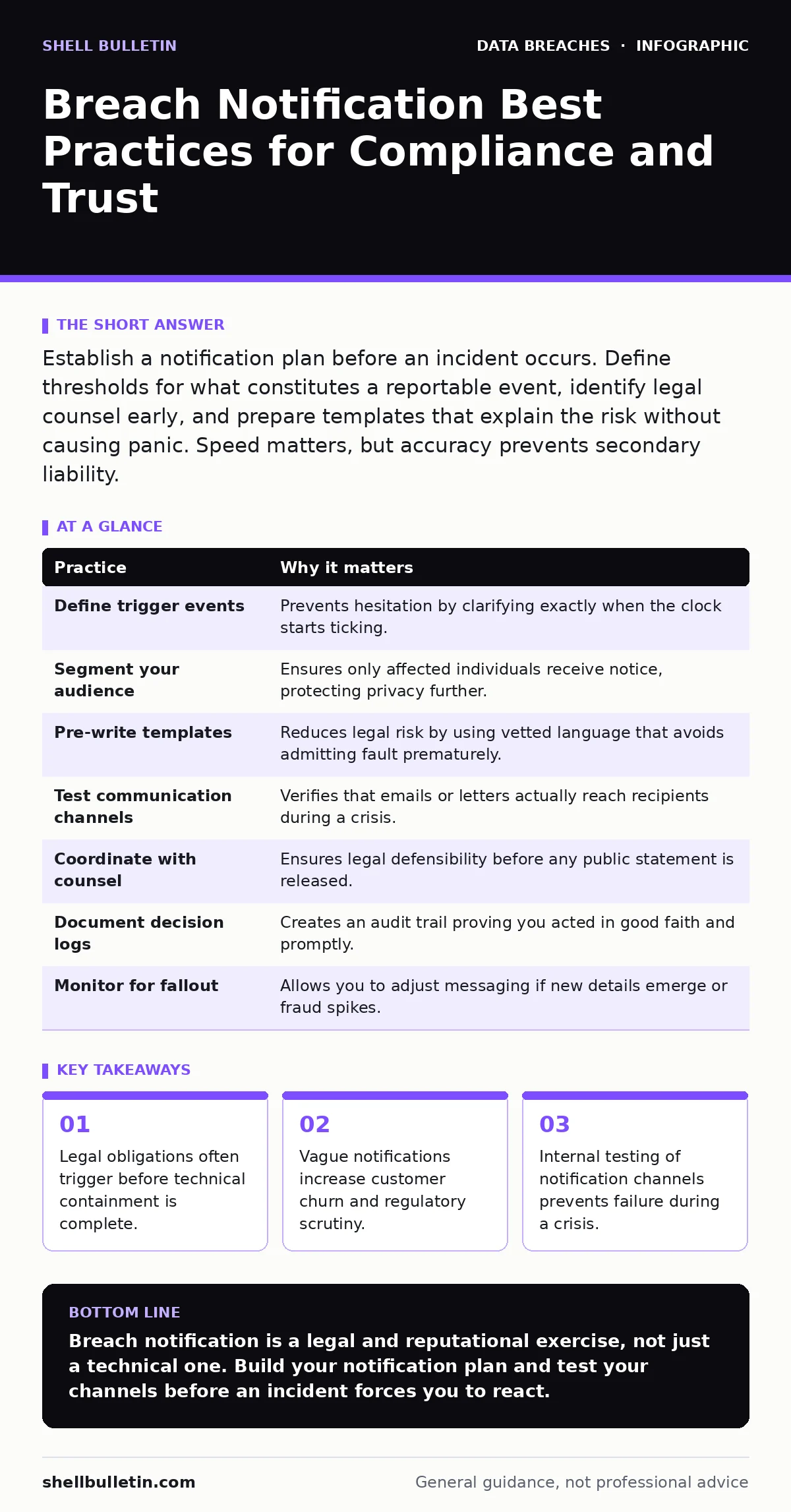
Establish a notification plan before an incident occurs. Define thresholds for what constitutes a reportable event, identify legal counsel early, and prepare templates that explain the risk without causing panic. Speed matters, but accuracy prevents secondary liability.
The Timing Trap in Disclosure
Speed is often cited as the primary goal in breach notification. This creates a dangerous tension with accuracy. You must report quickly to satisfy regulatory windows, yet you need enough facts to describe the harm. If you rush, you may understate the risk. If you wait too long, you face penalties. The balance lies in having a pre-approved process that allows for rapid, factual communication without requiring a full forensic report first.
Regulatory frameworks vary by region and industry. Some require notification within days of discovery. Others allow more time if the data was encrypted. You must know which rules apply to your specific data types. For example, the HIPAA Security Rule imposes strict timelines for covered entities. Ignoring these nuances leads to automatic non-compliance, regardless of your technical response quality.
| Practice | Why it matters |
|---|---|
| Define trigger events | Prevents hesitation by clarifying exactly when the clock starts ticking. |
| Segment your audience | Ensures only affected individuals receive notice, protecting privacy further. |
| Pre-write templates | Reduces legal risk by using vetted language that avoids admitting fault prematurely. |
| Test communication channels | Verifies that emails or letters actually reach recipients during a crisis. |
| Coordinate with counsel | Ensures legal defensibility before any public statement is released. |
| Document decision logs | Creates an audit trail proving you acted in good faith and promptly. |
| Monitor for fallout | Allows you to adjust messaging if new details emerge or fraud spikes. |
Defining What Triggers Notification
Not every security incident requires a public announcement. A failed login attempt is not a breach. A stolen laptop with no data at rest is not a breach. You must distinguish between a security event and a data breach. A breach occurs when unauthorized access results in the exfiltration or exposure of sensitive information. This distinction is critical because false positives waste resources and erode trust.
Imagine your firewall blocks a known malicious IP address. This is a security event. Your team logs it, but no data was accessed. No notification is needed. Now suppose that same IP bypasses the firewall and copies customer records. This is a breach. The trigger is not the attempt, but the successful compromise of data confidentiality. Your policy must define this threshold clearly so staff know when to escalate.
Segmenting the Affected Population
Sending a notification to every customer when only a few are affected is a violation of privacy principles. It exposes non-affected users to unnecessary alarm and potential phishing attempts masquerading as follow-up notices. You must isolate the scope of the breach. This requires precise mapping of your data flows. If you cannot identify who was affected, you cannot notify correctly.
This connects directly to your data retention policies. If you keep old records longer than necessary, you expand the blast radius of any potential breach. By minimizing stored data, you reduce the number of people you must notify. This simplifies the process and lowers the legal exposure. Review your personally identifiable information inventory regularly. Remove data that serves no active business purpose.
Drafting Clear, Non-Alarmist Language
The tone of your notification sets the stage for the recovery phase. Panic leads to mass account closures and support overload. Vague language leads to lawsuits for misleading disclosures. You need a balance: honest about the risk, but clear about the remediation. Avoid technical jargon that confuses the reader. Instead of saying "SQL injection occurred," say "our system was accessed without authorization."
Focus on the impact, not the method. Customers care about what happened to their data, not how the attacker got in. Specify what data was taken. Was it names and addresses? Or were payment card numbers involved? If payment data was exposed, you may need to reference PCI DSS compliance status to reassure users that their financial details were protected by tokenization or encryption. If not, be transparent about the risk of fraud.
Coordinating with Legal and PR
Technical teams understand the breach. They do not understand liability. Legal counsel understands liability. They do not understand the timeline. These two groups must align before any message goes out. Legal will want to limit admission of fault. PR will want to protect brand reputation. The technical truth must bridge this gap. If you release a statement that contradicts later forensic findings, you lose credibility.
Prepare a decision tree in advance. Who has the authority to approve the final message? Is it the CISO? The General Counsel? The CEO? Define this chain of command now. During a crisis, authority ambiguity causes delays. Every hour of delay increases the risk of regulatory penalty. A pre-agreed protocol ensures that the right people review the message for legal sufficiency without slowing down the response.
See also: How Eavesdropping Attacks Work and How to Stop Data Leaks · Potentially Unwanted Programs: What They Are and How to Stop Them
Testing Your Notification Channels
You cannot assume your email system will work during a breach. Attackers often compromise email servers to hide their tracks or send spam. If your notification goes out from a compromised account, recipients may mark it as phishing. You must have an alternate channel. This could be a verified phone line, a dedicated web portal, or certified mail.
Imagine your primary email domain is hijacked. Your notification bounces or lands in spam. Customers remain unaware. Fraudsters exploit this silence. By testing alternate channels quarterly, you ensure a backup path exists. Send test messages to a small group. Verify delivery. Check that links lead to a secure, separate domain. This simple test prevents a catastrophic communication failure.
Documenting the Decision Process
Regulators do not just care about the notification itself. They care about why you notified when you did. Your internal logs must show the timeline. When was the breach detected? When was it assessed? When was the decision made to notify? This documentation is your defense against claims of negligence. It proves you acted with reasonable care.
Include minutes from incident response meetings. Record the rationale for delaying notification if you waited to gather more facts. Did you wait to see if data was encrypted? Did you wait for law enforcement guidance? Document these reasons. If you cannot justify the delay, you may face penalties even if the notification was eventually accurate. Transparency in process builds trust with auditors.
Monitoring Post-Notification Fallout
The notification is not the end of the process. It is the beginning of the recovery phase. You must monitor for the consequences of your disclosure. Expect a spike in support calls. Prepare your help desk with FAQs. Monitor social media for misinformation. Attackers may use your notification to launch targeted phishing campaigns against your customers.
If you see a surge in fraud reports, you may need to issue a follow-up notice. This is not a failure. It is an update. New information may have emerged about the scope of the breach. Or you may have identified a new type of attack vector. Keep the communication loop open. Silence after the initial notice suggests you are hiding something. Proactive updates demonstrate control.
Key takeaways
- Legal obligations often trigger before technical containment is complete.
- Vague notifications increase customer churn and regulatory scrutiny.
- Internal testing of notification channels prevents failure during a crisis.
Breach notification is a legal and reputational exercise, not just a technical one. Build your notification plan and test your channels before an incident forces you to react.
Frequently asked questions
How soon must I notify authorities after a breach?
Timelines vary by jurisdiction and data type. Some regions require notification within 72 hours of discovery. Others allow more time if the data was encrypted. Check your local laws.
Do I need to notify customers if only internal data was stolen?
If the data does not include personally identifiable information or sensitive health records, notification may not be required. However, if the breach compromises your ability to secure customer data in the future, you may have a duty to inform.
Can I use a third-party vendor to send notifications?
Yes, but you remain liable for the content and timing. Ensure the vendor can provide proof of delivery and has secure processes to prevent data leaks during the notification process.
What if I am not sure if a breach occurred?
Err on the side of caution. Conduct a thorough investigation. If you cannot rule out a breach, consult legal counsel. Delaying notification while investigating is often permissible, but you must document the reason for the delay.
How this guide was produced: written by the Shell Bulletin editorial team with AI assistance, checked against the public references listed below, and reviewed when the facts change. See our editorial policy or report an error.