Data Retention Policies Checklist: Keep Less, Protect More
Storing data longer than necessary increases your attack surface and legal liability without providing operational value or business continuity benefits.

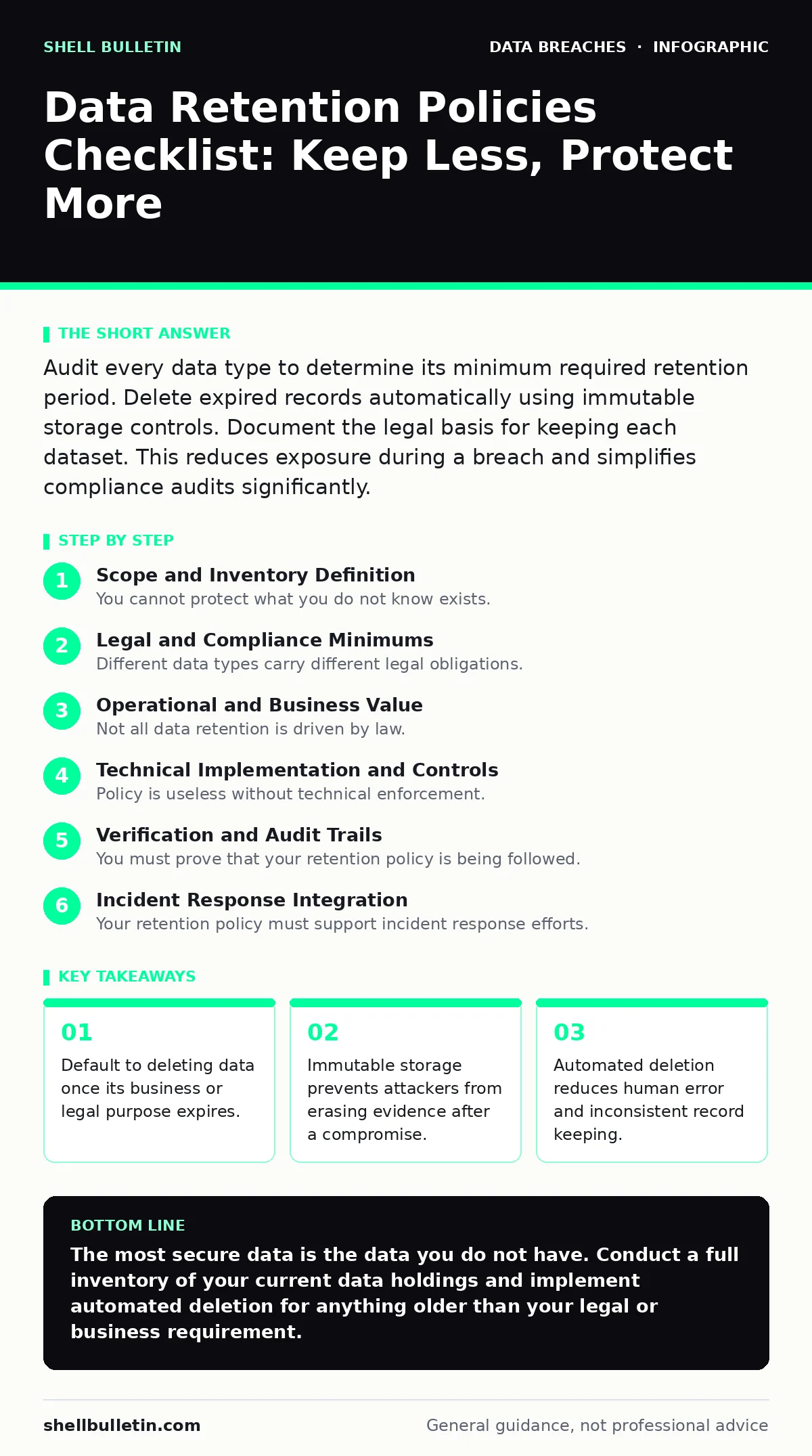
Audit every data type to determine its minimum required retention period. Delete expired records automatically using immutable storage controls. Document the legal basis for keeping each dataset. This reduces exposure during a breach and simplifies compliance audits significantly.
Scope and Inventory Definition
You cannot protect what you do not know exists. The first step in building a defensible retention policy is mapping every data asset your organization collects, processes, or stores. This includes customer records, employee files, system logs, and backup archives.
Many organizations treat data retention as an IT problem, but it is primarily a business and legal risk issue. Holding data indefinitely creates a persistent target for attackers. Every record you keep that is no longer needed is a liability waiting to be exploited.
- Catalog all data categories: Know exactly what types of information you hold, from transaction logs to support tickets.
- Identify data owners: Assign accountability for each dataset to a specific department or role.
- Map data flow: Trace how information moves from collection to storage to eventual deletion.
Legal and Compliance Minimums
Different data types carry different legal obligations. You must align your retention periods with the specific laws that govern your industry and jurisdiction. This often involves cross-referencing multiple frameworks to find the longest required retention period for a single dataset.
For example, financial records may require seven years of retention, while general marketing consent might only require data until the user withdraws permission. Ignoring these distinctions leads to either non-compliance or excessive data hoarding.
- Review PCI DSS requirements: Ensure payment card data is never stored beyond what is strictly necessary for transaction processing.
- Check HIPAA Security Rule obligations: If you handle health information, maintain records for six years from creation or last effective date.
- Consult local breach notification laws: Some jurisdictions require you to retain evidence of a breach for a specific period after discovery.
Operational and Business Value
Not all data retention is driven by law. Some data must be kept for operational continuity, audit trails, or business intelligence. However, the business case for keeping data must be explicit and documented. If you cannot articulate why the data is still useful, it should be deleted.
This approach forces a regular review of data utility. It prevents the "just in case" mentality that bloats storage costs and increases security complexity. You must balance the need for historical data against the risk of exposing it.
- Define business purpose: Document why each dataset is needed for daily operations or strategic planning.
- Set review cycles: Establish a schedule to reassess the value of archived data annually.
- Implement tiered storage: Move rarely accessed data to cheaper, more secure cold storage before deletion.
Technical Implementation and Controls
Policy is useless without technical enforcement. You need automated systems to enforce retention periods and prevent accidental or malicious extension of data lifespans. Manual deletion processes are prone to error and lack auditability.
Automated deletion scripts must be tested regularly to ensure they run correctly and do not delete active data prematurely. You should also implement immutable storage for critical logs to prevent tampering.
- Configure automated deletion: Use scripts or platform features to purge data automatically when retention periods expire.
- Enable immutable backups: Ensure that backup copies cannot be altered or deleted for a set period, protecting against ransomware.
- Log all deletion events: Keep a record of what was deleted, when, and by whom for audit purposes.
Verification and Audit Trails
You must prove that your retention policy is being followed. This requires regular audits and clear documentation of your processes. Auditors will look for evidence that you delete data on time and that your systems enforce these rules.
Without proper audit trails, you cannot demonstrate compliance or identify gaps in your retention strategy. This verification step is critical for maintaining trust with customers and regulators.
- Schedule annual audits: Review a sample of deleted records to confirm they were purged correctly.
- Document exceptions: Record any instances where data was retained beyond the standard period and the justification.
- Train staff on procedures: Ensure employees understand how to handle data requests and deletions.
See also: How Breach Notification Laws Work: A Step-by-Step Analysis · Breach Notification Best Practices for Compliance and Trust
Incident Response Integration
Your retention policy must support incident response efforts. If a breach occurs, you need access to historical logs and data to understand the scope of the attack. However, you should not keep this data longer than necessary for investigation.
This requires a clear protocol for preserving evidence while continuing to delete routine data. The tension between forensic needs and privacy obligations must be managed carefully.
- Define preservation triggers: Specify which events require immediate suspension of deletion for specific datasets.
- Isolate preserved data: Move forensic evidence to a secure, separate environment to prevent contamination.
- Review post-incident: After an investigation, delete preserved data if it is no longer needed for legal proceedings.
Key takeaways
- Default to deleting data once its business or legal purpose expires.
- Immutable storage prevents attackers from erasing evidence after a compromise.
- Automated deletion reduces human error and inconsistent record keeping.
The most secure data is the data you do not have. Conduct a full inventory of your current data holdings and implement automated deletion for anything older than your legal or business requirement.
Frequently asked questions
How long should I keep email archives?
Keep emails only as long as they contain legally required records or active business context. Delete routine correspondence once its purpose is served to reduce exposure.
Does deleting data affect my ability to recover from ransomware?
No, if you use immutable backups. These backups cannot be altered or deleted, allowing you to restore clean data even if your primary systems are compromised.
What if a customer requests their data be deleted?
You must comply with the request unless a legal hold applies. Document the deletion and ensure all copies, including backups, are purged or flagged for removal.
How do I handle data stored by third-party vendors?
Include data retention clauses in your contracts. Require vendors to provide proof of deletion and audit their retention practices regularly.
How this guide was produced: written by the Shell Bulletin editorial team with AI assistance, checked against the public references listed below, and reviewed when the facts change. See our editorial policy or report an error.