How the HIPAA Security Rule Works: Mechanics and Application
The HIPAA Security Rule defines required safeguards through addressable specifications, allowing organizations to implement equivalent controls if standard measures are technically infeasible.

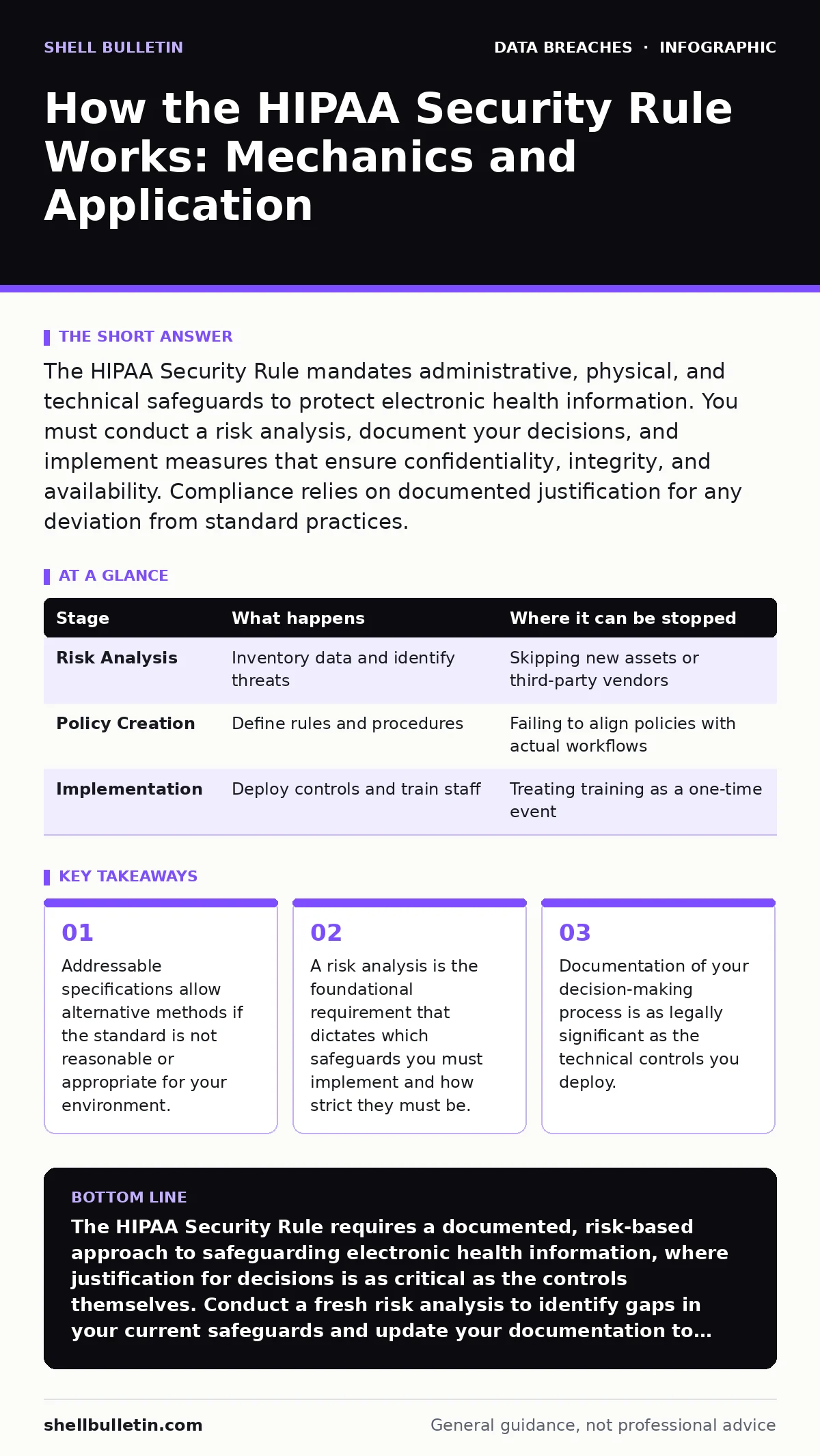
The HIPAA Security Rule mandates administrative, physical, and technical safeguards to protect electronic health information. You must conduct a risk analysis, document your decisions, and implement measures that ensure confidentiality, integrity, and availability. Compliance relies on documented justification for any deviation from standard practices.
The Structural Framework of Protection
The HIPAA Security Rule does not prescribe a single list of tools you must buy. Instead, it establishes a framework of safeguards designed to protect electronic protected health information. This data includes any individually identifiable health information held or transmitted by a covered entity or its business associate. The rule divides these safeguards into three distinct categories: administrative, physical, and technical. Each category addresses a different vector of risk, ensuring that protection is not limited to software alone.
Administrative safeguards manage the policies and procedures that govern access. Physical safeguards protect the actual hardware and facilities where data resides. Technical safeguards control the technology and access controls that regulate data flow. You must address all three areas to achieve compliance. Focusing solely on encryption, for instance, leaves your organization vulnerable to social engineering or physical theft of unencrypted devices.
Stage 1: Risk Analysis and Assessment
The first stage is identifying what you have and where it is vulnerable. You must conduct a thorough risk analysis to document all electronic protected health information in your environment. This involves mapping data flows from creation to destruction. You must identify potential threats and vulnerabilities that could impact the confidentiality, integrity, or availability of this data. This process connects directly to the CIA triad, a model that ensures data remains secret, accurate, and accessible when needed.
Many organizations treat this as a one-time checkbox. This is a critical error. Risk is dynamic. New software, new staff, and new threats change your risk profile constantly. Your analysis must reflect the current state of your operations. If you ignore changes in your environment, your safeguards may become obsolete before you even implement them. The goal is to understand your specific context, not to copy a generic template.
Stage 2: Policy Development and Implementation
Once you understand your risks, you must develop policies to mitigate them. These policies translate your risk findings into actionable rules. You must document these policies and ensure that all workforce members are trained on them. Training is not a single event but an ongoing process. Staff must understand their role in protecting data and how to report potential incidents.
You must also establish contingency plans. These plans ensure that you can recover data and resume operations after a disaster. This includes data backup plans and disaster recovery plans. Without these, a single hardware failure or ransomware event could result in permanent data loss. Your contingency plans must be tested regularly to ensure they work when needed.
| Stage | What happens | Where it can be stopped |
|---|---|---|
| Risk Analysis | Inventory data and identify threats | Skipping new assets or third-party vendors |
| Policy Creation | Define rules and procedures | Failing to align policies with actual workflows |
| Implementation | Deploy controls and train staff | Treating training as a one-time event |
Stage 3: Technical Safeguards Deployment
Technical safeguards involve the technology used to protect data and control access. Access control ensures that only authorized individuals can view or modify data. This includes unique user identification, emergency access procedures, and automatic logoff mechanisms. Audit controls record and examine activity in information systems. These logs are vital for detecting unauthorized access or system errors. You must maintain these logs for a period consistent with your log retention requirements and legal obligations.
Integrity controls prevent improper alteration or destruction of data. This includes mechanisms to verify that data has not been changed in transit or at rest. Transmission security protects data while it is being sent over electronic networks. Encryption is a common method for this, but it is not the only one. You must choose methods that are appropriate for your risk analysis. If encryption is not feasible, you must document why and implement alternative measures.
Stage 4: Physical and Administrative Controls
Physical safeguards protect your facilities and devices from natural and environmental hazards, as well as unauthorized intrusion. This includes facility access controls, workstation use policies, and device disposal procedures. When hardware reaches end-of-life, you must securely destroy the storage media. Simply deleting files is not enough. You must use methods that prevent data recovery, such as degaussing or physical destruction.
Administrative safeguards include security management processes, workforce security, and information access management. You must evaluate the security of your systems regularly. This evaluation should include both internal reviews and external audits. Business associates, such as cloud providers or billing companies, must also comply with these rules. You must have contracts in place that specify their security responsibilities. This extends your compliance obligations beyond your own four walls.
See also: Full Disk Encryption Myths: What You Get and What You Miss · Should You Pay for Identity Theft Protection? A Cost-Benefit Analysis
Stage 5: Monitoring and Continuous Improvement
Compliance is not a destination but a continuous process. You must monitor your systems for anomalies and potential threats. This involves reviewing audit logs, monitoring network traffic, and assessing user behavior. When you detect an issue, you must investigate and remediate it promptly. Documentation of these incidents is critical. It demonstrates that you are actively managing risk.
You must also review and update your policies regularly. Changes in technology, regulations, or business operations may require adjustments to your safeguards. If a standard specification is not reasonable or appropriate for your organization, you may implement an equivalent measure. This is known as an "addressable" requirement. You must document your decision-making process, including why the standard was not implemented and what alternative measure you chose.
Stage 6: Incident Response and Notification
Despite your best efforts, breaches can occur. You must have a plan to respond to incidents. This plan includes containment, eradication, recovery, and post-incident analysis. You must determine the scope and impact of the breach. If unsecured protected health information was compromised, you must notify affected individuals. The timing and content of these notifications are strictly regulated.
This process intersects with broader breach notification laws that may apply depending on your location and the type of data involved. You must also notify the Department of Health and Human Services and, in some cases, the media. Transparency is key to maintaining trust. Hiding a breach can lead to severe penalties and reputational damage. Your response plan should be tested regularly to ensure it is effective under pressure.
Navigating Related Compliance Frameworks
The HIPAA Security Rule does not exist in a vacuum. It often overlaps with other regulations. For instance, if you process payment card data, you must also comply with PCI DSS. This standard focuses on securing credit card transactions. While both frameworks aim to protect data, their specific requirements differ. You must map your controls to satisfy both sets of rules efficiently.
Similarly, you must manage personally identifiable information carefully. Not all PII is protected health information, but the overlap is significant. Misclassifying data can lead to inadequate protection or unnecessary overhead. You should also be aware of combo lists, which combine different datasets to create more detailed profiles. These lists can increase privacy risks even if the individual datasets are secure. Understanding these intersections helps you build a more resilient security posture.
Key takeaways
- Addressable specifications allow alternative methods if the standard is not reasonable or appropriate for your environment.
- A risk analysis is the foundational requirement that dictates which safeguards you must implement and how strict they must be.
- Documentation of your decision-making process is as legally significant as the technical controls you deploy.
The HIPAA Security Rule requires a documented, risk-based approach to safeguarding electronic health information, where justification for decisions is as critical as the controls themselves. Conduct a fresh risk analysis to identify gaps in your current safeguards and update your documentation to reflect your specific operational realities.
Frequently asked questions
Do I need to encrypt all my data to be HIPAA compliant?
Encryption is a standard safeguard but not strictly mandatory if you can document that an alternative measure is equally effective and appropriate for your risk profile.
How often must I perform a risk analysis?
You must perform risk analysis whenever there are significant changes to your environment, such as new technology, staff, or threats, and at least annually as a best practice.
What is the difference between a required and an addressable specification?
Required specifications must be implemented. Addressable specifications allow you to implement an equivalent alternative if the standard is not reasonable, provided you document your decision.
Who is responsible for HIPAA compliance in a small business?
The covered entity, which is the business itself, is responsible. However, this responsibility is shared with business associates and all workforce members who handle protected health information.
How this guide was produced: written by the Shell Bulletin editorial team with AI assistance, checked against the public references listed below, and reviewed when the facts change. See our editorial policy or report an error.