Should You Pay for Identity Theft Protection? A Cost-Benefit Analysis
Paid monitoring services detect data exposure after the fact and offer recovery assistance, but they cannot prevent the initial compromise of your personal information.

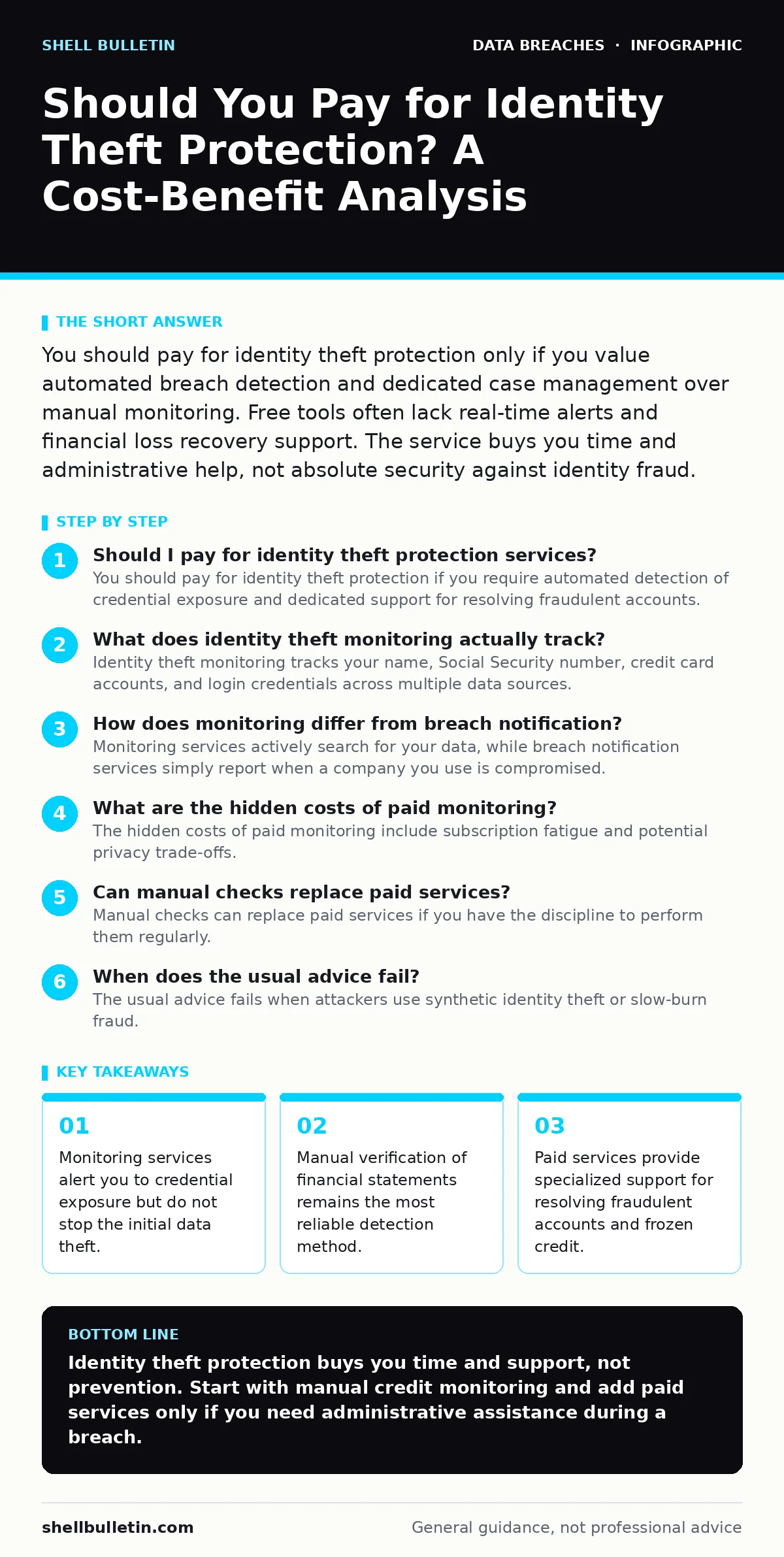
You should pay for identity theft protection only if you value automated breach detection and dedicated case management over manual monitoring. Free tools often lack real-time alerts and financial loss recovery support. The service buys you time and administrative help, not absolute security against identity fraud.
Should I pay for identity theft protection services?
You should pay for identity theft protection if you require automated detection of credential exposure and dedicated support for resolving fraudulent accounts. The primary value lies in the administrative burden reduction rather than active prevention. These services scan public records, credit bureaus, and dark web forums for your personal data. They cannot prevent hackers from stealing your information in the first place. The service acts as an early warning system, similar to a smoke detector that alerts you to a fire but does not extinguish it.
What does identity theft monitoring actually track?
Identity theft monitoring tracks your name, Social Security number, credit card accounts, and login credentials across multiple data sources. Most services check credit bureau reports for new inquiries or account openings. They also scan the dark web for leaked usernames and passwords. Some advanced plans monitor medical records or tax filing statuses. The coverage depends entirely on the specific data feeds the provider accesses. You must verify which sources are included, as gaps in coverage leave you vulnerable to specific types of fraud.
| Monitoring Type | Data Source | Detection Speed | False Positives |
|---|---|---|---|
| Credit Bureau | Equifax, Experian, TransUnion | Near real-time | Low |
| Dark Web Scanning | Public leaks, forums | Days to weeks | High |
| Public Records | Court filings, property | Weeks to months | Medium |
| Bank Account | Direct integration | Real-time | Very Low |
How does monitoring differ from breach notification?
Monitoring services actively search for your data, while breach notification services simply report when a company you use is compromised. A breach notification service tells you that a retailer you shop at was hacked. It does not confirm if your specific account was affected. Monitoring services cross-reference your personal details against known leaks to provide that confirmation. Understanding this difference prevents over-reliance on passive alerts. You need active verification to know if your specific credentials are exposed.
What are the hidden costs of paid monitoring?
The hidden costs of paid monitoring include subscription fatigue and potential privacy trade-offs. You pay for a service that may duplicate information you can check manually. Some providers require you to link financial accounts, granting them read-only access to your transaction history. This centralizes risk by creating another point of failure. If the monitoring provider suffers a security incident, your linked data could be exposed. You must weigh the convenience against the additional data surface area you create.
Can manual checks replace paid services?
Manual checks can replace paid services if you have the discipline to perform them regularly. You can check bank statements for unauthorized transactions every month. You can use password managers to detect reused credentials across sites. This approach costs nothing but requires significant time and attention. Most people fail to maintain this routine consistently, leading to delayed detection of fraud.
See also: Full Disk Encryption Myths: What You Get and What You Miss · PCI DSS Compliance Checklist for Secure Payment Data
When does the usual advice fail?
The usual advice fails when attackers use synthetic identity theft or slow-burn fraud. Synthetic identity theft combines real and fake information to create a new persona. Credit monitoring often misses this because no existing account is being compromised. Slow-burn fraud involves small, frequent transactions that stay under alert thresholds. These methods exploit the lag time between transaction and detection. Paid services with sophisticated behavioral analysis may catch these patterns faster than manual review.
How does this relate to data loss prevention?
Identity theft protection is a reactive measure, while data loss prevention is a proactive control. Data loss prevention stops sensitive information from leaving your organization or device. It prevents the initial theft that monitoring services later detect. For small businesses, implementing strong access controls and email encryption reduces the amount of personal data available for thieves. Reducing the data footprint makes identity theft protection less necessary for your customers and employees.
What steps should I take if fraud is detected?
Immediate action is required once identity theft is confirmed. You must place a fraud alert or credit freeze with the major credit bureaus. This stops new accounts from being opened in your name. You should report the fraud to the relevant financial institutions and file an identity theft report with law enforcement. Paid services often provide agents to handle these steps on your behalf. This support is the primary justification for the subscription cost during a crisis.
How do combo lists impact monitoring effectiveness?
Combo lists are compilations of usernames, passwords, and associated personal details sold on criminal markets. They are more dangerous than simple password lists because they include contextual data. Monitoring services that only check for password leaks miss the broader context of combo lists. Services that scan for full identity profiles are better equipped to detect this threat. You should prioritize providers that advertise deep scanning of personal records, not just credential leaks.
Is dark web monitoring sufficient for protection?
Dark web monitoring is insufficient for complete protection because it only covers data already exposed online. It does not detect fraud occurring in private systems or physical mail. Attackers often use stolen data immediately without posting it publicly. Relying solely on dark web scans creates a false sense of security. You need a layered approach that includes financial monitoring and personal record checks.
How does the CIA triad apply to personal data?
The CIA triad stands for Confidentiality, Integrity, and Availability. Identity theft protection primarily addresses Confidentiality by detecting unauthorized access. It does not ensure the Integrity of your data or its Availability for legitimate use. A comprehensive security strategy must address all three pillars. For personal data, this means using strong passwords for confidentiality, verifying document authenticity for integrity, and maintaining backups for availability.
Key takeaways
- Monitoring services alert you to credential exposure but do not stop the initial data theft.
- Manual verification of financial statements remains the most reliable detection method.
- Paid services provide specialized support for resolving fraudulent accounts and frozen credit.
Identity theft protection buys you time and support, not prevention. Start with manual credit monitoring and add paid services only if you need administrative assistance during a breach.
Frequently asked questions
Does identity theft insurance cover all losses?
No, policies have limits and exclusions. They typically cover direct financial losses and legal fees but may exclude indirect costs like lost wages or emotional distress.
Can I get identity theft protection for free?
Yes, many credit card companies and banks offer free monitoring to premium account holders. Check with your financial institution before purchasing a separate subscription.
How quickly do monitoring services detect fraud?
Detection times vary from real-time for bank transactions to weeks for dark web data. Credit bureau updates usually take 24 to 48 hours to reflect in monitoring dashboards.
Do I need identity theft protection for my business?
Businesses should focus on data loss prevention and access controls. Identity theft protection is primarily for individuals. Consider cyber liability insurance for business-specific risks.
How this guide was produced: written by the Shell Bulletin editorial team with AI assistance, checked against the public references listed below, and reviewed when the facts change. See our editorial policy or report an error.