Combo Lists: How Recycled Credentials Threaten Small Business Data
Recycled login details from old breaches allow attackers to bypass modern security layers without needing new hacking tools or complex exploits.

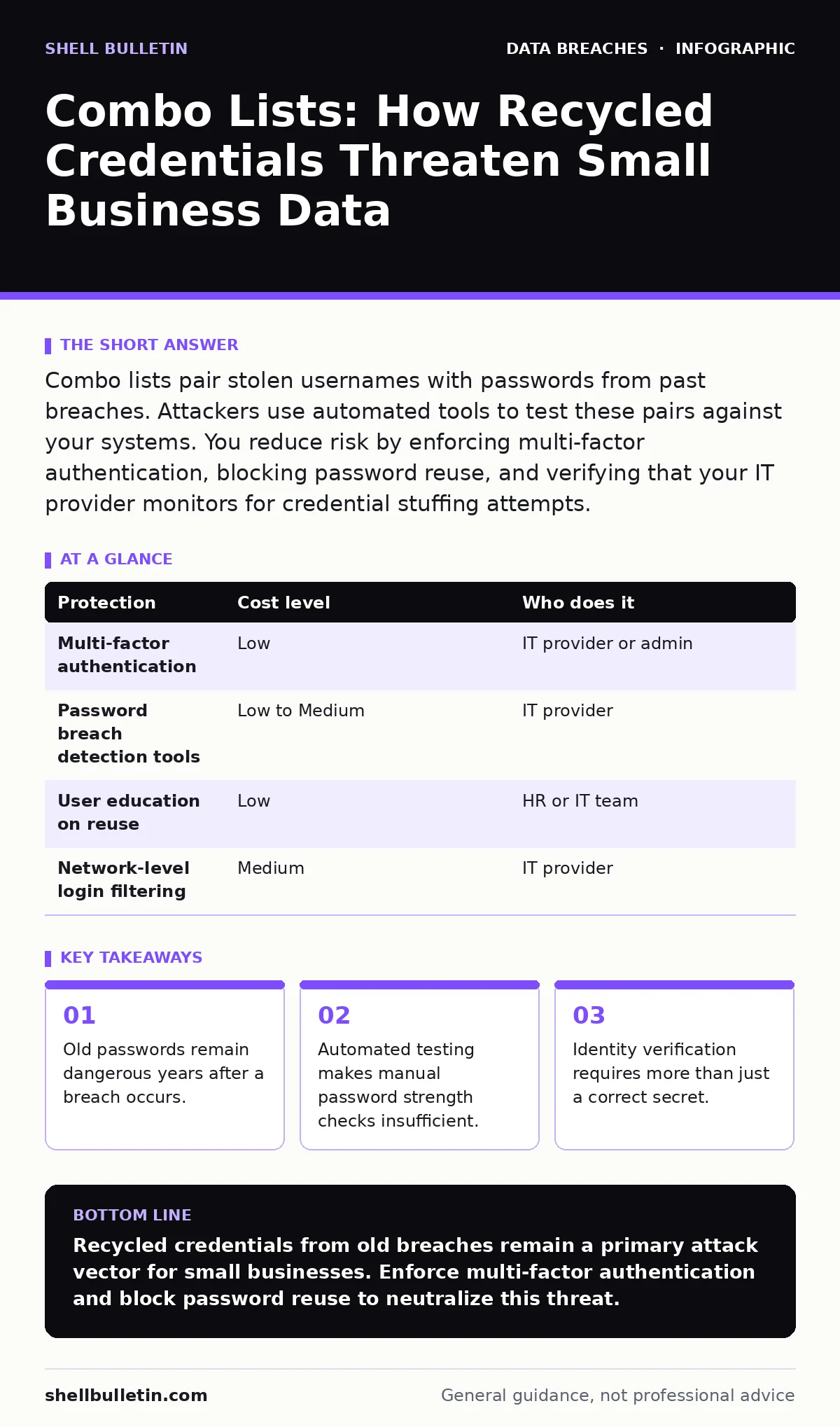
Combo lists pair stolen usernames with passwords from past breaches. Attackers use automated tools to test these pairs against your systems. You reduce risk by enforcing multi-factor authentication, blocking password reuse, and verifying that your IT provider monitors for credential stuffing attempts.
The Mechanics of Credential Recycling
A combo list is a database containing pairs of usernames and passwords. These pairs originate from previous data breaches on various platforms. Attackers compile these lists because human behavior rarely changes. You likely reuse passwords across different services. This habit creates a pattern that automated scripts can exploit.
The attack method is called credential stuffing. It differs from brute force attacks. Brute force tries every possible combination of characters. Credential stuffing uses known, valid pairs. The attacker does not need to guess your password. They simply test a list of passwords that you have already proven works elsewhere. This makes the attack faster and harder to detect through simple lockout policies.
Your organization is exposed not because your software is weak, but because your identity is linked to other failures. If you used your work email for a personal shopping account, and that store was breached, your work credentials are now in a combo list. The risk transfers from the compromised site to your business infrastructure.
Why Small Organizations Face Disproportionate Risk
Small organizations often lack dedicated security operations centers. This gap creates a specific vulnerability. Large enterprises deploy identity and access management platforms that detect unusual login patterns. They block logins from foreign countries or multiple failed attempts rapidly. Smaller teams often rely on basic authentication checks.
Attackers target small businesses because the defense is often thinner. They know you may not monitor logs in real time. They know you may not enforce strict password rotation policies. Furthermore, small businesses often hold valuable data, such as personally identifiable information or financial records. This data can be sold or used for further attacks. The return on investment for an attacker is high when the effort required is low.
Suppose your IT team checks for viruses but ignores login anomalies. The combo list attack bypasses traditional antivirus software entirely. It uses legitimate credentials. The system sees a valid user logging in. No malware is installed. No firewall is breached. The attacker walks in through the front door, holding a valid key.
The Hidden Cost of Password Reuse
Many users believe that changing passwords regularly provides safety. This belief is often incorrect if the new password is similar to the old one. Or, if the new password was used on another site that was breached in the meantime. This is a non-obvious consequence of human memory limitations. You cannot remember unique, complex strings for every service.
Combo lists grow continuously. A breach from five years ago adds thousands of credentials to the pool. These credentials do not expire. As long as you reuse that combination, it remains valid. The age of the breach is irrelevant to the attacker. The validity of the pair is what matters. This means your current password strength is only as good as the weakest site where you have used it.
Another hidden cost is the erosion of trust. When attackers gain access, they often move laterally. They access shared drives, email archives, and customer databases. The damage extends beyond the initial account. You face operational disruption, legal exposure, and reputational harm. The cost of remediation far exceeds the cost of preventive controls.
Low-Cost Protections That Actually Work
You do not need expensive security suites to mitigate this risk. The most effective control is multi-factor authentication. This requires a second form of verification, such as a code from an app or a hardware key. Even if the attacker has your password from a combo list, they cannot log in without the second factor. This breaks the chain of the credential stuffing attack.
| Protection | Cost level | Who does it |
|---|---|---|
| Multi-factor authentication | Low | IT provider or admin |
| Password breach detection tools | Low to Medium | IT provider |
| User education on reuse | Low | HR or IT team |
| Network-level login filtering | Medium | IT provider |
Another effective measure is blocking known breached passwords. Some email and identity platforms allow you to reject passwords that appear in public breach databases. This prevents users from setting a password that is already in a combo list. You enforce this at the point of creation. It stops the problem before it starts.
Limiting login attempts is also useful. However, be careful. If you lock accounts after three failed tries, you create a denial-of-service risk. Attackers can intentionally trigger lockouts to prevent legitimate staff from working. Balance security with availability. Use CAPTCHAs or temporary delays instead of immediate permanent locks.
What to Ask Your IT Provider
Your IT provider plays a central role in defense. You must verify they are actively managing identity risks. Do not assume they are. Many providers focus on infrastructure health, not identity security. Ask specific questions to ensure they are covering this gap.
- Do you monitor for credential stuffing attempts in real time?
- Can you detect logins from unusual geographic locations or devices?
- Do you enforce multi-factor authentication for all administrative accounts?
- How do you handle password reset requests to prevent social engineering?
You should also ask about their incident response plan for identity compromises. If an attacker gains access via a combo list, how quickly will they know? Who notifies you? What is the containment procedure? Ensure they test this plan regularly. A written plan is useless if the team has never practiced it.
Consider the intersection of identity security and data retention policies. If attackers access old emails, they may find expired credentials or sensitive data. Ensure your provider helps you archive or delete unnecessary historical data. This reduces the value of the account if it is compromised.
See also: Security Culture: How Small Teams Build Lasting Defenses · Command and Control Traffic: Risks and Protection for Small Businesses
Integrating Broader Security Frameworks
Identity security does not exist in isolation. It connects to broader compliance and security frameworks. For example, PCI DSS requires strong access controls for systems that handle payment data. If your combo list exposure affects these systems, you fail compliance. Similarly, HIPAA Security Rule mandates strict access controls for health data. Credential stuffing is a direct violation of these requirements if it leads to unauthorized access.
You should also review your breach notification laws obligations. If a combo list attack leads to data exposure, you may be required to notify affected parties. Knowing your legal timeline helps you prepare. Do not wait for an incident to understand your duties. Review these regulations annually.
Log retention is another critical piece. You need to keep logs of login attempts long enough to investigate incidents. If your logs are deleted after 30 days, you may lose evidence of a slow-moving attack. Ensure your provider retains logs for a period that matches your legal and operational needs. This supports forensic analysis after a breach.
Building a Resilient Identity Posture
The goal is to make your credentials useless to attackers. This means treating every password as potentially compromised. Assume your credentials are in a combo list. Design your defenses around this assumption. Use multi-factor authentication everywhere. Block reused passwords. Monitor for anomalies.
You must also educate your staff. They are the first line of defense. Teach them to recognize phishing attempts that try to harvest credentials. Explain why password reuse is dangerous. Make identity security a regular topic in training. This cultural shift reduces the risk significantly.
Review your defenses regularly. Technology changes. Attack methods evolve. What worked yesterday may fail today. Stay informed about new threats. Consult your IT provider for updates. Keep your security posture adaptive and proactive.
Key takeaways
- Old passwords remain dangerous years after a breach occurs.
- Automated testing makes manual password strength checks insufficient.
- Identity verification requires more than just a correct secret.
Recycled credentials from old breaches remain a primary attack vector for small businesses. Enforce multi-factor authentication and block password reuse to neutralize this threat.
Frequently asked questions
How do attackers obtain combo lists?
Attackers buy or steal these lists from the dark web. They originate from previous data breaches on various websites. The data is compiled and sold to other malicious actors.
Can multi-factor authentication be bypassed?
Yes, through methods like SIM swapping or social engineering. However, it significantly increases the difficulty for automated attacks. It stops the majority of credential stuffing attempts.
Is password rotation enough to stop combo list attacks?
No, if you reuse passwords. Rotating a password that is already in a breach database does not help. You must use new, unique passwords that have not been exposed.
How often should I review my identity security?
Review controls quarterly or after any significant change. Ensure multi-factor authentication is enabled and monitoring is active. Adjust policies based on new threats or organizational changes.
How this guide was produced: written by the Shell Bulletin editorial team with AI assistance, checked against the public references listed below, and reviewed when the facts change. See our editorial policy or report an error.