Security Culture: How Small Teams Build Lasting Defenses
Technical controls fail when staff ignore them; culture turns employees into active defenders who spot threats before breaches occur.

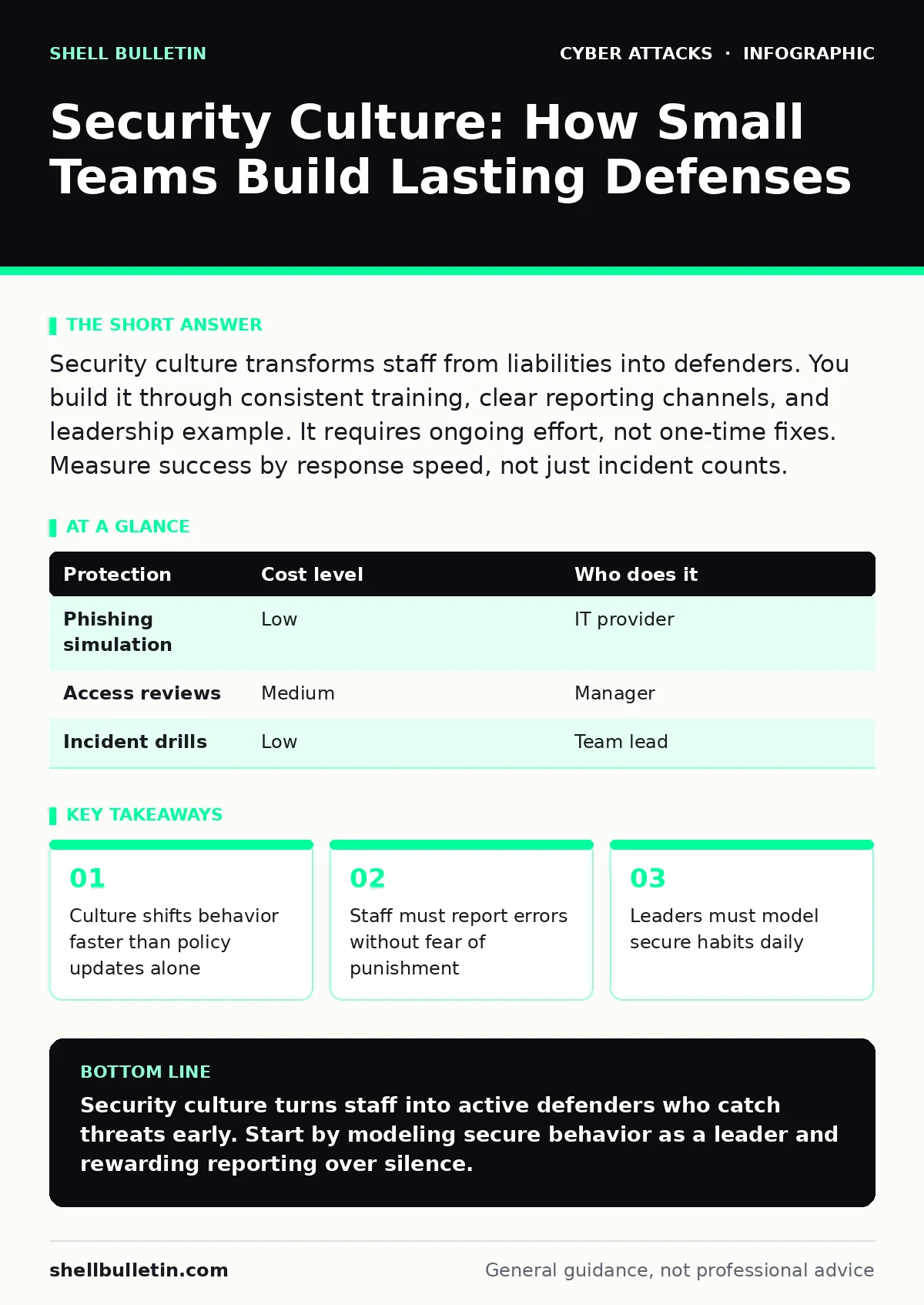
Security culture transforms staff from liabilities into defenders. You build it through consistent training, clear reporting channels, and leadership example. It requires ongoing effort, not one-time fixes. Measure success by response speed, not just incident counts.
Why Culture Outperforms Technology
Technical tools enforce boundaries, but people decide whether to respect them. A firewall blocks unauthorized network traffic, but it cannot stop an employee from writing a password on a sticky note. Security culture defines the shared values and behaviors that determine how staff handle sensitive information. One mistake can expose the entire organization.
Imagine a team where everyone assumes security is the IT provider’s job. When a suspicious email arrives, the recipient ignores it because "the system should block it." The system fails, and the breach occurs. Culture changes this dynamic by making every team member responsible for their own digital hygiene. It creates a safety net that catches errors technology misses.
Security culture reduces the window of exposure. When staff recognize phishing attempts early, they report them before malware executes. This early detection limits damage significantly more than retrospective scans. You build this mindset by reinforcing positive actions, not just punishing mistakes. The goal is proactive vigilance, not reactive compliance.
Building Habits That Last
Habits form through repetition and clear feedback. You must integrate security into daily workflows rather than treating it as an external chore. Start with simple, high-impact actions like verifying sender addresses before opening attachments. Consistency matters more than complexity. A simple rule followed daily beats a complex policy ignored weekly.
Training must be specific to your industry and tools. Generic advice about strong passwords often fails because it does not address how staff actually work. Instead, teach them how to spot OAuth consent phishing attempts that mimic their actual software vendors. Show them real examples of emails that look legitimate but contain malicious links. Contextual learning sticks better than abstract warnings.
Reward good behavior publicly. When an employee reports a suspicious message, acknowledge it in team meetings. This reinforces the value of reporting and encourages others to follow suit. Negative reinforcement, such as blaming staff for clicks, drives errors underground. You want staff to admit mistakes quickly so you can contain them. Silence is far more dangerous than a single error.
| Protection | Cost level | Who does it |
|---|---|---|
| Phishing simulation | Low | IT provider |
| Access reviews | Medium | Manager |
| Incident drills | Low | Team lead |
The Hidden Cost of Blame
Blame culture suppresses reporting. When staff fear punishment for clicking a bad link, they hide the evidence. This delay allows attackers to move laterally through your network. You lose visibility into the attack’s scope and duration. The result is often a larger breach than if the error had been reported immediately.
Imagine an accountant who receives a fake invoice request. They realize it is suspicious but worry about looking incompetent. They delete the email without reporting it. The attacker tries again with a different tactic, eventually succeeding. The silence protected the employee’s ego but exposed the company to financial loss.
You must decouple error from intent. Most security incidents stem from confusion, not malice. Staff may misread a similar-looking domain or trust a familiar contact name. Create a "no-blame" reporting channel where mistakes are treated as learning opportunities. Analyze the root cause of the error and adjust training or tools accordingly. This approach builds trust and improves overall resilience.
Leadership Sets the Standard
Culture flows from the top. If leaders bypass security protocols for convenience, staff will do the same. You cannot demand secure behavior while modeling careless habits. Leaders must use multi-factor authentication, lock their screens, and report their own errors. This visible commitment signals that security is a core value, not a bureaucratic hurdle.
Suppose a manager shares their password with an assistant to access a shared drive. This action undermines every policy about credential protection. Staff observe this behavior and conclude that rules are flexible for those in power. The perception of unfairness erodes compliance across the entire team. Consistency in application is non-negotiable.
Leadership also involves resource allocation. You must invest time and budget into security training and tools. Cutting these costs to save money signals that security is optional. Staff pick up on these priorities. If you do not invest in protection, they will not invest effort in following rules. Align your spending with your stated values to maintain credibility.
Measuring What Actually Matters
Most metrics focus on negative outcomes, such as the number of breaches. This approach is too late to be useful. Instead, measure leading indicators that predict future performance. Track the time it takes for staff to report suspicious emails. These metrics show engagement and readiness.
You should also measure the effectiveness of your controls. Do phishing simulations result in fewer clicks over time? Are access reviews completing without delays? These data points reveal whether your culture is improving. If metrics stagnate, adjust your approach. Change the training content, simplify the reporting process, or increase leadership visibility.
Avoid vanity metrics like the number of policies written. Policies only matter if they are understood and followed. Focus on behavior change. A smaller team with high engagement is more secure than a larger team with low compliance. Quality of interaction beats quantity of documentation every time.
See also: Command and Control Traffic: Risks and Protection for Small Businesses · How Malware Payloads Operate: A Step-by-Step Breakdown
What to Ask Your IT Provider
Your IT provider plays a key role in shaping culture. They should offer more than technical fixes. They must help you build human defenses. Ask specific questions to evaluate their support for cultural initiatives. Do they provide regular phishing simulations? Do they offer training tailored to your industry? Can they help you analyze reporting trends?
- Do you provide quarterly phishing simulations with detailed feedback?
- Can you help us create a no-blame incident reporting process?
- Do you review our access controls to ensure least privilege?
- How do you measure the effectiveness of your security training?
- Can you explain how our current setup prevents account takeover?
Your provider should act as a partner, not just a vendor. They must understand your business processes and tailor their advice accordingly. If they only talk about technology, they are missing half the battle. Culture requires human insight. Ensure your provider has experience in behavioral security, not just network configuration.
Integrating Culture Into Daily Work
Security must become invisible in its execution. Staff should not have to think about security every time they act. Integrate controls into existing workflows. Use single sign-on to reduce password fatigue. Enable automatic updates to prevent software vulnerabilities. These technical choices support cultural goals by reducing friction.
Imagine a workflow where every file share requires a quick verification step. This step becomes routine, like checking a seatbelt. Staff do not resist it because it is fast and consistent. The behavior becomes automatic. You achieve security without constant reminders. This integration is the hallmark of a mature culture.
Review your processes regularly. Identify steps that cause friction or confusion. Simplify them where possible. Complex procedures lead to shortcuts. Shortcuts lead to breaches. Keep it simple, keep it consistent, and keep it visible. Culture is built one small action at a time.
Key takeaways
- Culture shifts behavior faster than policy updates alone
- Staff must report errors without fear of punishment
- Leaders must model secure habits daily
Security culture turns staff into active defenders who catch threats early. Start by modeling secure behavior as a leader and rewarding reporting over silence.
Frequently asked questions
How long does it take to build a security culture?
Culture shifts over months, not days. Expect three to six months of consistent effort before seeing significant behavior change.
Can remote teams build strong security culture?
Yes, remote teams can build strong culture through virtual training, clear communication, and regular check-ins. Consistency matters more than location.
What if staff resist security training?
Resistance often stems from complexity or fear. Simplify training, focus on relevance, and remove blame. Show how security helps them do their jobs better.
How do I handle a staff member who repeatedly violates policy?
Address the root cause. Is it confusion, lack of training, or intentional disregard? Adjust support or enforce consequences based on intent and pattern.
How this guide was produced: written by the Shell Bulletin editorial team with AI assistance, checked against the public references listed below, and reviewed when the facts change. See our editorial policy or report an error.