Account Takeover: How Attackers Bypass Login Security
Most account takeover attacks succeed because they exploit trust in familiar interfaces rather than breaking encryption or guessing passwords.
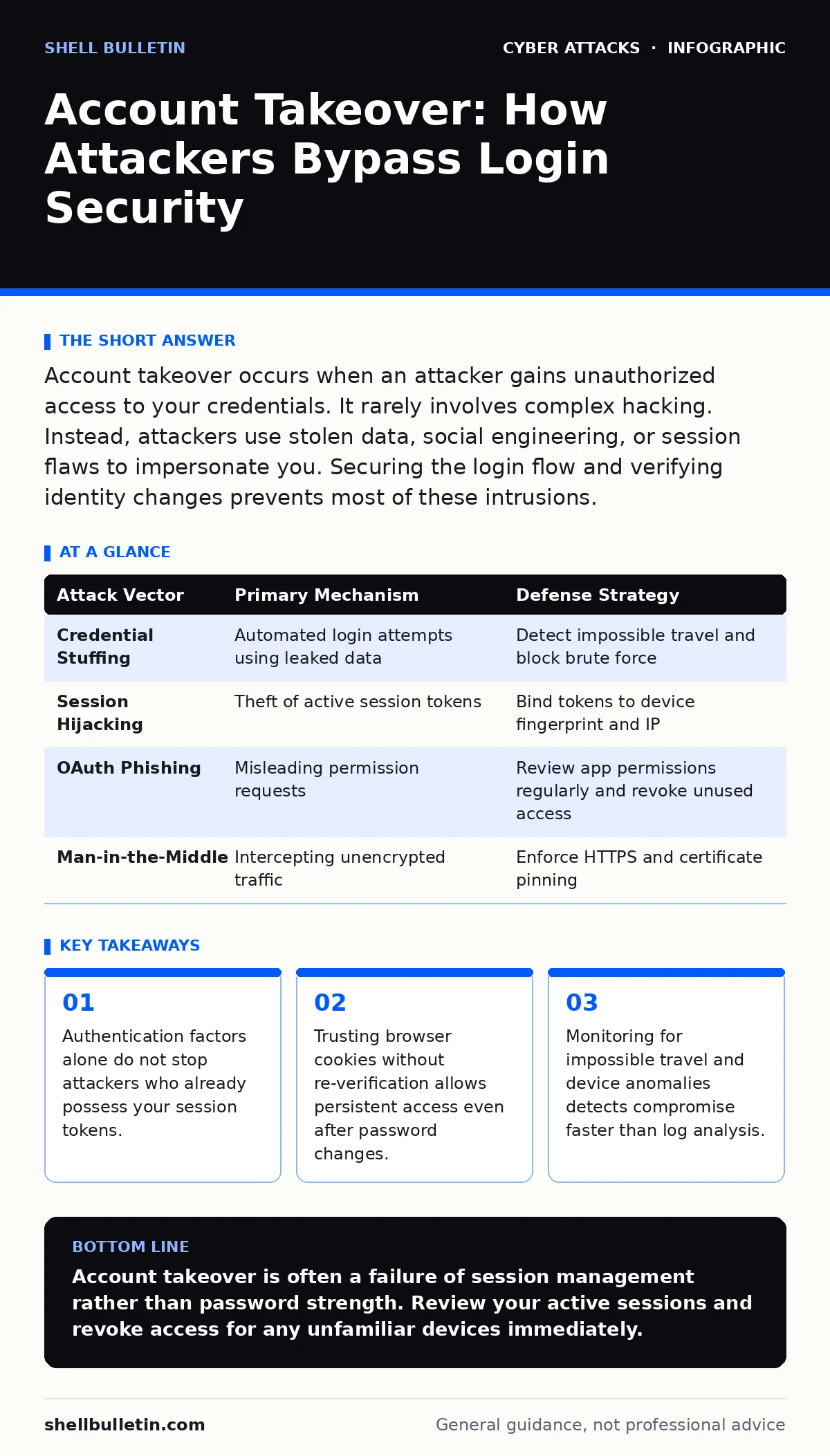
Account takeover occurs when an attacker gains unauthorized access to your credentials. It rarely involves complex hacking. Instead, attackers use stolen data, social engineering, or session flaws to impersonate you. Securing the login flow and verifying identity changes prevents most of these intrusions.
What exactly is account takeover?
Account takeover happens when an attacker assumes control of a user’s digital identity. The attacker does not need to break into your server. They simply need to convince the system that they are you. This allows them to read private data, make purchases, or pivot to other systems.
How do attackers get my credentials in the first place?
Attackers rarely guess passwords correctly. They buy them from underground markets where data breaches are aggregated. If you reuse a password across multiple sites, a breach on one platform exposes all your other accounts. This is why unique credentials matter more than complexity.
Why did changing my password fail to stop the attacker?
Changing your password only invalidates new login attempts. It does not automatically terminate existing sessions if the system relies on session tokens. The attacker’s browser still holds a valid ticket to access your account. You must force a global logout or revoke active sessions to stop this.
How does session hijacking work?
Session hijacking occurs when an attacker steals the temporary token that proves you are logged in. This token often lives in your browser’s memory or cookies. If an attacker captures this token, the server treats their requests as yours. Network sniffing or malicious scripts can steal these tokens without ever knowing your password.
What is cross-site scripting and why does it matter?
Cross-site scripting, or XSS, allows an attacker to inject malicious code into a trusted website. When you visit the compromised page, your browser executes that code. This script can steal your session cookie and send it to the attacker. This bypasses password protection entirely because the browser already trusts the site.
Why are two-factor codes sometimes not enough?
Two-factor authentication adds a layer of security, but it is not foolproof. Attackers can use real-time phishing kits to intercept the one-time code as you type it. They forward your credentials and the code to the legitimate site in seconds. You are authenticated, but the attacker is logging in simultaneously behind you.
How does OAuth consent phishing steal access?
OAuth consent phishing tricks you into granting a malicious app permission to access your account. You see a legitimate login screen, but the request is for excessive permissions. Once granted, the attacker can read your data without needing your password again. This method bypasses multi-factor authentication because the system trusts the authorized app.
| Attack Vector | Primary Mechanism | Defense Strategy |
|---|---|---|
| Credential Stuffing | Automated login attempts using leaked data | Detect impossible travel and block brute force |
| Session Hijacking | Theft of active session tokens | Bind tokens to device fingerprint and IP |
| OAuth Phishing | Misleading permission requests | Review app permissions regularly and revoke unused access |
| Man-in-the-Middle | Intercepting unencrypted traffic | Enforce HTTPS and certificate pinning |
What is the hidden cost of not using network segmentation?
If an attacker takes over a single account, they may try to move laterally to other systems. Without network segmentation, that single compromised account can access sensitive internal resources. Segmentation limits the damage by isolating critical assets from general user access. This prevents a simple login breach from becoming a full network compromise.
How do I detect a takeover in progress?
Look for anomalies in user behavior patterns. An account that suddenly downloads large volumes of data is suspicious. Logins from multiple geographic locations within minutes are impossible for a single user. These signals indicate automation or remote access tools. Your security systems should flag these deviations automatically.
What is the most effective way to lock out an attacker?
Force a global logout for all devices. This invalidates every active session token tied to your account. Then, reset your credentials and enable hardware-based two-factor authentication. Software apps are more secure than SMS codes because they cannot be intercepted via SIM swapping. This combination removes the attacker’s current access and raises the barrier for future entry.
Why does cyber hygiene fail to prevent advanced takeovers?
Standard cyber hygiene focuses on password strength and updates. It often ignores the context of the login. An attacker using stolen credentials and a familiar device looks like a legitimate user. You must verify the context, not just the credentials. This requires behavioral analysis and continuous monitoring rather than one-time checks.
How does DNS hijacking facilitate account takeover?
DNS hijacking redirects your browser to a fake website that looks identical to the real one. You enter your credentials on the fake site, thinking you are safe. The attacker captures this data in real time. This method works because your browser trusts the domain name, not the underlying IP address. Validating DNS records prevents this redirection.
Key takeaways
- Authentication factors alone do not stop attackers who already possess your session tokens.
- Trusting browser cookies without re-verification allows persistent access even after password changes.
- Monitoring for impossible travel and device anomalies detects compromise faster than log analysis.
Account takeover is often a failure of session management rather than password strength. Review your active sessions and revoke access for any unfamiliar devices immediately.
Frequently asked questions
Can a virus steal my login session?
Yes, malware can record keystrokes or scrape browser cookies to steal active session tokens without knowing your password.
Is biometric authentication safer than passwords?
Biometrics are harder to steal remotely, but you cannot revoke a fingerprint if it is compromised, unlike a password.
What is SIM swapping and how does it affect accounts?
SIM swapping tricks your carrier into transferring your phone number to the attacker, allowing them
How this guide was produced: written by the Shell Bulletin editorial team with AI assistance, checked against the public references listed below, and reviewed when the facts change. See our editorial policy or report an error.