PCI DSS Compliance Checklist for Secure Payment Data
Compliance requires mapping data flows before configuring controls, a step often skipped until audits fail during the discovery phase.

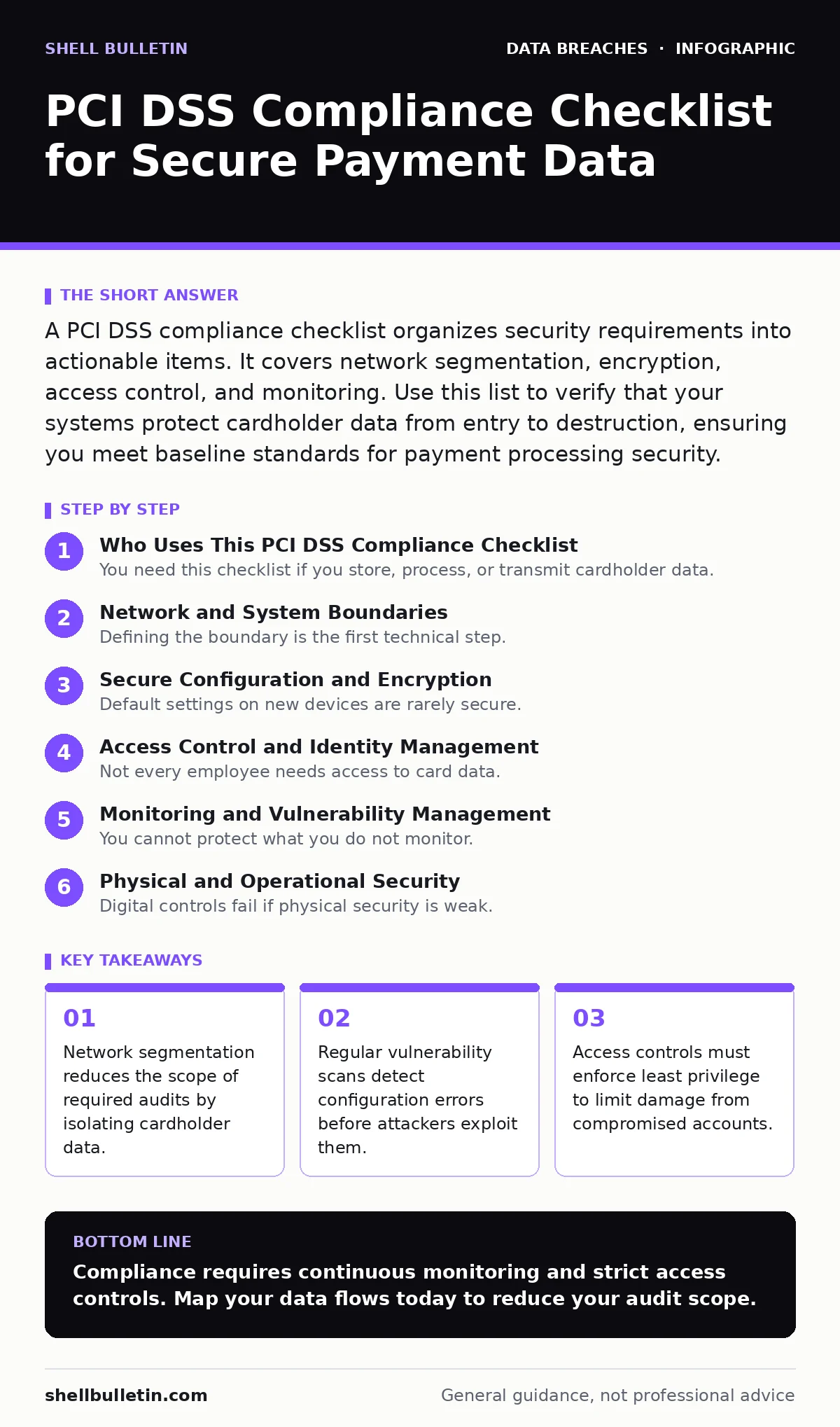
A PCI DSS compliance checklist organizes security requirements into actionable items. It covers network segmentation, encryption, access control, and monitoring. Use this list to verify that your systems protect cardholder data from entry to destruction, ensuring you meet baseline standards for payment processing security.
Who Uses This PCI DSS Compliance Checklist
You need this checklist if you store, process, or transmit cardholder data. It applies to merchants and service providers regardless of size. The checklist helps you verify that your security posture meets the standard. Use it to audit your current environment. Check each box only when you have evidence of implementation. Do not assume compliance based on vendor claims alone. You must validate that controls are active and effective.
Network and System Boundaries
Defining the boundary is the first technical step. You must isolate systems that handle card data from the rest of your network. This reduces the number of systems you must audit.
- Document all network segments: Clear boundaries prevent scope creep and reduce audit effort.
- Implement firewall rules between segments: Firewalls restrict traffic to only what is necessary for business operations.
- Disable wireless access in sensitive areas: Uncontrolled wireless networks provide easy entry points for attackers.
- Review firewall configuration quarterly: Rules drift over time, allowing unintended access to protected zones.
Segmentation is not just a physical separation. It requires logical controls. If a user can move laterally from a public web server to a database holding card numbers, your segmentation has failed. This failure expands your audit scope to the entire network.
Secure Configuration and Encryption
Default settings on new devices are rarely secure. You must change them immediately. Encryption protects data at rest and in transit. Without encryption, stolen data is immediately usable by criminals.
- Change default passwords on all devices: Default credentials are known to attackers and enable instant access.
- Encrypt cardholder data at rest: Encryption renders stolen data unreadable without the decryption keys.
- Use strong encryption for data in transit: Secure protocols prevent interception of data moving across networks.
- Disable unnecessary services and ports: Each open port is a potential entry point for malware.
Imagine a server with a default admin password. An attacker scans the internet for these defaults. They find your server. They install a keylogger. Now every card number entered is stolen. Changing defaults stops this chain. Refer to your full disk encryption policy to ensure drives are protected even if physically stolen.
Access Control and Identity Management
Not every employee needs access to card data. Least privilege means users get only the access they need. This limits the impact of a compromised account.
- Assign unique IDs to each user: Shared accounts make it impossible to trace actions to specific individuals.
- Restrict access to card data by business need: Limiting access reduces the number of accounts attackers can target.
- Require multi-factor authentication for remote access: MFA prevents access even if passwords are stolen.
- Review access rights quarterly: Employees change roles; old access rights often remain active and dangerous.
A common mistake is granting admin rights to all IT staff. If one admin account is compromised, the attacker controls the whole system. Use role-based access control. Check for password leaks regularly to see if your credentials appear in public breaches.
Monitoring and Vulnerability Management
You cannot protect what you do not monitor. Logs provide evidence of attacks. Vulnerability management ensures known flaws are fixed.
- Log all access to cardholder data: Logs create an audit trail for forensic analysis and detection.
- Monitor firewall and router logs: Network logs reveal scanning and intrusion attempts before data is stolen.
- Run internal vulnerability scans quarterly: Scans identify unpatched systems and misconfigurations before attackers do.
- Test external security controls quarterly: External tests verify that perimeter defenses work against outside threats.
Logs are only useful if you review them. Many organizations collect logs but never analyze them. This is like recording a security camera but never watching the footage. Ensure your log retention policy keeps records long enough for investigations. Also, consider dark web monitoring to detect if your credentials are being sold.
See also: Fix CIA Triad Misconceptions to Strengthen Your Security Posture · Dark Web Monitoring: 8 Real Questions Answered for Security
Physical and Operational Security
Digital controls fail if physical security is weak. Attackers can plug devices directly into network ports. They can steal hardware containing data.
- Restrict physical access to data centers: Physical access allows attackers to bypass digital controls entirely.
- Log visitors and remove credentials on exit: Temporary access is often left active, creating long-term vulnerabilities.
- Secure hardware disposal: Destroying drives prevents data recovery from discarded equipment.
- Implement data loss prevention tools: DLP tools detect and block unauthorized data transfers.
Suppose an employee leaves a laptop in a parking lot. If the drive is not encrypted, the thief reads the data. If the drive is encrypted, the data is safe. Physical security and encryption work together. Also, email encryption protects sensitive information sent externally.
Policy and Maintenance
Security is not a one-time project. It requires ongoing maintenance. Policies define expectations. Reviews ensure they are followed.
- Publish and maintain security policies: Policies provide a standard for employee behavior and system configuration.
- Train employees on security awareness: Humans are often the weakest link in the security chain.
- Review policies annually: Threats change; policies must evolve to address new risks.
- Conduct incident response tests: Drills ensure your team knows how to react to a breach.
A policy that sits on a shelf is useless. Employees must understand the CIA triad principles: confidentiality, integrity, and availability. If they do not know why they should report suspicious activity, they will not. Test your incident response plan regularly. Check for combo lists of usernames and passwords to ensure your users are not reusing credentials.
Key takeaways
- Network segmentation reduces the scope of required audits by isolating cardholder data.
- Regular vulnerability scans detect configuration errors before attackers exploit them.
- Access controls must enforce least privilege to limit damage from compromised accounts.
Compliance requires continuous monitoring and strict access controls. Map your data flows today to reduce your audit scope.
Frequently asked questions
How often must I scan for vulnerabilities?
You must perform internal and external vulnerability scans at least quarterly. These scans detect misconfigurations and unpatched software before attackers exploit them.
Does using a payment gateway remove my responsibility?
No. While a gateway reduces the amount of data you handle, you remain responsible for securing your network and ensuring proper segmentation.
What happens if I miss a checklist item?
Missing an item can lead to non-compliance. This may result in fines, loss of processing privileges, or liability for stolen data.
How do I prove I am compliant?
You need documented evidence. Keep logs, scan reports, policy acknowledgments, and configuration records to demonstrate adherence to the standard.
How this guide was produced: written by the Shell Bulletin editorial team with AI assistance, checked against the public references listed below, and reviewed when the facts change. See our editorial policy or report an error.