PCI DSS Misconceptions: Six Ways Businesses Misread Compliance Rules
Compliance is a structural audit of controls, not a guarantee of security, and scoping determines your actual workload more than your revenue does.

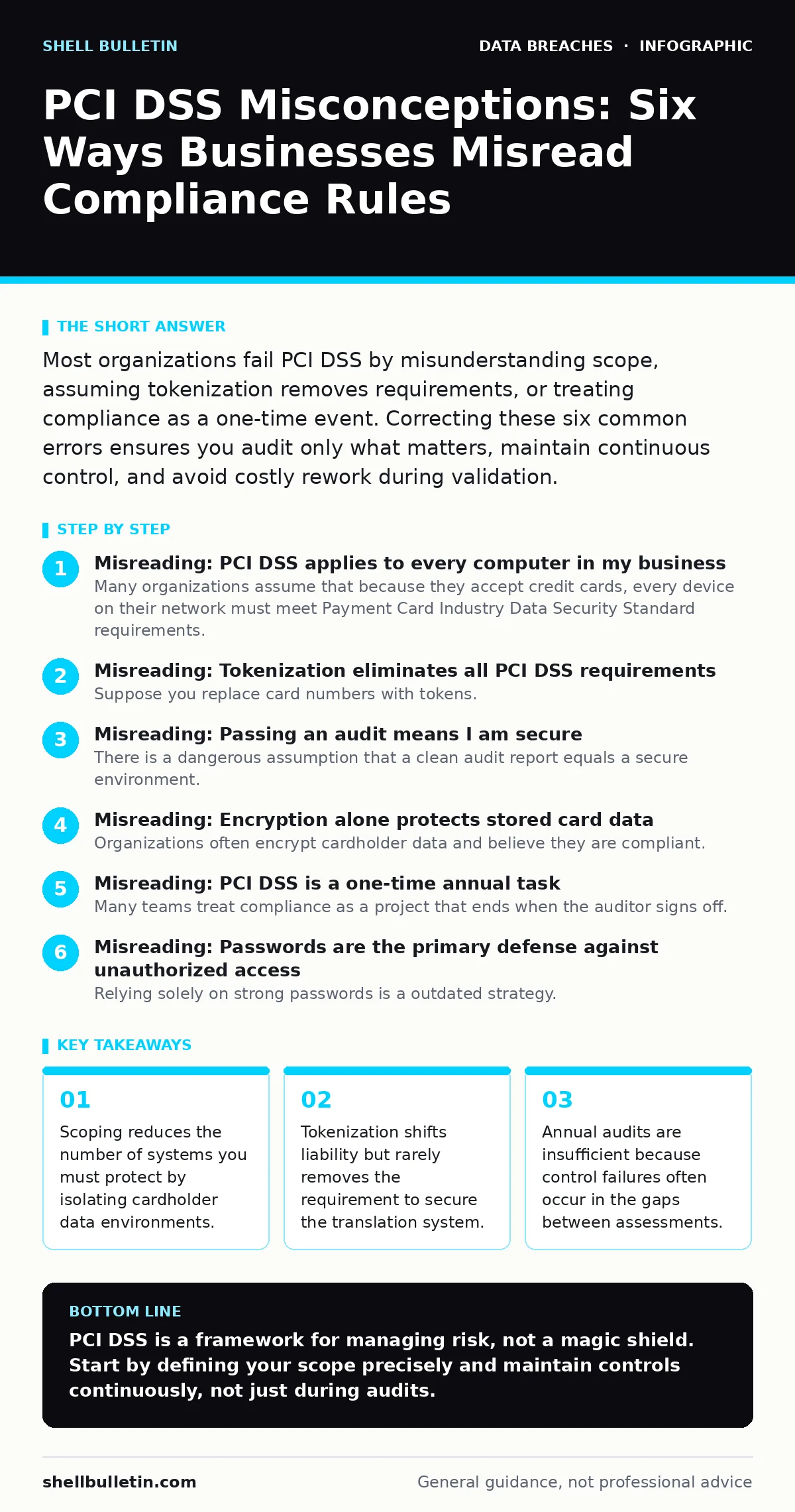
Most organizations fail PCI DSS by misunderstanding scope, assuming tokenization removes requirements, or treating compliance as a one-time event. Correcting these six common errors ensures you audit only what matters, maintain continuous control, and avoid costly rework during validation.
Misreading: PCI DSS applies to every computer in my business
Many organizations assume that because they accept credit cards, every device on their network must meet Payment Card Industry Data Security Standard requirements. This view is incorrect and financially damaging. PCI DSS applies only to the Cardholder Data Environment, which is the network segment that stores, processes, or transmits cardholder data.
Correct reading: You must define the boundary of your environment with precision. Any system outside this boundary does not need to meet PCI DSS controls, provided no data flows across the boundary. Use network segmentation to isolate payment systems from general office networks. This reduces the number of assets you must audit and harden. If you cannot segment the network, every device becomes part of the scope, increasing your workload exponentially.
Misreading: Tokenization eliminates all PCI DSS requirements
Suppose you replace card numbers with tokens. You might believe this removes the need for encryption or access controls. This is a frequent error. While tokenization replaces sensitive data with a non-sensitive equivalent, the system that performs the translation often retains the mapping or the original data.
Correct reading: If you manage the tokenization service yourself, you remain in scope for the systems holding the mapping. Even with third-party tokenization, you must secure the integration points. The tokens themselves may not be sensitive, but the processes generating them are. You must validate the security of the token vault and the APIs that request translations. Tokenization reduces risk but does not erase compliance obligations for the infrastructure supporting it.
Misreading: Passing an audit means I am secure
There is a dangerous assumption that a clean audit report equals a secure environment. This confuses compliance with security. PCI DSS is a set of minimum requirements for handling payment data. It does not cover every threat vector, nor does it guarantee immunity from attack.
Correct reading: An audit is a point-in-time assessment. It verifies that controls were configured correctly at the moment of inspection. It does not monitor for configuration drift, insider threats, or zero-day vulnerabilities. You must treat the audit as a baseline, not a shield. Continuous monitoring and regular vulnerability scans are necessary to maintain security between annual assessments. Refer to the CIA triad to understand that confidentiality, integrity, and availability require ongoing maintenance beyond checklist compliance.
Misreading: Encryption alone protects stored card data
Organizations often encrypt cardholder data and believe they are compliant. Encryption is necessary but insufficient. PCI DSS requires that encryption keys are managed securely. If an attacker steals the data and the keys, encryption provides no protection.
Correct reading: You must implement strong key management practices. This includes generating keys with sufficient entropy, storing them separately from the encrypted data, and rotating them regularly. Weak key management renders encryption useless. Additionally, you must ensure that decryption only occurs in authorized environments. If logs or backups contain plaintext data, your encryption strategy has failed. Review your data retention policies to ensure you are not storing more data than necessary, which reduces the attack surface.
Misreading: PCI DSS is a one-time annual task
Many teams treat compliance as a project that ends when the auditor signs off. This creates a false sense of security. Systems change constantly. Software updates, configuration changes, and new hires introduce vulnerabilities daily.
Correct reading: Compliance is a continuous state. You must maintain controls throughout the year. Implement change management procedures to ensure that any modification to the network is reviewed for security impact. Regular internal audits help identify drift before the external assessment. If you wait until the audit to fix issues, you risk finding critical gaps that require immediate remediation, potentially delaying business operations. This approach also aligns with breach notification protocols, as maintaining continuous security reduces the likelihood of incidents requiring disclosure.
See also: Data Loss Prevention: What It Is and How to Stop Leaks · Full Disk Encryption Myths: What You Get and What You Miss
Misreading: Passwords are the primary defense against unauthorized access
Relying solely on strong passwords is a outdated strategy. Passwords can be guessed, stolen, or reused. PCI DSS requires multi-factor authentication for remote access and administrative access to the Cardholder Data Environment.
Correct reading: You must implement multi-factor authentication for all non-console administrative access. This adds a layer of security beyond something you know. Even if an attacker obtains a password, they cannot access the system without the second factor. This is critical for protecting against credential stuffing and password leaks. Ensure that your authentication mechanisms are resilient to replay attacks and that session timeouts are enforced.
Misreading: Third-party vendors handle all their own compliance
Businesses often assume that if a vendor is PCI DSS compliant, they are responsible for all security aspects of the shared data. This leads to gaps in oversight. While vendors must be compliant, you remain responsible for ensuring that their services do not compromise your environment.
Correct reading: You must validate the security of third-party providers. Review their Attestation of Compliance and ensure their controls align with your requirements. Define clear responsibilities in your contracts. If a vendor’s failure leads to a breach, you may still face liability and breach notification laws obligations. Monitor their security posture regularly and have an incident response plan that includes vendor coordination.
Key takeaways
- Scoping reduces the number of systems you must protect by isolating cardholder data environments.
- Tokenization shifts liability but rarely removes the requirement to secure the translation system.
- Annual audits are insufficient because control failures often occur in the gaps between assessments.
PCI DSS is a framework for managing risk, not a magic shield. Start by defining your scope precisely and maintain controls continuously, not just during audits.
Frequently asked questions
Do I need PCI DSS if I only accept cash?
No. PCI DSS applies only if you store, process, or transmit cardholder data. If you handle no card data, you are not in scope.
Can I self-assess instead of hiring an auditor?
It depends on your transaction volume. Lower-volume merchants may use a Self
How this guide was produced: written by the Shell Bulletin editorial team with AI assistance, checked against the public references listed below, and reviewed when the facts change. See our editorial policy or report an error.