Dark Web Monitoring: 8 Real Questions Answered for Security
Dark web monitoring reveals stolen credentials and exposed data before attackers can exploit them, but it cannot stop the initial theft that made the data available.

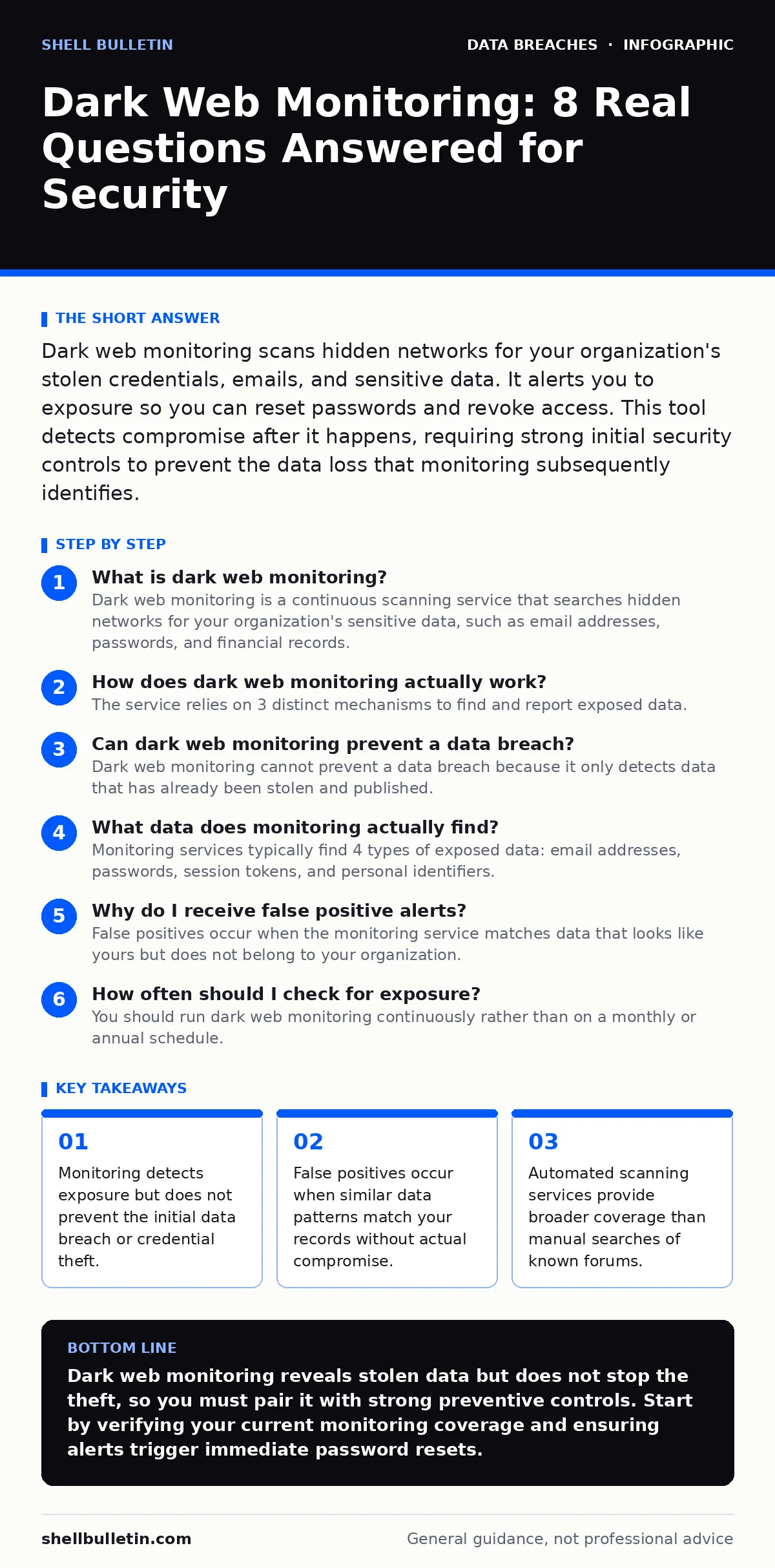
Dark web monitoring scans hidden networks for your organization's stolen credentials, emails, and sensitive data. It alerts you to exposure so you can reset passwords and revoke access. This tool detects compromise after it happens, requiring strong initial security controls to prevent the data loss that monitoring subsequently identifies.
What is dark web monitoring?
Dark web monitoring is a continuous scanning service that searches hidden networks for your organization's sensitive data, such as email addresses, passwords, and financial records. These services use automated crawlers to index forums, marketplaces, and paste sites where stolen information is traded. The system compares found data against your internal records and alerts you when a match occurs. This process happens outside your network perimeter, meaning it does not interfere with daily operations. It provides visibility into data that has already left your control.
How does dark web monitoring actually work?
The service relies on 3 distinct mechanisms to find and report exposed data. First, automated bots crawl known dark web marketplaces and chat rooms that trade stolen credentials. Second, the system uses pattern matching to identify your specific data formats, such as employee email domains or credit card structures. Third, human analysts review ambiguous findings to reduce false positives before generating alerts. This combination ensures that alerts are relevant and actionable. The process is passive, meaning it observes data without interacting with the criminals hosting it.
Can dark web monitoring prevent a data breach?
Dark web monitoring cannot prevent a data breach because it only detects data that has already been stolen and published. It serves as a detection tool, not a prevention mechanism. Prevention requires strong access controls, encryption, and secure coding practices. Monitoring helps you respond faster by revealing exposure early, which limits the window of opportunity for attackers. You must pair monitoring with preventive measures to create a complete security posture. Relying solely on monitoring leaves your systems vulnerable to initial compromise.
| Capability | Prevention | Detection | Response |
|---|---|---|---|
| Stops initial theft | Yes | No | No |
| Identifies exposed data | No | Yes | No |
| Triggers remediation | No | No | Yes |
What data does monitoring actually find?
Monitoring services typically find 4 types of exposed data: email addresses, passwords, session tokens, and personal identifiers. Email addresses are the most common finding, often appearing in combo lists that aggregate breaches from multiple sources. Passwords may be found in plain text or hashed formats, depending on how the attacker stored them. Session tokens are dangerous because they allow immediate access without needing a password. Personal identifiers, such as social security numbers or health records, indicate a more severe breach.
Why do I receive false positive alerts?
False positives occur when the monitoring service matches data that looks like yours but does not belong to your organization. This happens because many people share common email domains or similar data patterns. For example, a breach of a different company using the same email domain structure might trigger an alert for your employees. The service may also flag publicly available data, such as directory listings, as compromised. You must verify each alert by checking if the specific individual or account is actually affected. Ignoring false positives leads to alert fatigue, while ignoring true positives risks further compromise.
See also: Should You Pay for Identity Theft Protection? A Cost-Benefit Analysis · PCI DSS Compliance Checklist for Secure Payment Data
How often should I check for exposure?
You should run dark web monitoring continuously rather than on a monthly or annual schedule. Stolen data moves quickly through underground markets, and delays in detection increase the risk of exploitation. Continuous monitoring ensures you receive alerts within hours or days of exposure. This speed is critical for resetting compromised credentials before attackers can use them. Setting up automated notifications ensures your security team sees alerts immediately. Manual checks are insufficient because they create blind spots between review periods.
What should I do when an alert fires?
When an alert fires, you must follow 3 immediate steps to mitigate risk. First, verify the alert by confirming the identity of the affected user and the type of data exposed. Second, force a password reset for the affected account and any other accounts using the same credentials. Third, review recent activity logs for that account to identify unauthorized access. If the exposed data includes sensitive business information, you may need to update your data retention policies or notify affected parties. Document the incident for future analysis and compliance reporting.
How does this relate to compliance requirements?
Dark web monitoring supports compliance with frameworks like PCI DSS and HIPAA Security Rule by providing evidence of ongoing risk assessment. These standards require organizations to monitor for unauthorized access and protect sensitive data. Monitoring logs can serve as proof that you are actively searching for exposed information. However, monitoring alone does not satisfy all compliance requirements. You must also implement access controls, encryption, and regular audits. Check your specific regulatory obligations to determine how monitoring fits into your overall compliance strategy.
Is dark web monitoring enough for security?
Dark web monitoring is not enough for security because it only addresses the symptom of a breach, not the cause. You need layered security controls, including full disk encryption, strong authentication, and regular security training. Monitoring helps you detect when defenses fail, but it does not stop the failure itself. Combine monitoring with preventive measures to create a resilient security posture. Regularly review your security controls to ensure they remain effective against evolving threats. A single tool cannot protect your organization from all attack vectors.
Key takeaways
- Monitoring detects exposure but does not prevent the initial data breach or credential theft.
- False positives occur when similar data patterns match your records without actual compromise.
- Automated scanning services provide broader coverage than manual searches of known forums.
Dark web monitoring reveals stolen data but does not stop the theft, so you must pair it with strong preventive controls. Start by verifying your current monitoring coverage and ensuring alerts trigger immediate password resets.
Frequently asked questions
Does dark web monitoring scan the entire internet?
No, it focuses on hidden networks, forums, and marketplaces where stolen data is typically traded, not the surface web or public search engines.
Can I monitor my competitors' data on the dark web?
Monitoring services are designed to protect your own
How this guide was produced: written by the Shell Bulletin editorial team with AI assistance, checked against the public references listed below, and reviewed when the facts change. See our editorial policy or report an error.