Fix CIA Triad Misconceptions to Strengthen Your Security Posture
Treating confidentiality, integrity, and availability as equal priorities often creates blind spots that attackers exploit during an incident.

The CIA triad is not a checklist of equal parts. It is a decision-making framework for trade-offs. You must prioritize one pillar over the others based on your specific business context. Misreading it as rigid rules leads to wasted resources and vulnerable systems.
Misreading: The three pillars are equally important
Many organizations treat confidentiality, integrity, and availability as a balanced triad where each corner holds equal weight. This assumption leads to uniform security spending and equal priority in incident response. In reality, your business context dictates which pillar matters most. A public-facing website prioritizes availability, while a legal archive prioritizes confidentiality.
Correct reading: You must explicitly rank these values for every system. Define which failure is acceptable. If a system goes down, is that better than data being leaked? If data is leaked, is that better than it being altered? Documenting this hierarchy prevents paralysis during a crisis. See our guide on breach notification to understand how prioritization affects reporting timelines.
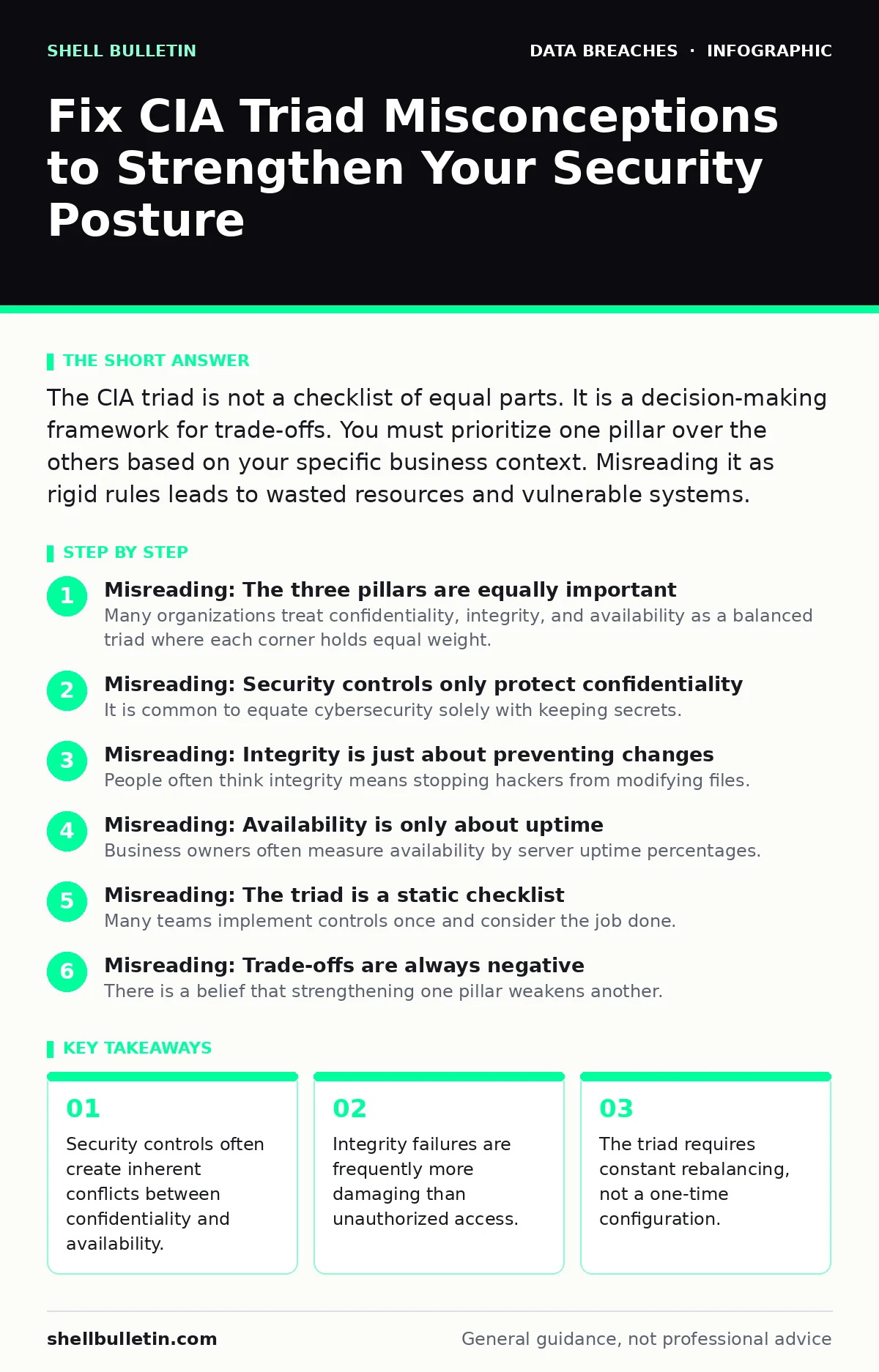
Misreading: Security controls only protect confidentiality
It is common to equate cybersecurity solely with keeping secrets. This narrow view focuses on encryption and access controls. It ignores the fact that an attacker can disrupt service without stealing data. A distributed denial-of-service attack targets availability, not confidentiality. Similarly, ransomware encrypts files, destroying availability while compromising integrity.
Correct reading: Security controls must address all three dimensions. Firewalls and intrusion detection systems protect availability by filtering malicious traffic. Checksums and digital signatures protect integrity by verifying data has not changed. Encryption protects confidentiality by rendering data unreadable to unauthorized parties. You need a mix of tools to cover the full spectrum.
Misreading: Integrity is just about preventing changes
People often think integrity means stopping hackers from modifying files. This misses the broader definition. Integrity also includes ensuring data remains complete and consistent over time. A database that loses entries due to a power surge has failed integrity, even if no hacker was involved. A file that gets corrupted during transfer is an integrity failure.
Correct reading: Integrity covers accidental and malicious changes. You need mechanisms to detect any deviation from the expected state. Hash functions create a unique fingerprint for data. If the fingerprint changes, the data has been altered. This applies to software updates, configuration files, and customer records. Protecting integrity requires verification, not just prevention.
Misreading: Availability is only about uptime
Business owners often measure availability by server uptime percentages. This metric is insufficient. Availability also means data is accessible when needed and usable. If a system is online but the data is corrupted, it is not available. If a system is online but only accessible to authorized users who are currently locked out, it is not available.
Correct reading: Availability encompasses usability and accessibility. Redundancy and backups are standard measures. However, you must also test restoration processes. A backup that cannot be restored quickly fails the availability test. Ensure your recovery time objectives align with business needs. For financial institutions, see how PCI DSS standards define availability requirements for cardholder data.
Misreading: The triad is a static checklist
Many teams implement controls once and consider the job done. They check the boxes for encryption, backups, and redundancy. They forget that the threat environment and business needs change. A system that was primarily confidential may become critical for availability. A new regulation may shift the priority to integrity.
Correct reading: The triad requires continuous assessment. Re-evaluate priorities when business processes change. Update controls when new threats emerge. Regular audits help identify shifts in risk. This dynamic approach ensures your security posture remains aligned with your actual needs. Review your data retention policies to ensure they still match your confidentiality and integrity goals.
See also: What Is Incident Response: The Plan That Stops Digital Chaos · Threat Intelligence Programs: Definition, Purpose and Core Components
Misreading: Trade-offs are always negative
There is a belief that strengthening one pillar weakens another. This is often true, but it is not always a failure. Adding multi-factor authentication increases security but may reduce availability for users who lose access tokens. Encrypting data at rest protects confidentiality but may slow down database queries, affecting availability.
Correct reading: View trade-offs as managed risks, not failures. You must accept some degradation in one area to gain strength in another. Document these decisions. Explain why you chose stricter confidentiality over faster access. This transparency helps stakeholders understand the security landscape. It also aids in compliance with frameworks like the HIPAA Security Rule, which balances patient privacy with data access.
Misreading: Personal data is the only concern
Organizations often focus exclusively on personally identifiable information. They encrypt customer names and addresses. They ignore proprietary algorithms, financial records, and operational data. This leaves other critical assets exposed. An attacker stealing trade secrets may cause more damage than one stealing customer emails.
Correct reading: Identify all data assets that support your business. Classify them by sensitivity and criticality. Apply the CIA triad to each class. Not all data needs the same level of protection. However, all data needs some protection. This broader view prevents blind spots. Check your systems for password leaks that could expose credentials to these diverse data sets.
Misreading: Compliance equals security
Many equate passing an audit with being secure. Compliance frameworks often have specific requirements for the CIA triad. Meeting these requirements is a baseline, not a finish line. An organization can be compliant and still vulnerable to novel attacks. Compliance checks are snapshots in time. Security is a continuous process.
Correct reading: Use compliance as a starting point. Go beyond the minimum requirements. Implement additional controls where risk is high. Regularly test your defenses. Assume that compliance does not guarantee protection. This mindset drives proactive security. It also prepares you for breach notification laws that may trigger even if you were compliant at the time of the incident.
Key takeaways
- Security controls often create inherent conflicts between confidentiality and availability.
- Integrity failures are frequently more damaging than unauthorized access.
- The triad requires constant rebalancing, not a one-time configuration.
Frequently asked questions
How do I prioritize the CIA triad for my business?
Identify your most critical business function. Determine which pillar supports that function most. If sales stop without the website, prioritize availability. If lawsuits stop without contracts, prioritize confidentiality.
Can I have perfect confidentiality, integrity, and availability?
No. Perfect security is theoretical and often impractical. Trade-offs are inevitable. Aim for "good enough" security that aligns with your risk tolerance and business objectives.
What is the biggest mistake small businesses make with the triad?
Ignoring integrity. Many focus on keeping data secret and available. They forget to verify that data has not been altered. This leaves them vulnerable to subtle attacks that change financial records or configuration settings.
How often should I review my triad priorities?
At least annually. Also review after any significant business change, new technology adoption, or major security incident. Business needs shift, and your security priorities must shift with them. BOTTOM LINE: The CIA triad is a tool for balancing competing security goals, not a rigid set of rules. Start by ranking confidentiality, integrity, and availability for each of your critical systems today.
How this guide was produced: written by the Shell Bulletin editorial team with AI assistance, checked against the public references listed below, and reviewed when the facts change. See our editorial policy or report an error.