SOC Playbooks: Concrete Benefits and Hidden Limitations
Standardized response procedures reduce human error during crises but often fail when facing novel threats or complex, multi-stage intrusions that defy simple categorization.

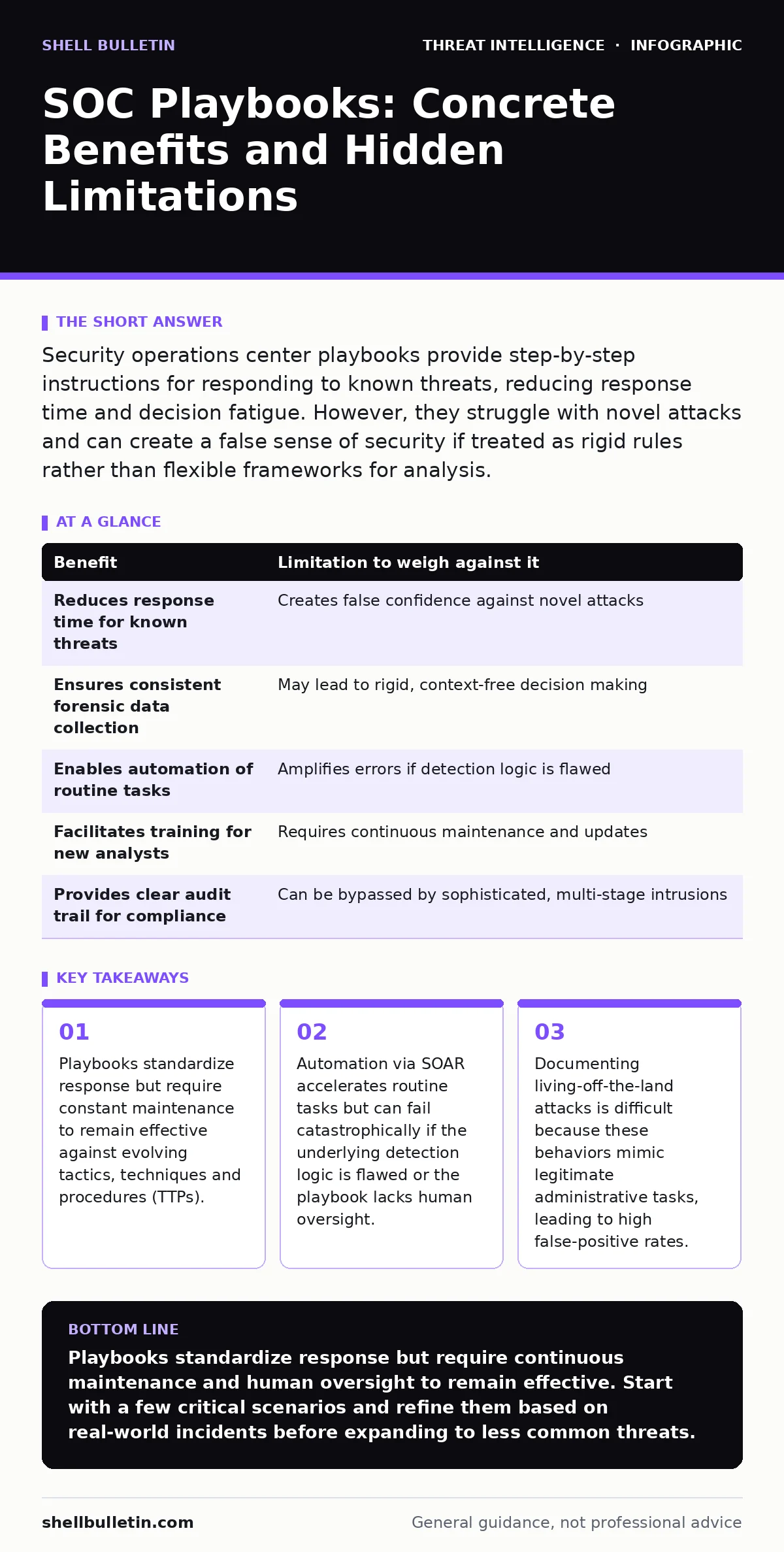
Security operations center playbooks provide step-by-step instructions for responding to known threats, reducing response time and decision fatigue. However, they struggle with novel attacks and can create a false sense of security if treated as rigid rules rather than flexible frameworks for analysis.
The Illusion of Perfect Preparedness
Many organizations treat security operations center playbooks as static documents that guarantee a perfect response. This view is dangerous. A playbook is a living framework that guides analysts through the chaos of an incident. It reduces cognitive load by providing a predefined path for common scenarios.
Imagine an analyst discovering a spike in outbound traffic. Without a playbook, they might panic, skip steps, or forget to isolate the affected host. With a playbook, they follow a checklist: verify the alert, isolate the system, capture memory, and analyze logs. The structure ensures consistency.
However, this structure comes with a cost. Playbooks assume the threat behaves in a predictable way. Real-world attacks are messy. An attacker might combine port scanning with LSASS credential theft in a way that triggers multiple conflicting responses. The playbook cannot account for every permutation of attacker behavior.
Standardization Versus Rigidity
The primary benefit of a playbook is standardization. It ensures that a junior analyst and a senior engineer respond to a specific alert in the same manner. This consistency is vital for forensic integrity. It also allows for better measurement of response times and quality.
Yet, this same standardization can breed rigidity. Analysts may follow the steps blindly without understanding the context. If the playbook says "block IP address X," they might do so even if IP address X is a legitimate cloud service provider. This blind adherence can cause business disruption that outweighs the security benefit.
You must balance the need for speed with the need for accuracy. A fast, wrong response is worse than a slow, correct one. The playbook should encourage critical thinking, not suppress it. It should ask "why" at key decision points, not just "what" to do next.
Automation and the SOAR Trap
Security orchestration, automation and response (SOAR) platforms allow you to automate parts of your playbooks. This is where efficiency gains are most visible. Routine tasks like gathering host details or blocking a malicious domain can be executed in seconds.
However, automation amplifies errors. If your detection logic is noisy, your automation will act on false positives. Imagine a playbook that automatically disables user accounts when a password cracking attempt is detected. If an employee forgets their password and tries five times, the account is locked. This creates help desk tickets and user frustration.
Automation also creates a dependency on the health of the underlying tools. If the ticketing system goes down, the playbook fails. If the firewall API changes, the automation breaks. You must maintain the integration layer as carefully as you maintain the security logic.
The Challenge of Novel Tactics
Playbooks are built on historical data. They work well for known threats. They struggle with novel tactics, techniques and procedures (TTPs). An attacker using a zero-day exploit will not trigger the playbook for a known vulnerability.
Living-off-the-land attacks are particularly difficult to address. These attacks use legitimate system tools like PowerShell or WMI to perform malicious actions. Because the tools are legitimate, standard playbooks that look for known malware signatures will miss them entirely.
You need a threat intelligence program that feeds new context into your playbooks. If you see a new TTP, you must update the playbook. This is not a one-time task. It is a continuous cycle of detection, response, and refinement.
Weighing the Trade-Offs
The decision to implement a playbook requires weighing specific benefits against inherent limitations. Below is a comparison to help you evaluate the value for your environment.
| Benefit | Limitation to weigh against it |
|---|---|
| Reduces response time for known threats | Creates false confidence against novel attacks |
| Ensures consistent forensic data collection | May lead to rigid, context-free decision making |
| Enables automation of routine tasks | Amplifies errors if detection logic is flawed |
| Facilitates training for new analysts | Requires continuous maintenance and updates |
| Provides clear audit trail for compliance | Can be bypassed by sophisticated, multi-stage intrusions |
This table highlights that every benefit has a shadow. The speed gained through automation is offset by the risk of automated errors. The consistency gained through standardization is offset by the loss of contextual nuance.
See also: What Is Incident Response: The Plan That Stops Digital Chaos · DNS Hijacking Response: Recovery Steps and Containment Plan
When It Is Worth It
Implementing playbooks is worth the effort when you have a high volume of repetitive alerts. If your team spends hours investigating benign activity, a playbook can filter and respond to these automatically. This frees up analysts to focus on complex investigations.
It is also worth it when you have a distributed team. If analysts are in different time zones, a playbook ensures that the night shift handles an incident the same way as the day shift. This continuity is critical for maintaining security posture.
For small businesses, even a simple text file with steps for "ransomware detected" or "phishing email received" is valuable. It reduces the paralysis that comes with uncertainty. You do need a full SOAR platform to start. A checklist is a playbook.
When It Is Not Worth It
Playbooks are not worth the investment if your security posture is immature. If you cannot detect an attack, you cannot respond to it. Do not write a playbook for LSASS credential theft if you do not have the logging capabilities to detect it.
It is also not worth it if you treat the playbook as a set-and-forget solution. If you do not have the resources to update the playbook regularly, it will become a liability. Outdated steps can lead to missed indicators or wasted effort.
Finally, do not create a playbook for every single possible threat. Focus on the high-impact, high-frequency scenarios. Trying to document every edge case leads to bloated, unusable documents. Prioritize the threats that matter most to your business.
Key takeaways
- Playbooks standardize response but require constant maintenance to remain effective against evolving tactics, techniques and procedures (TTPs).
- Automation via SOAR accelerates routine tasks but can fail catastrophically if the underlying detection logic is flawed or the playbook lacks human oversight.
- Documenting living-off-the-land attacks is difficult because these behaviors mimic legitimate administrative tasks, leading to high false-positive rates.
Playbooks standardize response but require continuous maintenance and human oversight to remain effective. Start with a few critical scenarios and refine them based on real-world incidents before expanding to less common threats.
Frequently asked questions
How often should I update my SOC playbooks?
Review playbooks quarterly and update them immediately after any significant incident or change in your technology stack.
Can I use playbooks if I do not have a dedicated security team?
Yes, simple checklists act as playbooks. They provide structure for incident response even for small teams or IT staff handling security duties.
What is the difference between a playbook and a detection use case?
A detection use case identifies the threat. A playbook defines the steps to take once the threat is identified and confirmed.
Do playbooks replace the need for security training?
No, playbooks support training. Analysts still need to understand the underlying concepts to interpret alerts correctly and handle exceptions not covered by the playbook.
How this guide was produced: written by the Shell Bulletin editorial team with AI assistance, checked against the public references listed below, and reviewed when the facts change. See our editorial policy or report an error.