Risk-Based Vulnerability Management: How to Prioritize What to Fix First
Patching order should follow exploitability and business context, not just severity scores, because the highest number rarely indicates the most likely breach vector.

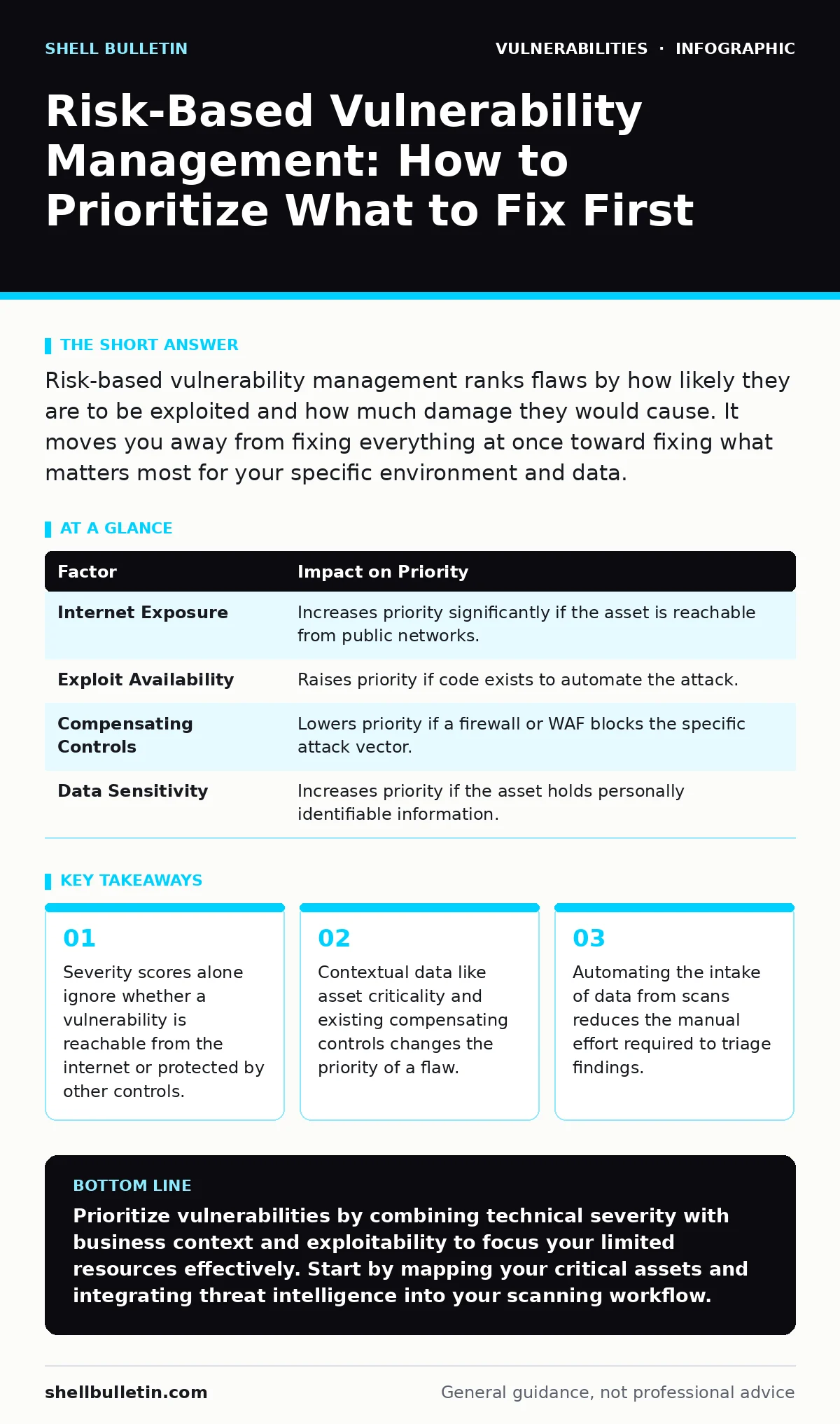
Risk-based vulnerability management ranks flaws by how likely they are to be exploited and how much damage they would cause. It moves you away from fixing everything at once toward fixing what matters most for your specific environment and data.
What is risk-based vulnerability management?
Risk-based vulnerability management is a method that prioritizes security flaws based on the actual risk they pose to your specific organization. It combines technical severity with contextual factors like asset value and exploit availability. This approach ensures your team fixes the most dangerous issues first rather than chasing the highest numbers on a report.
Why do standard severity scores fail?
Standard scores like CVSS provide a generic rating that does not account for your unique environment. A high score might apply to a service running in an isolated, air-gapped network that no one can reach. Conversely, a moderate score might apply to a public-facing login page with known exploit code. Ignoring context leads teams to waste hours on low-risk items while ignoring immediate threats.
How do I determine which assets are critical?
You must map your software and hardware to the business functions they support. A server hosting customer payment data carries more risk than a development server used only by internal staff. This mapping allows you to weight vulnerabilities differently based on the potential financial or reputational damage. Without this mapping, every flaw looks equally important, which paralyzes decision-making.
What data sources improve accuracy?
Accurate prioritization requires more than just output from vulnerability scanning tools. You need data on internet exposure, user activity, and known exploit activity in the wild. Integrating this external intelligence helps you identify which flaws are actively being weaponized. This turns a static list of broken checks into a dynamic view of real-world danger.
| Factor | Impact on Priority |
|---|---|
| Internet Exposure | Increases priority significantly if the asset is reachable from public networks. |
| Exploit Availability | Raises priority if code exists to automate the attack. |
| Compensating Controls | Lowers priority if a firewall or WAF blocks the specific attack vector. |
| Data Sensitivity | Increases priority if the asset holds personally identifiable information. |
How do compensating controls change risk?
Compensating controls are other security measures that reduce the likelihood or impact of a vulnerability. If a web server has a buffer overflow vulnerabilities flaw but sits behind a web application firewall that blocks the payload, the effective risk is lower. You should document these controls so your risk calculation reflects the true attack surface. This prevents unnecessary patching efforts on protected systems.
See also: Exploitability vs Severity: Why High Scores Don't Always Mean Danger
What is the role of exploitability?
Exploitability measures how easy it is for an attacker to use a vulnerability. Some flaws require complex conditions, specific user interactions, or physical access to trigger. Others can be triggered remotely with a single packet. Focusing on high-exploitability flaws ensures you stop attacks that are likely to succeed. This is more efficient than fixing complex bugs that few attackers can leverage.
How do I handle third-party dependencies?
Third-party libraries often contain flaws that affect your application without your code being at fault. You need a process to track dependency updates and assess their risk within your supply chain. A flaw in a common logging library might affect thousands of applications, making it a high-priority target. Automating the detection of these updates helps you stay ahead of widespread attacks.
How do I measure success?
Success is measured by the time between discovery and remediation of high-risk items. Tracking mean time to remediate (MTTR) for critical flaws shows if your prioritization is working. If high-risk items are fixed quickly while low-risk items languish, your strategy is effective. This metric proves to stakeholders that security efforts are aligned with business risk.
What are the hidden costs of this approach?
Implementing this method requires initial investment in data collection and integration. You must spend time mapping assets and configuring tools to correlate data sources. However, the long-term savings in engineering hours and reduced incident response costs outweigh the setup effort. The hidden cost is often the cultural shift required to trust automated risk scores over manual triage.
How does this relate to privilege escalation?
Some vulnerabilities only matter if an attacker already has access. Privilege escalation vulnerabilities allow an attacker with low-level access to gain higher permissions. These are lower priority for internet-facing assets but critical for internal systems. Understanding the attack path helps you prioritize flaws that serve as stepping stones to deeper system compromise.
Key takeaways
- Severity scores alone ignore whether a vulnerability is reachable from the internet or protected by other controls.
- Contextual data like asset criticality and existing compensating controls changes the priority of a flaw.
- Automating the intake of data from scans reduces the manual effort required to triage findings.
Prioritize vulnerabilities by combining technical severity with business context and exploitability to focus your limited resources effectively. Start by mapping your critical assets and integrating threat intelligence into your scanning workflow.
Frequently asked questions
How often should I update my risk models?
You should update your risk models whenever your asset inventory changes or when new threat intelligence becomes available. Continuous updates ensure your prioritization reflects the current state of your environment and the threat environment.
Can I use this method for cloud environments?
Yes, cloud environments benefit greatly from this approach because the attack surface changes frequently. Cloud-specific data like configuration errors and identity misuses must be included in the risk calculation.
What if I lack threat intelligence feeds?
You can still apply risk-based management by focusing on internet exposure and asset criticality. Publicly available information about exploit availability can supplement missing commercial feeds.
How does this differ from traditional patching?
Traditional patching often fixes all vulnerabilities by age or severity score regardless of context. Risk-based management filters these lists to focus only on flaws that pose a genuine threat to your specific operations.
How this guide was produced: written by the Shell Bulletin editorial team with AI assistance, checked against the public references listed below, and reviewed when the facts change. See our editorial policy or report an error.