Exploitability vs Severity: Why High Scores Don't Always Mean Danger
High severity scores often ignore the practical difficulty of an attack, leaving you chasing threats that cannot actually reach your systems in the real world.

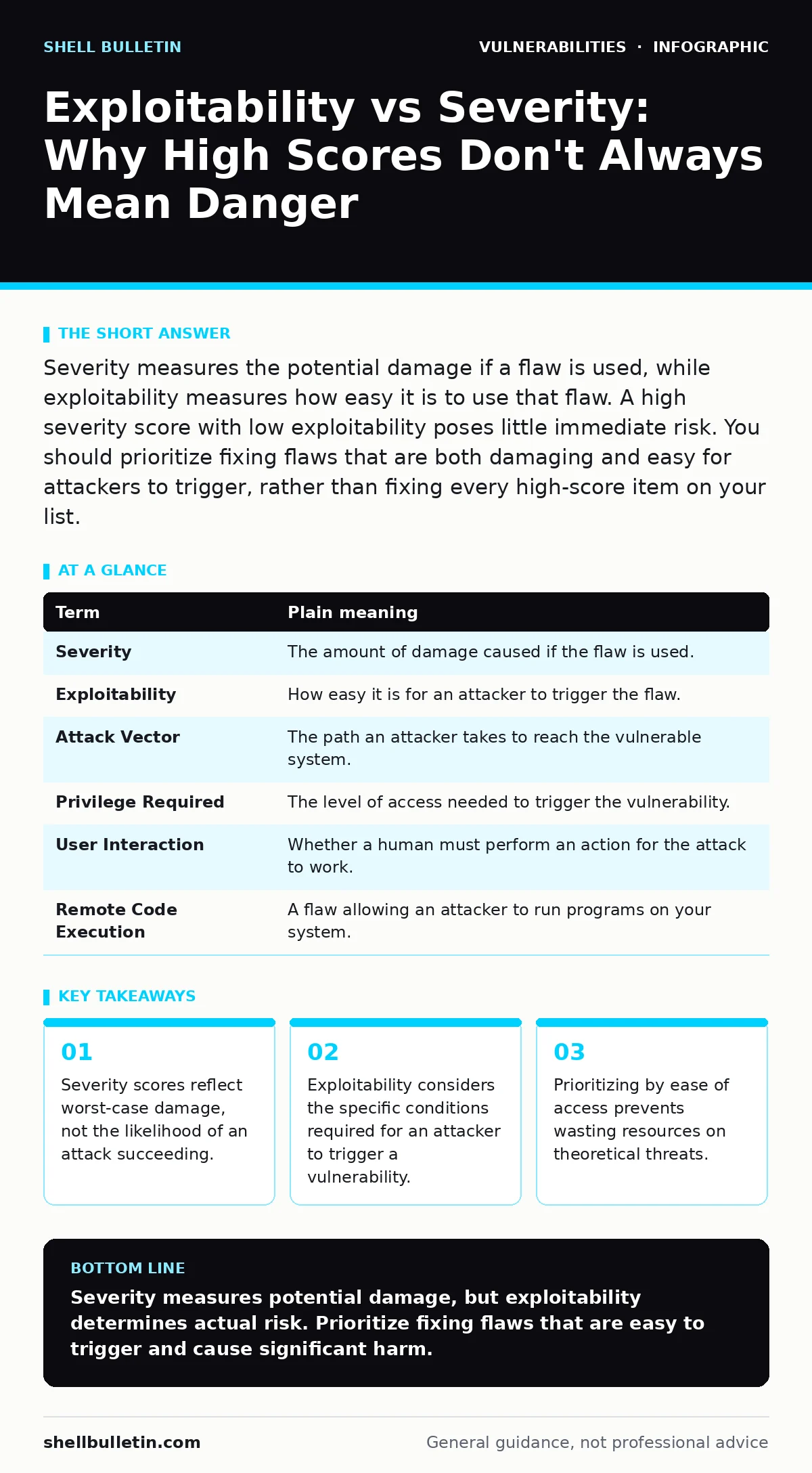
Severity measures the potential damage if a flaw is used, while exploitability measures how easy it is to use that flaw. A high severity score with low exploitability poses little immediate risk. You should prioritize fixing flaws that are both damaging and easy for attackers to trigger, rather than fixing every high-score item on your list.
The House and the Lock
Imagine you own a sturdy house. The front door has a complex deadbolt that requires a specific key to open. This represents a vulnerability with low exploitability. An attacker needs a specific tool and effort to enter. Now imagine a window on the second floor is unlocked. This represents high exploitability. An attacker can simply walk up and open it. The damage from either entry is similar, but the effort required differs drastically. You must decide which entry point to secure first based on how easily an intruder can reach it.
Defining Severity and Damage
Severity describes the impact if a vulnerability is successfully exploited. It answers the question of what happens when the barrier fails. If an attacker gains access, what data can they read? Can they take control of the system? High severity means the consequences are severe, such as total system compromise or data loss. This metric does not care how hard it is to get in. It only cares about the outcome once the attacker is inside. This distinction is vital for risk-based vulnerability management.
Understanding Exploitability and Effort
Exploitability measures how easy it is for an attacker to trigger the flaw. It considers the complexity of the attack. Does the attacker need physical access? Do they need to trick a user into clicking a link? Or can they send a single packet from the internet? High exploitability means the attack is simple, automated, and requires no special skills. Low exploitability means the attack requires specific conditions, like a rare configuration or a complex sequence of actions. Understanding this helps you interpret security advisories correctly.
The Common Confusion Trap
Many teams fix vulnerabilities in order of their severity score alone. This creates a hidden cost. You might spend weeks patching a high-severity flaw that is nearly impossible to exploit because it requires physical access to a server room. Meanwhile, a medium-severity flaw that allows remote code execution sits open. Attackers follow the path of least resistance. They will not try to break the complex lock if the window is unlocked. This misalignment is why vulnerability scanning results often feel overwhelming and unhelpful.
Real-World Technical Examples
Consider buffer overflow vulnerabilities. These can cause high severity by crashing a system or allowing code execution. However, modern operating systems include protections like address space layout randomization. This makes exploiting these flaws difficult and unreliable. The exploitability is lower than the raw score suggests. Contrast this with command injection flaws in web applications. These often have moderate severity but very high exploitability. An attacker can trigger them with a simple web request. The ease of access makes these more dangerous in practice.
Applying the Matrix to Your Work
You need to map your findings to a matrix of impact versus effort. Place high severity and high exploitability items in the immediate action zone. These are the unlocked windows on the ground floor. Place high severity but low exploitability items in the planned maintenance zone. These are the complex locks on the back door. Fix them when you have time, but do not panic. This approach aligns with best practices for security advisory reading, where you look beyond the headline score to the technical details.
Mini Glossary of Terms
| Term | Plain meaning |
|---|---|
| Severity | The amount of damage caused if the flaw is used. |
| Exploitability | How easy it is for an attacker to trigger the flaw. |
| Attack Vector | The path an attacker takes to reach the vulnerable system. |
| Privilege Required | The level of access needed to trigger the vulnerability. |
| User Interaction | Whether a human must perform an action for the attack to work. |
| Remote Code Execution | A flaw allowing an attacker to run programs on your system. |
Try This Now
- Review your last 10 open vulnerabilities and categorize them by how an attacker would reach them.
- Identify which flaws require no user interaction or authentication to trigger.
- Prioritize fixing the flaws that are remote and require no special skills over those with higher scores but higher barriers.
Advanced Considerations
Some vulnerabilities depend on specific software versions or configurations. Cisco IOS XE vulnerabilities often require specific router setups to be exploitable. If your network uses a different configuration, the exploitability drops to near zero. Similarly, PHP object injection flaws require specific code patterns to be present. If your application does not use those patterns, the high severity score is irrelevant. Always verify the context before acting.
Final Prioritization Strategy
Your goal is not to eliminate all vulnerabilities, but to eliminate the ones that matter. Focus on the intersection of high impact and high ease of access. This strategy protects your most valuable assets without burning out your team. By understanding the difference between how bad a flaw is and how easy it is to use, you make smarter decisions. This clarity is the foundation of effective risk-based vulnerability management.
Key takeaways
- Severity scores reflect worst-case damage, not the likelihood of an attack succeeding.
- Exploitability considers the specific conditions required for an attacker to trigger a vulnerability.
- Prioritizing by ease of access prevents wasting resources on theoretical threats.
Severity measures potential damage, but exploitability determines actual risk. Prioritize fixing flaws that are easy to trigger and cause significant harm.
Frequently asked questions
Does a critical severity score always mean I should patch immediately?
No, a critical score only indicates high potential damage. You must also check if the flaw is easy to exploit in your specific environment.
How do I know if a vulnerability is easy to exploit?
Look for flaws that allow remote access, require no authentication, and need no user interaction. These are the easiest for attackers to use.
What is the difference between an attack vector and exploitability?
The attack vector is the path the attacker takes, while exploitability measures the overall difficulty and effort required to succeed.
Can a low severity vulnerability be dangerous?
Yes, if it has high exploitability, it can serve as an entry point for attackers to reach more critical systems within your network.
How this guide was produced: written by the Shell Bulletin editorial team with AI assistance, checked against the public references listed below, and reviewed when the facts change. See our editorial policy or report an error.