Security Advisory Reading: 9 FAQs on Parsing CVE Data
Most teams waste time patching low-impact flaws while ignoring complex chains that bypass standard network defenses.

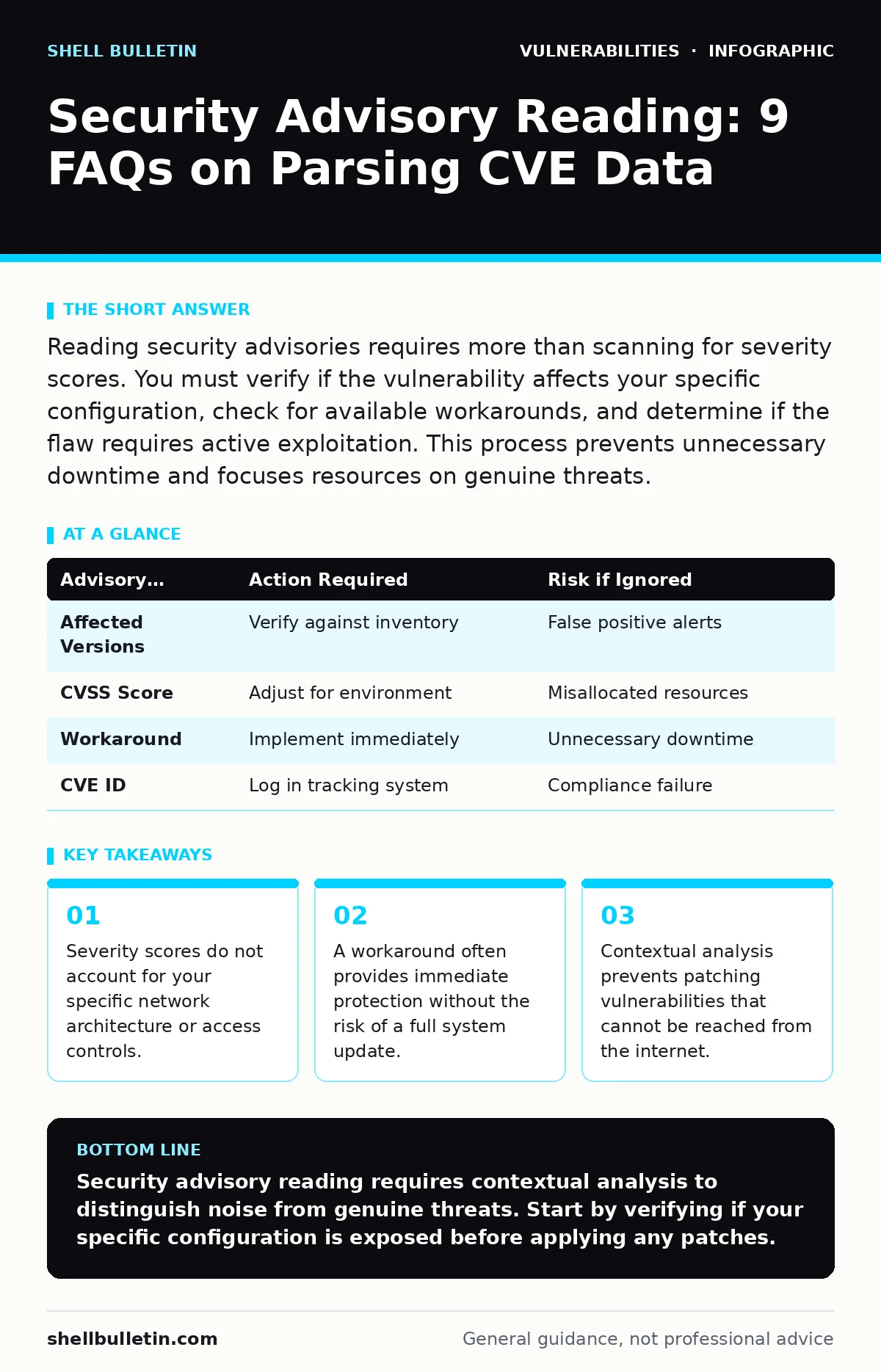
Reading security advisories requires more than scanning for severity scores. You must verify if the vulnerability affects your specific configuration, check for available workarounds, and determine if the flaw requires active exploitation. This process prevents unnecessary downtime and focuses resources on genuine threats.
What determines if a vulnerability affects my systems?
A vulnerability affects your systems only if the vulnerable component is installed, enabled, and accessible to an attacker. Many advisories list software versions that contain a flaw, but your environment may not run that specific version or may disable the affected feature. You must compare the affected version range in the advisory against your current inventory. This step eliminates false positives that clutter your tracking lists.
How do I interpret the severity score correctly?
The Common Vulnerability Scoring System (CVSS) provides a baseline metric, but it assumes a default configuration that rarely matches your setup. A high score indicates potential damage, not immediate risk. You must adjust this score based on your environment. For example, a service running on a private network has a lower effective severity than one exposed to the public internet. Always cross-reference the base score with your actual exposure.
Does a high severity rating mean I must patch immediately?
A high rating signals potential impact, but it does not dictate urgency without context. You must assess exploitability before acting. Some flaws require physical access or specific credentials that an attacker cannot obtain remotely. Check the advisory for required conditions. If the flaw demands authentication you have restricted, you can delay patching while monitoring for exploit activity. This approach saves operational resources.
How do I distinguish between a bug and a security flaw?
A security flaw allows an unauthorized action or disclosure, while a bug causes unintended behavior without compromising confidentiality, integrity, or availability. Advisories for security flaws include a CVE identifier and discuss attack vectors. Bugs may mention crashes or errors but lack a discussion of privilege escalation or data theft. Look for terms like "unauthorized access" or "information disclosure" to confirm a security relevance.
What is the value of a published workaround?
A workaround provides immediate mitigation without requiring a software update, which carries its own risks of instability. Advisories often list configuration changes that disable the vulnerable feature. Applying these changes reduces the attack surface instantly. You should implement the workaround while testing the official patch in a non-production environment. This two-step approach ensures business continuity during the remediation process.
How do I handle vulnerabilities in third-party libraries?
Vulnerabilities in dependencies require you to update the library or the application that uses it. You cannot patch the library in isolation if it is bundled within a vendor’s software. Contact the vendor for a patched version of their product. If they do not provide one, you must assess the risk of keeping the vulnerable dependency. This situation highlights the need for strict dependency updates policies.
When should I ignore a published advisory?
You should ignore an advisory if the affected component is not present in your environment or if the attack vector is impossible to reach. For instance, a flaw in a web server module is irrelevant if you do not run a web server. Ignoring irrelevant advisories reduces noise and allows your team to focus on genuine threats. Document your reason for ignoring each item to maintain an audit trail.
How do I prioritize patches when many are released?
Prioritization depends on the combination of severity, exploitability, and business impact. You cannot patch everything at once. Use a risk-based vulnerability management framework to rank items. Focus first on flaws that are actively exploited in the wild and affect externally facing services. Then address high-severity internal flaws. This method ensures you protect the most valuable assets first.
What role do external frameworks play in analysis?
External frameworks provide standardized categories for common flaws, helping you understand the nature of the risk. The OWASP Top 10 lists the most critical web application security risks. Referencing this list helps you recognize patterns in advisories. For example, a flaw labeled as broken object level authorization (BOLA) indicates a specific logic error in access control. Understanding these categories speeds up your analysis.
| Advisory Element | Action Required | Risk if Ignored |
|---|---|---|
| Affected Versions | Verify against inventory | False positive alerts |
| CVSS Score | Adjust for environment | Misallocated resources |
| Workaround | Implement immediately | Unnecessary downtime |
| CVE ID | Log in tracking system | Compliance failure |
How do I verify if an exploit exists?
An advisory may mention "proof of concept" code, which indicates the flaw is easy to exploit. If no exploit is mentioned, the risk is lower but not zero. You must monitor threat intelligence feeds for new developments. The presence of an exploit changes the urgency from planned maintenance to emergency response. This distinction is critical for allocating your team’s immediate attention.
What is the impact of remote code execution?
Remote code execution allows an attacker to run arbitrary commands on your server. This is the most severe class of vulnerability because it grants full control. Advisories highlighting this capability demand immediate attention. You must isolate affected systems and apply patches as soon as possible. This type of flaw bypasses most network defenses and requires strict isolation.
How do I handle authentication bypass flaws?
Authentication bypass flaws allow access without valid credentials. These are particularly dangerous because they defeat the primary security barrier. Advisories for these flaws often mention specific protocols like SAML authentication bypass. You must verify if your system uses the affected protocol. If it does, you must enforce additional controls such as multi-factor authentication immediately.
What is the long-term strategy for advisory management?
A long-term strategy involves continuous monitoring and regular review of your software inventory. You must integrate advisory reading into your change management process. This ensures that every update is evaluated for security impact. Regular reviews prevent the accumulation of unpatched vulnerabilities. This discipline reduces the overall risk profile of your organization.
How do I track advisory responses?
You must log every advisory you review and the action you took. This log serves as evidence for audits and internal reviews. Include the CVE ID, the decision (patched, ignored, workaround), and the reason. This record helps you identify patterns in your security posture. It also simplifies future incident response by providing a clear history of your defenses.
What are the common pitfalls in reading advisories?
Common pitfalls include relying solely on automated scanners, ignoring configuration details, and failing to test patches. Automated tools may miss context-specific risks. Configuration details determine if a flaw is exploitable in your environment. Testing patches prevents introducing new issues. Avoiding these pitfalls ensures a more accurate and effective security posture.
How do I stay updated on new advisories?
Subscribe to reputable security mailing lists and vendor notification services. These sources provide timely updates on new vulnerabilities. You should also monitor open standards bodies for protocol-level flaws. Regularly reviewing these sources ensures you are aware of emerging threats. This proactive approach allows you to prepare before an exploit becomes widespread.
Key takeaways
- Severity scores do not account for your specific network architecture or access controls.
- A workaround often provides immediate protection without the risk of a full system update.
- Contextual analysis prevents patching vulnerabilities that cannot be reached from the internet.
Security advisory reading requires contextual analysis to distinguish noise from genuine threats. Start by verifying if your specific configuration is exposed before applying any patches.
Frequently asked questions
How do I know if a CVE is critical for my business?
A CVE is critical if it affects a system you use, is exposed to potential attackers, and has a known exploit. You must verify each of these conditions independently.
Can I rely on automated tools to read advisories?
Automated tools can aggregate data but cannot interpret context. You must manually review high-severity items to determine if they apply to your specific environment.
What is the difference between a vulnerability and a threat?
A vulnerability is a weakness in your system. A threat is an actor or event that can exploit that weakness. Advisories describe vulnerabilities, not threats.
How often should I review security advisories?
You should review advisories daily for critical systems and weekly for less critical ones. Consistent review ensures you catch new threats before they are exploited.
How this guide was produced: written by the Shell Bulletin editorial team with AI assistance, checked against the public references listed below, and reviewed when the facts change. See our editorial policy or report an error.