Detect Broken Object Level Authorization: Logs, Tools, and Blind Spots
Broken object level authorization often hides in plain sight because the server returns success codes for unauthorized data access, masking the logic error as valid behavior.
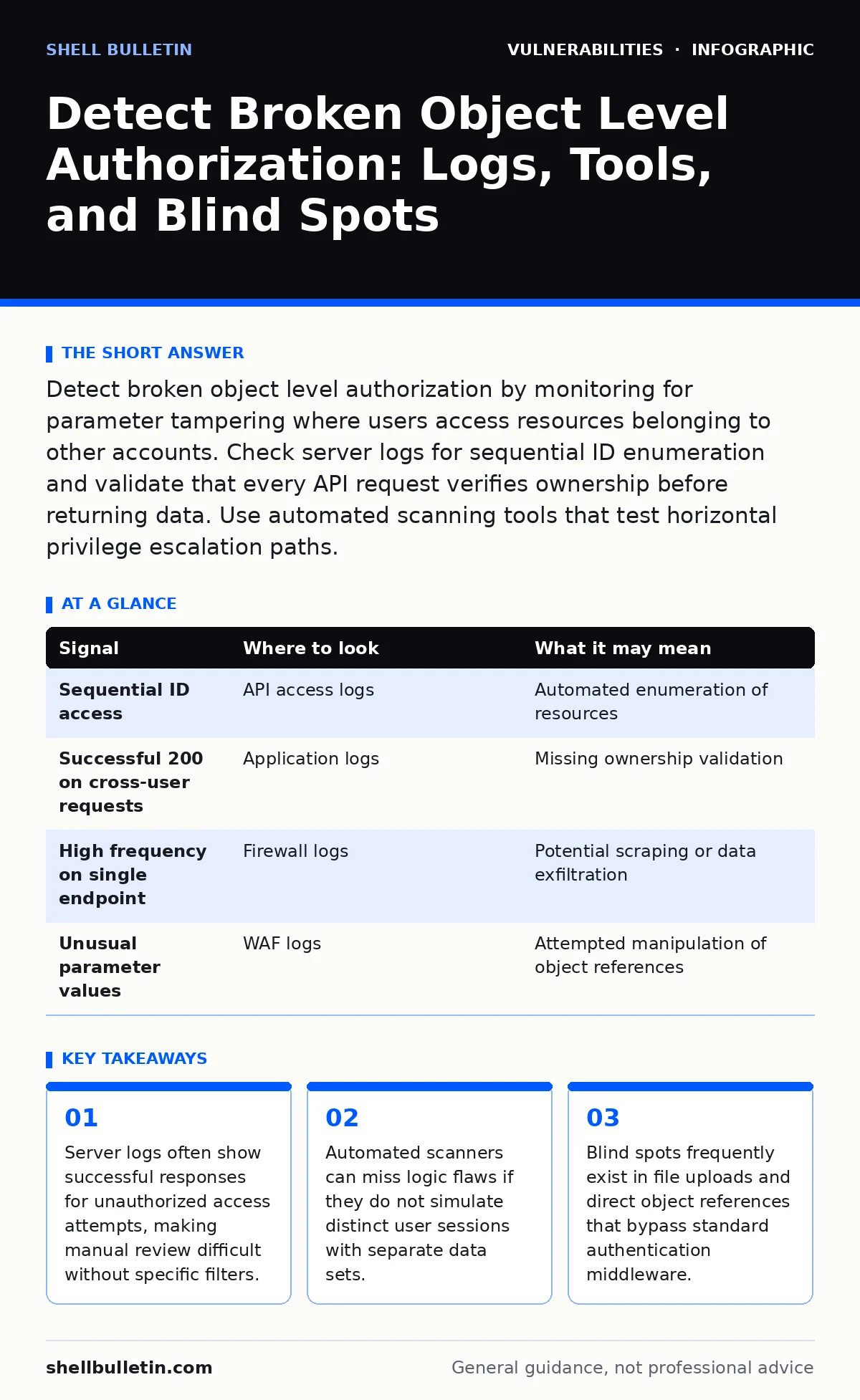
Detect broken object level authorization by monitoring for parameter tampering where users access resources belonging to other accounts. Check server logs for sequential ID enumeration and validate that every API request verifies ownership before returning data. Use automated scanning tools that test horizontal privilege escalation paths.
Understanding the Logic Flaw
Broken object level authorization occurs when an application exposes internal identifiers directly to users without verifying ownership. The server accepts a request containing an ID, such as a customer number or document reference, and returns the associated data. The vulnerability exists because the application trusts the client-supplied identifier. It assumes that because the user is authenticated, they have the right to view any object they reference. This is a logic error, not an authentication failure. The user is who they say they are, but the application fails to check if they are allowed to see this specific piece of data.
This flaw is distinct from missing function level authorization. In function level issues, a user accesses a feature they should not have, like an admin panel. In object level issues, the user accesses the correct feature, like viewing an invoice, but sees someone else's invoice. The mechanism relies on direct object references. These references are often sequential integers or predictable UUIDs. Predictability allows an attacker to guess valid IDs for other users. The application must enforce ownership checks on every single request that accesses sensitive data.
Server Logs and Access Patterns
Server logs provide the first line of evidence for broken object level authorization. You must look for patterns where a single session accesses multiple distinct resource identifiers. Normal user behavior typically involves accessing a limited set of their own resources. An attacker will access many resources in rapid succession. Look for HTTP 200 OK responses for requests that involve changing the object ID parameter. If a user changes an ID from 101 to 102 and still receives a successful response, the server likely lacks proper authorization checks.
The log entries will show the same user agent and session token accessing different resource paths. The key indicator is the combination of a successful status code and a changed parameter. You should filter logs for endpoints that accept IDs in the query string or request body. Look for sequences of requests where the ID increments or decrements. This enumeration pattern suggests an automated tool is testing boundaries. The absence of HTTP 403 Forbidden responses for these changed IDs confirms the vulnerability.
| Signal | Where to look | What it may mean |
|---|---|---|
| Sequential ID access | API access logs | Automated enumeration of resources |
| Successful 200 on cross-user requests | Application logs | Missing ownership validation |
| High frequency on single endpoint | Firewall logs | Potential scraping or data exfiltration |
| Unusual parameter values | WAF logs | Attempted manipulation of object references |
Client-Side Behavior and Traffic
Client-side traffic analysis reveals how the application handles object references. Inspect the network requests made by the browser when a user performs standard actions. Note which parameters are sent to the server. If the parameter name is generic, such as "id" or "user_id," it is more likely to be vulnerable. Specific names like "my_invoice_id" might imply better design, but do not guarantee security. The content of the parameter is what matters. If the value is a simple integer, it is easy to manipulate.
Use a proxy tool to intercept and modify requests in transit. Change the object ID in a legitimate request to a value that belongs to another test account. Send the modified request and observe the response. If the server returns data for the other account, the vulnerability is confirmed. This manual testing is critical because automated tools often fail to understand the relationship between user sessions and data ownership. You must simulate the perspective of an attacker who has valid credentials but malicious intent.
Automated Scanning Limitations
Automated vulnerability scanners help identify common misconfigurations, but they struggle with business logic flaws. These tools operate by sending predefined payloads and checking for known error signatures. Broken object level authorization does not produce a standard error signature. The server behaves correctly from a technical standpoint, returning valid JSON or HTML. The scanner sees a successful response and assumes the application is working as intended. It does not know that the data belongs to a different user.
To improve detection, use scanners that support authenticated testing with multiple user roles. Configure the tool to create separate sessions for different users. The scanner must understand that User A should not see User B's data. Some advanced tools allow you to define relationships between objects and owners. Without this context, the scanner will miss the vulnerability entirely. Combine automated scanning with manual review of critical endpoints. Automation can cover breadth, but human analysis is required for depth.
Common Blind Spots in Architecture
Developers often secure the main data retrieval endpoints but forget secondary interfaces. File upload handlers are a frequent blind spot. If a file name contains an ID, an attacker might modify the ID to overwrite another user's file. Search functions also present risks. If a search returns results based on a keyword, an attacker might craft a query that exposes private data if the search index lacks proper access controls.
Another blind spot is the use of client-side encryption. Some applications encrypt sensitive data before sending it to the client, assuming that decryption keys are stored securely in the browser. If the application relies on client-side logic to enforce access, it is vulnerable. The server must enforce authorization before sending any data, even if that data is encrypted. The encryption layer does not replace the need for server-side validation.
Mitigation and Validation Strategies
The primary defense against broken object level authorization is strict ownership validation on the server side. Every request that accesses an object must verify that the authenticated user is the owner of that object. This check should happen before the data is retrieved from the database. Use database queries that include both the object ID and the user ID in the WHERE clause. This ensures that the database only returns data that belongs to the requesting user.
Avoid exposing sequential IDs to users. Use opaque identifiers like UUIDs or tokens that cannot be guessed. While this does not prevent an attacker from accessing data if they obtain a valid ID, it prevents bulk enumeration attacks. Combine this with rate limiting to slow down attempts to guess valid IDs. Regularly review code for endpoints that accept user-supplied identifiers. Ensure that no path bypasses the authorization middleware.
Integrating with Security Workflows
Detecting broken object level authorization requires integrating checks into your development pipeline. Static analysis tools can identify code patterns that accept user input without validation. Dynamic analysis tools can test running applications for logic flaws. Combine these with manual penetration testing focused on business logic. Train developers to recognize the difference between authentication and authorization. Authentication verifies identity, while authorization verifies permissions.
Regularly update your testing procedures to cover new endpoints. As your application grows, new features may introduce new object references. Ensure that every new endpoint undergoes rigorous testing for ownership validation. Review security advisories for common patterns in similar applications. Learning from others' mistakes helps you anticipate potential flaws in your own systems.
Key takeaways
- Server logs often show successful responses for unauthorized access attempts, making manual review difficult without specific filters.
- Automated scanners can miss logic flaws if they do not simulate distinct user sessions with separate data sets.
- Blind spots frequently exist in file uploads and direct object references that bypass standard authentication middleware.
Frequently asked questions
Does using UUIDs prevent broken object level authorization?
No, UUIDs prevent easy enumeration but do not stop an attacker from accessing data if they obtain a valid ID. You must still validate ownership on the server.
Can a WAF detect this vulnerability?
Standard WAF rules focus on known attack signatures like SQL injection. They rarely detect logic flaws unless you create custom rules for specific parameter manipulation.
How do I test this in a staging environment?
Create multiple user accounts with distinct data. Use one account to access resources owned by another account via modified API requests.
Is this the same as cross-site scripting (XSS)?
No, XSS involves injecting malicious scripts into web pages. Broken object level authorization involves unauthorized data access through logic errors.
How this guide was produced: written by the Shell Bulletin editorial team with AI assistance, checked against the public references listed below, and reviewed when the facts change. See our editorial policy or report an error.