How Security Advisories Drive Patch Decisions and Reduce Risk
Security advisories translate raw technical data into actionable business decisions, preventing silent system decay and guiding resource allocation before exploitation occurs.

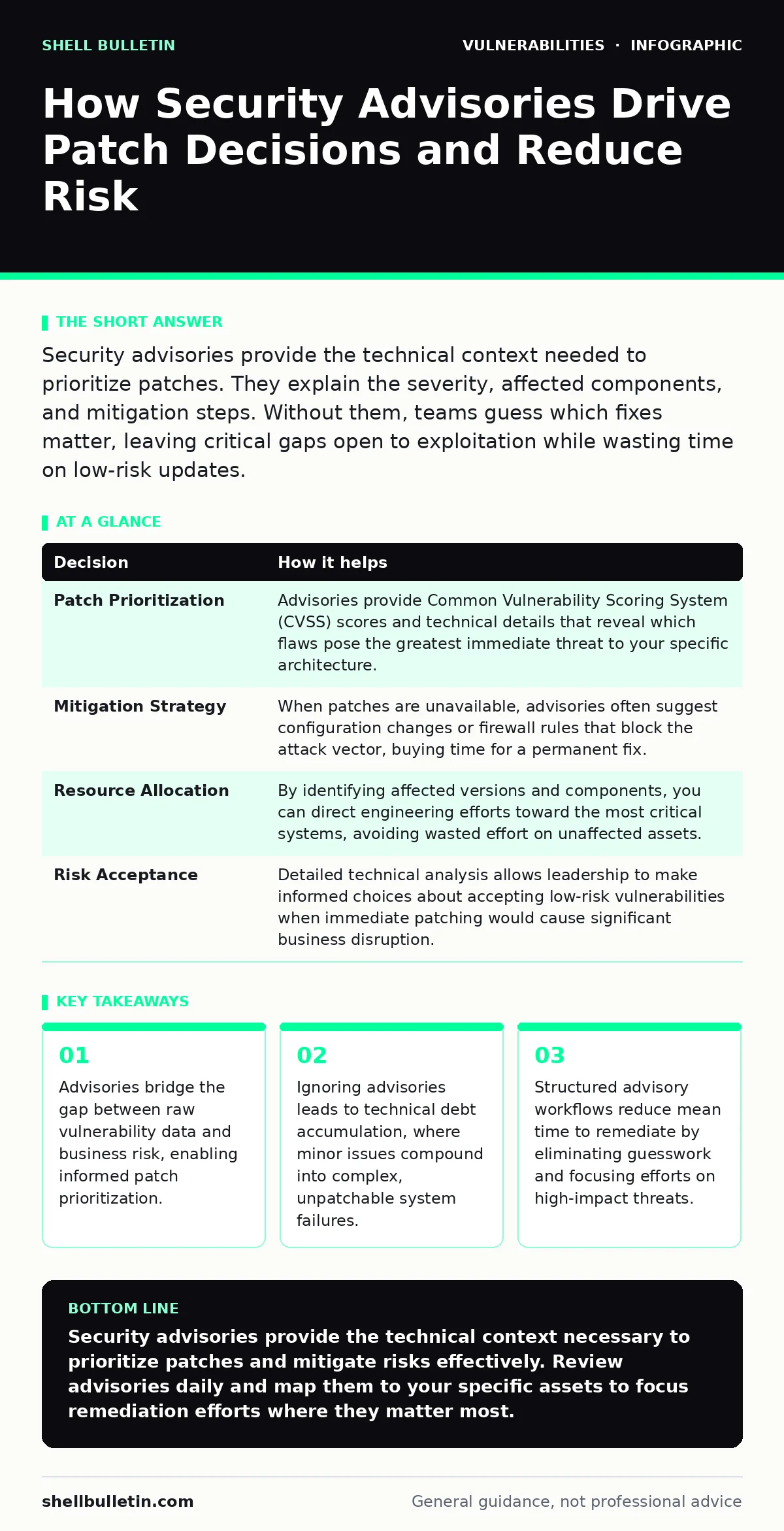
Security advisories provide the technical context needed to prioritize patches. They explain the severity, affected components, and mitigation steps. Without them, teams guess which fixes matter, leaving critical gaps open to exploitation while wasting time on low-risk updates.
The Hidden Cost of Unstructured Data
A vulnerability is a flaw in software that allows an attacker to bypass security controls. A security advisory is the official documentation that describes this flaw, its severity, and how to fix it. Many organizations treat these documents as noise, filing them away or ignoring them until a breach occurs. This passive approach creates a hidden cost: decision paralysis.
When every alert looks the same, teams cannot distinguish between a minor cosmetic issue and a critical privilege escalation vulnerabilities that grants an attacker full control of your system. You must treat advisories as the primary source of truth for your security posture. They provide the technical details required to assess real-world impact, not just theoretical risk. Without this context, you are defending your infrastructure blindfolded.
Decisions Informed by Technical Context
Security advisories do more than list broken software; they inform specific operational decisions. They tell you which systems are affected, what the attack vector is, and whether a temporary mitigation exists before a permanent patch is available. This information allows you to prioritize work based on actual exposure rather than arbitrary deadlines. For example, an advisory might reveal that a vulnerability requires user interaction to exploit, meaning your server-side infrastructure is safe until you update client-facing applications. This nuance saves resources and prevents unnecessary downtime.
| Decision | How it helps |
|---|---|
| Patch Prioritization | Advisories provide Common Vulnerability Scoring System (CVSS) scores and technical details that reveal which flaws pose the greatest immediate threat to your specific architecture. |
| Mitigation Strategy | When patches are unavailable, advisories often suggest configuration changes or firewall rules that block the attack vector, buying time for a permanent fix. |
| Resource Allocation | By identifying affected versions and components, you can direct engineering efforts toward the most critical systems, avoiding wasted effort on unaffected assets. |
| Risk Acceptance | Detailed technical analysis allows leadership to make informed choices about accepting low-risk vulnerabilities when immediate patching would cause significant business disruption. |
The Contrast: Two Hypothetical Teams
Team A uses the advisory to tailor their response. They understand the mechanism of the attack and the specific conditions required for exploitation. Team B treats the advisory as a generic alarm, triggering a blunt, disruptive response. The difference is not just in efficiency; it is in risk management. Team A’s approach preserves business continuity while reducing risk. Team B’s approach introduces operational risk that may be worse than the vulnerability itself.
What Goes Wrong Without Advisories
Without a structured process for consuming security advisories, organizations fall into a cycle of reactive panic. Teams rely on automated scanners that report thousands of vulnerabilities without context. This floods operators with alerts, leading to alert fatigue. Important signals get buried under noise. You might spend days patching a low-severity issue while a critical buffer overflow vulnerabilities remains open because it was flagged as "medium" by a scanner that did not understand your specific configuration.
Furthermore, ignoring advisories leads to memory corruption bugs going unnoticed in legacy systems. These flaws are often complex and require deep technical understanding to mitigate. Without the detailed explanation found in advisories, you may not realize your old software is vulnerable to a newly discovered exploit. This creates a false sense of security. The system appears stable, but the underlying code is compromised. When an attacker finally exploits the flaw, the damage is often catastrophic because the team had no prior warning or context.
How Teams Use Advisories Effectively
Effective teams integrate advisory consumption into their secure software development lifecycle. This means developers and security engineers review new advisories as part of their regular workflow, not as an afterthought. They map advisories to their inventory of assets. This mapping is critical. An advisory for a database server is irrelevant if you do not run that database. By filtering advisories through the lens of your actual environment, you reduce noise and focus on what matters.
Teams also use advisories to guide dependency updates. Modern applications rely on dozens of third-party libraries. When an advisory is issued for one of these libraries, the team can quickly identify which applications are affected. This allows for targeted updates rather than a blanket refresh of all dependencies. This precision reduces the risk of introducing new bugs during the update process. It also ensures that business-critical applications are updated first, maintaining stability while improving security.
See also: Exploitability vs Severity: Why High Scores Don't Always Mean Danger
The Role of Risk-Based Management
Security advisories are the fuel for risk-based vulnerability management. This approach prioritizes vulnerabilities based on the likelihood of exploitation and the potential impact on your business. An advisory provides the technical details needed to calculate these factors. For instance, an advisory might reveal that a vulnerability is actively being exploited in the wild. This changes the risk profile from theoretical to immediate. Teams can then fast-track remediation for this specific issue, even if other vulnerabilities have higher theoretical scores.
This method also helps in communicating risk to leadership. Technical details in advisories can be translated into business terms. Instead of saying "there is a SQL injection flaw," you can say "an attacker can access customer data through our login page." This clarity drives better decision-making and resource allocation. It ensures that security efforts are aligned with business objectives, rather than operating in a silo.
Integration with Scanning and Output
Output encoding is a common mitigation strategy for web application vulnerabilities. Advisories often specify whether proper output encoding can mitigate the issue without a code change. This is a vital piece of information for development teams. It allows them to apply quick fixes while planning for a more comprehensive solution. This layered approach ensures that you are protected in the short term while working on long-term improvements.
Ultimately, security advisories are not just documents; they are tools for action. They inform decisions, prevent silent failures, and guide effective remediation. By integrating them into your workflow, you transform raw data into strategic advantage. You stop guessing and start managing risk with precision. This discipline is what separates mature security programs from those that merely react to breaches.
Key takeaways
- Advisories bridge the gap between raw vulnerability data and business risk, enabling informed patch prioritization.
- Ignoring advisories leads to technical debt accumulation, where minor issues compound into complex, unpatchable system failures.
- Structured advisory workflows reduce mean time to remediate by eliminating guesswork and focusing efforts on high-impact threats.
Security advisories provide the technical context necessary to prioritize patches and mitigate risks effectively. Review advisories daily and map them to your specific assets to focus remediation efforts where they matter most.
Frequently asked questions
How do I prioritize which security advisories to act on first?
Prioritize based on the vulnerability's severity score, whether it is actively being exploited, and how critical the affected system is to your business operations.
Can automated tools replace human review of security advisories?
No, automated tools can identify vulnerabilities but often lack the context to determine true risk. Human review is necessary to interpret technical details and apply them to your specific environment.
What is the difference between a vulnerability and a security advisory?
A vulnerability is a flaw in the software code. A security advisory is the official report that describes the flaw, its severity, and how to fix it.
How often should I check for new security advisories?
Check for new advisories daily, especially for critical systems. Integrate advisory monitoring into your regular security workflow to ensure timely responses.
How this guide was produced: written by the Shell Bulletin editorial team with AI assistance, checked against the public references listed below, and reviewed when the facts change. See our editorial policy or report an error.