Patch Prioritization Checklist: Fix Critical Vulnerabilities First
Prioritizing patches by exploitability and exposure reduces breach risk faster than applying every update immediately, saving operational overhead.

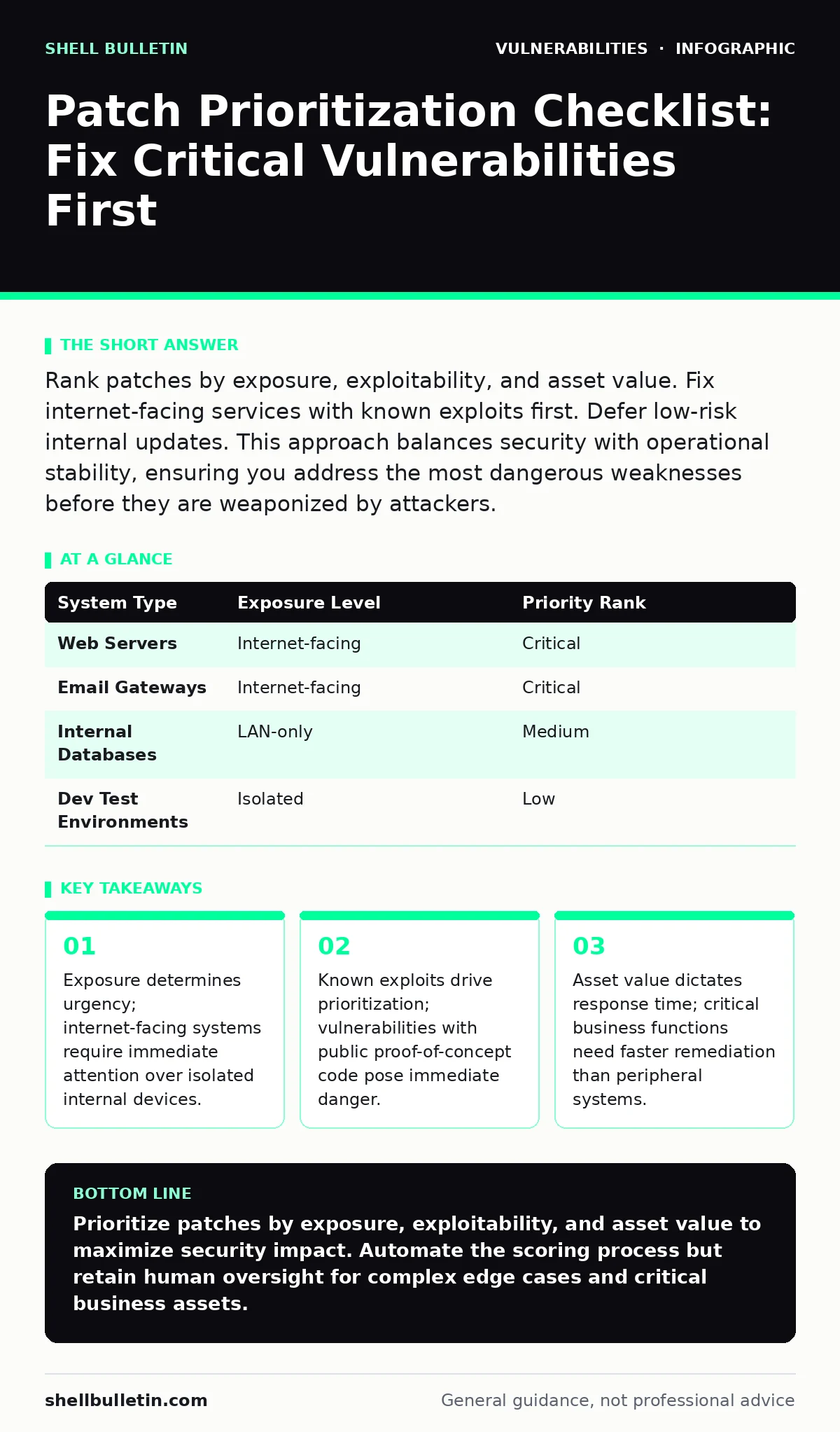
Rank patches by exposure, exploitability, and asset value. Fix internet-facing services with known exploits first. Defer low-risk internal updates. This approach balances security with operational stability, ensuring you address the most dangerous weaknesses before they are weaponized by attackers.
Assessing Exposure and Attack Surface
Network exposure defines your initial patching priority. Systems visible to the internet face constant automated scanning. Attackers target these surfaces first because they offer the easiest entry point. Internal systems, while still important, require an attacker to already be inside your network. You must distinguish between public-facing services and private infrastructure. This distinction allows you to allocate limited security resources where they prevent the most damage.
| System Type | Exposure Level | Priority Rank |
|---|---|---|
| Web Servers | Internet-facing | Critical |
| Email Gateways | Internet-facing | Critical |
| Internal Databases | LAN-only | Medium |
| Dev Test Environments | Isolated | Low |
Evaluating Exploitability and Weaponization
Not all vulnerabilities are created equal. Some require complex conditions to trigger, while others can be exploited with a simple request. You must check if public exploit code exists. If attackers have released working code, the window for remediation shrinks dramatically. This is often called "wildfire" status in security circles. You should also consider the complexity of the attack. Vulnerabilities requiring no user interaction are far more dangerous than those needing a click.
- Check for public exploit code: Public code lowers the barrier for attackers to launch immediate attacks.
- Assess interaction requirements: Zero-click exploits bypass user awareness and require faster remediation.
- Review complexity ratings: Lower complexity means a wider range of attackers can successfully exploit the flaw.
This approach mirrors the urgency seen when addressing buffer overflow vulnerabilities, where the execution path is often straightforward for automated tools.
Analyzing Asset Criticality and Data Sensitivity
A vulnerability on a printer is less dangerous than one on a customer database. You must map software to the data it holds. Systems processing sensitive information, such as payment details or health records, carry higher risk. The cost of a breach on these systems includes regulatory fines and reputational damage. Peripheral systems, like a breakroom TV or a test server, hold little value. You should prioritize patches based on the impact of a potential compromise on business continuity.
- Identify data sensitivity: Systems holding PII or financial data require immediate patching to prevent leaks.
- Map business impact: Downtime on critical production servers costs more than downtime on non-essential tools.
- Review access controls: Systems with fewer access controls need faster patching to compensate for weak barriers.
Imagine a scenario where a firmware vulnerabilities affects a network switch. While the switch does not store customer data, it controls traffic flow. Compromising it allows an attacker to intercept all data passing through. This illustrates why network infrastructure often ranks higher than expected.
Integrating Deployment and Testing Constraints
Patching is not just about finding flaws; it is about fixing them safely. Some updates break existing functionality. You must consider the risk of introducing new issues. Systems that are difficult to test or rollback require careful scheduling. You cannot patch a legacy system without verifying compatibility. This trade-off often means delaying a patch until a maintenance window opens. However, you must balance this delay against the growing risk of exposure.
- Check compatibility dependencies: Ensure the patch does not break integrated applications or workflows.
- Verify rollback procedures: Confirm you can revert the patch if it causes system instability.
- Schedule maintenance windows: Apply updates during low-traffic periods to minimize user disruption.
This process connects directly to security regression testing, which ensures that new fixes do not inadvertently open new doors for attackers.
Managing Technical Debt and End-of-Life
Software support does not last forever. When a vendor stops releasing patches, the software becomes end-of-life. These systems cannot be patched in the traditional sense. You must isolate them or replace them. Technical debt accumulates when you defer updates for too long. Eventually, the backlog becomes unmanageable. You should track unsupported software separately. These assets require compensating controls, such as network segmentation, to reduce risk.
- Identify end-of-life software: Unsupported systems lack security fixes and require immediate isolation or replacement.
- Track deferred patches: Maintain a log of postponed updates to prevent technical debt accumulation.
- Implement compensating controls: Use network segmentation to protect systems that cannot be patched directly.
Ignoring this leads to situations similar to broken object level authorization (BOLA), where fundamental design flaws persist because the underlying code is no longer maintained or reviewed.
See also: Implement Vulnerability Scanning: A Step-by-Step Operational Guide
Automating Prioritization and Review
Manual prioritization is slow and error-prone. You should use tools to automate the collection of vulnerability data. These tools can score risks based on exposure, exploitability, and asset value. Regular reviews ensure the list remains current. Threats evolve, and new vulnerabilities emerge constantly. You must update your prioritization criteria as your environment changes. Automation provides consistency, but human judgment is still needed for edge cases.
- Use vulnerability scanners: Automate the detection of known flaws across your infrastructure.
- Integrate with ticketing systems: Create tasks automatically for high-priority patches.
- Review scores monthly: Adjust criteria based on new threat intelligence and business changes.
This automation helps prevent issues like GitHub Actions workflow injection, where outdated dependencies in automated pipelines can become entry points.
Handling Specific Vulnerability Types
Some vulnerabilities require special handling. For example, cross-site scripting (XSS) flaws often reside in application code rather than system software. Patching these requires code changes, not just binary updates. You must work with developers to fix the root cause. Similarly, host header injection vulnerabilities require specific application-level fixes. General system patches will not resolve these. You need a tailored approach for application-layer flaws.
- Separate code fixes: Application vulnerabilities like XSS require developer intervention and code review.
- Address configuration issues: Some flaws are configuration errors, not software bugs, and need immediate correction.
- Monitor for new patterns: Stay alert for emerging vulnerability types that bypass traditional defenses.
Reviewing Memory and Logic Flaws
Deep system flaws, such as memory corruption bugs, are difficult to detect and exploit. They often require specialized knowledge. However, when exploited, they can lead to full system control. You must prioritize patches for operating systems and core libraries. These components run with high privileges. A flaw here gives an attacker significant power. You should monitor vendor advisories closely for these types of issues. They often have lower public profiles but high impact.
- Prioritize OS updates: Core system components run with high privileges and require fast patching.
- Watch library updates: Common libraries used by many apps can propagate risk across your environment.
- Check vendor advisories: Stay informed about deep system flaws that may not have public exploits yet.
Key takeaways
- Exposure determines urgency; internet-facing systems require immediate attention over isolated internal devices.
- Known exploits drive prioritization; vulnerabilities with public proof-of-concept code pose immediate danger.
- Asset value dictates response time; critical business functions need faster remediation than peripheral systems.
Prioritize patches by exposure, exploitability, and asset value to maximize security impact. Automate the scoring process but retain human oversight for complex edge cases and critical business assets.
Frequently asked questions
How often should I review my patch prioritization list?
Review the list at least monthly. New vulnerabilities and changes in business criticality can shift priorities rapidly.
What if a critical patch breaks my application?
Isolate the vulnerable system temporarily and work with vendors for a fix. Do not leave it exposed while waiting.
Can I ignore low-severity vulnerabilities?
Do not ignore them indefinitely. They can be chained with other flaws to create a severe risk. Schedule them for regular maintenance.
How do I handle end-of-life software?
Isolate the system from the internet and internal critical networks. Plan for replacement as soon as possible.
How this guide was produced: written by the Shell Bulletin editorial team with AI assistance, checked against the public references listed below, and reviewed when the facts change. See our editorial policy or report an error.