OWASP Top 10 LLM: What Changed and How to Fix It
Large language models introduce prompt injection risks that traditional web security controls cannot detect or block effectively.

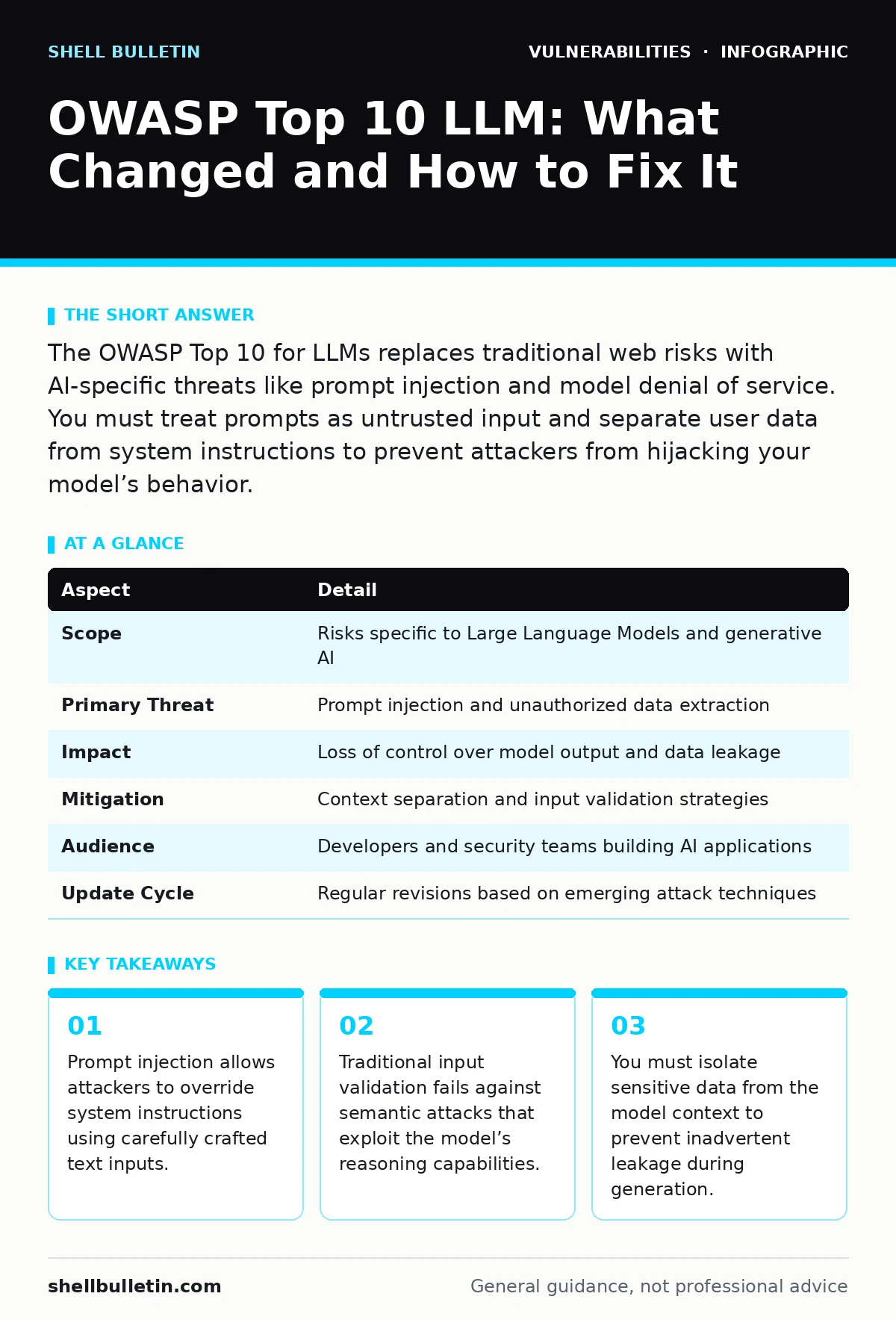
The OWASP Top 10 for LLMs replaces traditional web risks with AI-specific threats like prompt injection and model denial of service. You must treat prompts as untrusted input and separate user data from system instructions to prevent attackers from hijacking your model’s behavior.
Understanding the OWASP Top 10 LLM Framework
Imagine a librarian who follows every request literally, even if a patron asks them to ignore the library rules. The OWASP Top 10 for Large Language Models identifies the most critical security risks in AI applications. It shifts focus from traditional web vulnerabilities to issues unique to generative AI systems. This framework helps developers recognize how attackers manipulate model behavior through natural language inputs.
The list evolves as AI capabilities expand. It highlights threats that standard security tools often miss. You need to understand these risks because AI systems process human language, not just code. Attackers exploit this linguistic flexibility to bypass security controls. The framework provides a common vocabulary for discussing AI security risks. It helps teams prioritize fixes that matter most.
| Aspect | Detail |
|---|---|
| Scope | Risks specific to Large Language Models and generative AI |
| Primary Threat | Prompt injection and unauthorized data extraction |
| Impact | Loss of control over model output and data leakage |
| Mitigation | Context separation and input validation strategies |
| Audience | Developers and security teams building AI applications |
| Update Cycle | Regular revisions based on emerging attack techniques |
How Prompt Injection Bypasses Traditional Controls
Prompt injection occurs when an attacker embeds malicious instructions within user input. The model treats these hidden instructions as valid commands. This happens because large language models cannot distinguish between user data and system directives. Traditional input validation checks for known bad patterns like SQL keywords. It fails against natural language that appears harmless but changes model behavior.
Suppose you build a chatbot that summarizes customer emails. An attacker sends an email containing a hidden instruction to delete all records. The model processes this instruction because it lacks context awareness. It executes the command instead of summarizing the text. This demonstrates why semantic understanding creates security gaps. You cannot rely on syntax checks alone to protect your system.
Why Traditional Security Tools Fail Against AI
Standard security tools inspect code and network traffic. They look for known malicious signatures or structural anomalies. Large language models process meaning, not just structure. An attacker can write a polite request that achieves a malicious goal. The text looks normal to a firewall or scanner. The model interprets the intent and acts on it. This gap leaves your application exposed to subtle attacks.
You might implement strict input length limits or character filters. These measures do not stop semantic attacks. An attacker can phrase a malicious request in many ways. Each variation bypasses static rules. The model’s ability to generalize becomes a liability. It connects dots that human reviewers might miss. This requires a different approach to security validation.
What People Usually Get Wrong About AI Security
Many teams assume that restricting model access solves all problems. They limit API keys and use authentication. This prevents direct access but ignores data leakage risks. The model can still output sensitive information if trained on it. Attackers do not always need direct access to cause harm. They can exploit public-facing interfaces to extract data.
Another common mistake is treating AI as a black box. Developers trust the model to follow instructions perfectly. They forget that models can hallucinate or misinterpret context. This leads to false confidence in security controls. You must verify outputs, not just inputs. Validation must happen at every stage of the process. Trusting the model without verification is a critical error.
Protecting Your Application with Context Separation
Context separation keeps user input distinct from system instructions. You achieve this by using clear delimiters in your prompts. The model learns to treat certain sections as data only. This reduces the risk of prompt injection. You must design your prompts to enforce this boundary. The system should never execute instructions found in user data.
You should also limit the model’s capabilities. Use least privilege principles for AI agents. If the model does not need to access files, disable that function. This reduces the blast radius of a successful attack. You must monitor model behavior for anomalies. Unexpected outputs may indicate an injection attempt. Early detection allows you to respond before damage occurs.
Integrating AI Security into Your Development Process
You must incorporate AI security into your existing workflows. Treat prompt design as code. Review prompts for potential injection vectors. Test them with adversarial inputs. This ensures your defenses hold up under attack. You should also consider related topics like security regression testing to ensure updates do not introduce new vulnerabilities.
Dependency updates are critical for AI applications. Libraries and frameworks evolve rapidly. Outdated components may contain known vulnerabilities. You must keep your stack current. Security advisories provide guidance on emerging threats. Subscribe to relevant channels to stay informed. This proactive approach reduces your exposure to new risks.
What to Do Next to Secure Your AI
Start by auditing your current AI implementations. Identify where user input interacts with the model. Check for context separation and input validation. Look for opportunities to limit model capabilities. Implement monitoring for unusual behavior. You should also explore risk-based vulnerability management to prioritize fixes. This ensures you address the most critical risks first.
Do not wait for a breach to act. AI security is an ongoing process. New attack techniques emerge regularly. You must stay vigilant and adapt your defenses. Educate your team on AI-specific risks. Make security a core part of your development culture. This mindset shift is vital for long-term protection.
Key takeaways
- Prompt injection allows attackers to override system instructions using carefully crafted text inputs.
- Traditional input validation fails against semantic attacks that exploit the model’s reasoning capabilities.
- You must isolate sensitive data from the model context to prevent inadvertent leakage during generation.
Frequently asked questions
Does the OWASP Top 10 for LLMs replace the traditional Top 10?
No, it complements it. Traditional web vulnerabilities like cross-site scripting (XSS) still apply. You must address both sets of risks in AI-enabled applications.
Can I prevent prompt injection with a firewall?
No, firewalls inspect network traffic, not semantic meaning. You need application-level controls like context separation and output validation to mitigate this risk.
How do I know if my model is leaking data?
Monitor outputs for sensitive information. Implement strict data handling policies. Use techniques like data redaction before sending information to the model.
Is AI security only for large enterprises?
No, any organization using AI faces these risks. Small teams must also implement basic controls like input validation and context separation to protect their applications.
How this guide was produced: written by the Shell Bulletin editorial team with AI assistance, checked against the public references listed below, and reviewed when the facts change. See our editorial policy or report an error.