OWASP Top 10 for Agentic Applications: Risks and Mitigations
Traditional web security controls fail when AI agents possess autonomous decision-making power, creating new attack surfaces that require behavioral monitoring and strict permission boundaries.

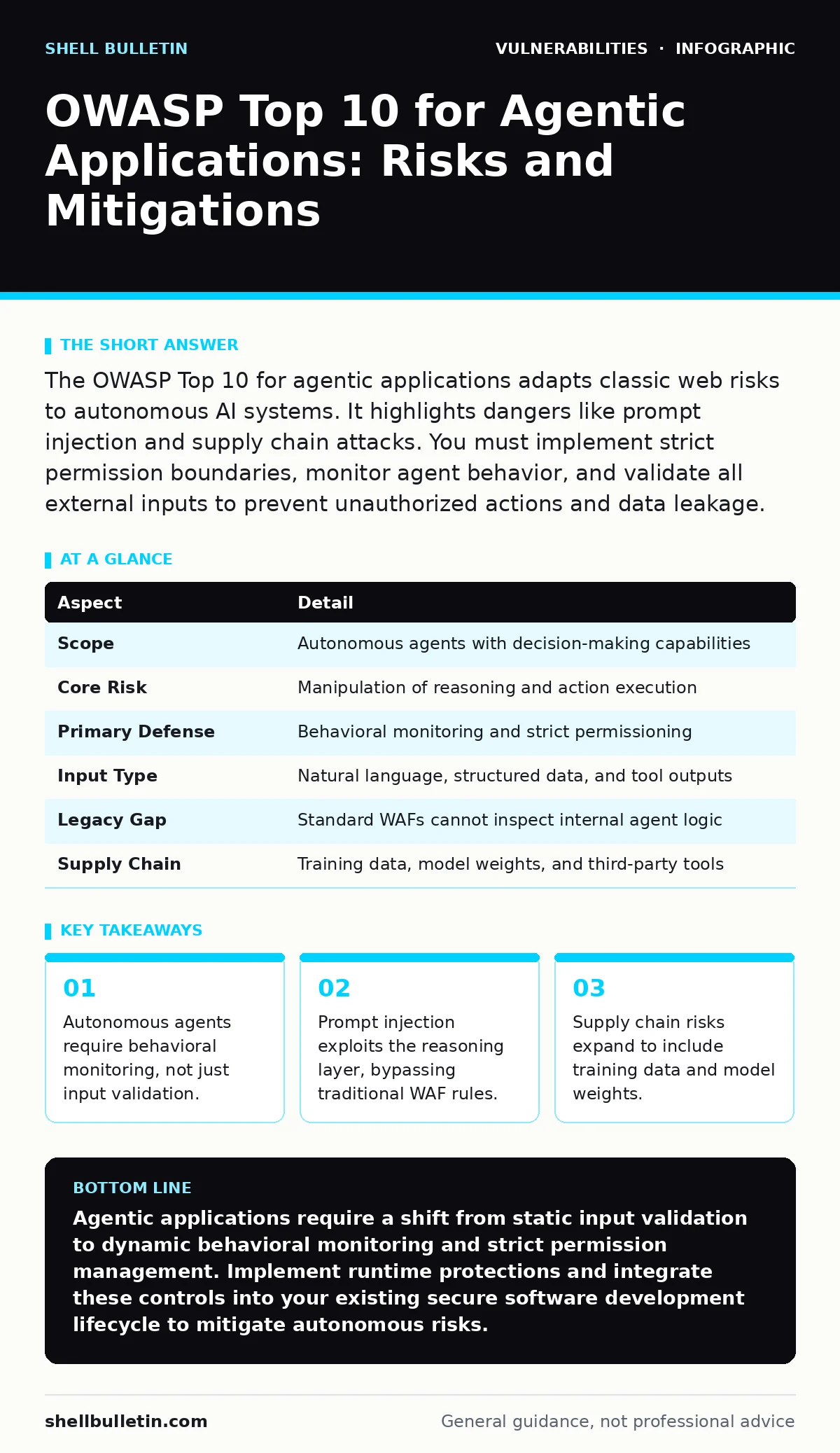
The OWASP Top 10 for agentic applications adapts classic web risks to autonomous AI systems. It highlights dangers like prompt injection and supply chain attacks. You must implement strict permission boundaries, monitor agent behavior, and validate all external inputs to prevent unauthorized actions and data leakage.
Understanding the Shift to Agentic Security
Traditional security frameworks assume a passive application that responds to user requests. Agentic applications differ because they make independent decisions, execute tasks, and interact with external systems without constant human oversight. The OWASP Top 10 for agentic applications addresses this shift by focusing on how autonomous behavior introduces unique failure modes. You cannot rely on standard input validation alone when the system can reinterpret instructions or alter its own logic.
The framework extends classic web application security principles to cover the lifecycle of an autonomous agent. It examines how an agent perceives the world, plans actions, and executes commands. This broader scope reveals vulnerabilities that exist in the reasoning process itself, not just in the code execution. You must treat the agent’s decision-making process as a critical asset that requires protection from manipulation and abuse.
What People Usually Get Wrong
Many teams assume that securing the API endpoints is sufficient for agentic systems. This view ignores the fact that an agent can construct its own requests based on internal reasoning. If an agent receives a malicious instruction, it may generate legitimate-looking API calls that bypass standard security filters. You face a gap between what the system is allowed to do and what the agent decides to do in pursuit of a goal.
Another common error is treating AI models as black boxes that are immune to traditional attacks. Models can be influenced by subtle patterns in input data that humans do not notice. These patterns can steer the agent toward harmful actions without triggering obvious error messages. You must validate the intent behind the agent’s actions, not just the syntax of its outputs. This requires a deeper understanding of how the model interprets context and constraints.
| Aspect | Detail |
|---|---|
| Scope | Autonomous agents with decision-making capabilities |
| Core Risk | Manipulation of reasoning and action execution |
| Primary Defense | Behavioral monitoring and strict permissioning |
| Input Type | Natural language, structured data, and tool outputs |
| Legacy Gap | Standard WAFs cannot inspect internal agent logic |
| Supply Chain | Training data, model weights, and third-party tools |
The OWASP Top 10 for Agentic Applications
The OWASP Top 10 for agentic applications categorizes risks specific to autonomous systems. It begins with prompt injection, where attackers embed malicious instructions in user input to override the agent’s primary directives. Unlike simple input errors, these injections exploit the model’s ability to follow complex instructions. You must sanitize all external inputs before they reach the reasoning engine.
The list also covers supply chain vulnerabilities related to AI components. Attackers can poison training data or inject malicious code into third-party libraries used by the agent. These compromises are difficult to detect because the malicious behavior appears only under specific conditions. You need rigorous verification of all models and dependencies before deployment.
Another critical category is the misuse of agent privileges. Agents often require elevated access to complete tasks, such as reading databases or sending emails. If an attacker compromises the agent, they inherit these privileges. You must implement the principle of least privilege, granting the agent only the specific permissions needed for its immediate task.
Prompt Injection and Reasoning Manipulation
Prompt injection is the most significant risk for agentic applications. It occurs when an attacker crafts input that changes the agent’s interpretation of its instructions. The agent may believe it is following a legitimate command while actually executing a malicious one. This attack targets the semantic understanding of the model, which standard encoding techniques cannot protect.
You can mitigate this by separating system instructions from user input. Use distinct delimiters and explicit instructions to ignore embedded commands. Additionally, monitor the agent’s behavior for deviations from expected patterns. If the agent attempts an action outside its normal scope, block it and alert an administrator. This adds a layer of runtime protection that catches attacks after they bypass static checks.
Supply Chain and Model Integrity
Agentic applications rely on complex ecosystems of models, tools, and data. Each component introduces potential vulnerabilities. Attackers can compromise a library used by the agent, introducing malicious logic that executes during normal operations. This form of supply chain attack is particularly dangerous because the compromised code runs with the agent’s privileges.
You must verify the integrity of all third-party components. Use cryptographic signatures to ensure that model weights and libraries have not been tampered with. Implement a secure software development lifecycle that includes automated testing for known vulnerabilities. Regularly update dependencies to patch any discovered flaws. This reduces the risk of inheriting compromised code from external sources.
Privilege Management and Execution Control
Agents often need to interact with external systems to complete tasks. This requires granting them access to APIs, databases, and file systems. If an attacker compromises the agent, they gain access to these resources. You must restrict the agent’s permissions to the minimum necessary for its specific tasks.
Implement a sandbox environment that isolates the agent’s execution. This prevents malicious actions from affecting the broader system. Monitor all external calls made by the agent and validate them against a whitelist of allowed actions. If the agent attempts an unauthorized action, block it immediately. This containment strategy limits the damage of a successful attack.
Behavioral Monitoring and Anomaly Detection
Traditional security tools focus on known attack signatures. Agentic applications require a different approach because the attack surface is dynamic. You must monitor the agent’s behavior for anomalies that indicate compromise. This includes unusual API calls, unexpected data access patterns, or deviations from normal reasoning paths.
Deploy machine learning models that learn the normal behavior of your agents. These models can detect subtle changes that indicate manipulation. Combine this with human oversight for high-risk actions. Require manual approval for sensitive operations, such as deleting data or transferring funds. This hybrid approach balances automation with security control.
Integration with Existing Security Practices
You cannot treat agentic security in isolation. It must integrate with your existing security framework. Output encoding remains relevant to prevent injection attacks when the agent generates content for users. Cross-site scripting (XSS) protections are still necessary if the agent renders web content. You must apply these controls consistently across all components.
Cross-site WebSocket hijacking is another risk if your agent uses real-time communication channels. Ensure that authentication tokens are properly validated and not exposed in URLs. Privilege escalation vulnerabilities can occur if an agent gains unauthorized access to system functions. Regularly review access controls to prevent this.
Risk-based vulnerability management helps prioritize which issues to fix first. Focus on vulnerabilities that allow remote code execution or data exfiltration. This approach ensures that you address the most critical risks efficiently. By combining these practices, you create a defense-in-depth strategy that protects both traditional and agentic components.
Key takeaways
- Autonomous agents require behavioral monitoring, not just input validation.
- Prompt injection exploits the reasoning layer, bypassing traditional WAF rules.
- Supply chain risks expand to include training data and model weights.
Agentic applications require a shift from static input validation to dynamic behavioral monitoring and strict permission management. Implement runtime protections and integrate these controls into your existing secure software development lifecycle to mitigate autonomous risks.
Frequently asked questions
How does prompt injection differ from traditional SQL injection?
SQL injection exploits syntax errors in database queries, while prompt injection manipulates the semantic understanding of an AI model to override its instructions.
Can a firewall protect an agentic application from prompt injection?
No, because prompt injection occurs at the reasoning layer, which is invisible to network-level firewalls that inspect packet headers and payloads.
What is the role of sandboxing in agentic security?
Sandboxing isolates the agent’s execution environment, preventing malicious actions from affecting the broader system or accessing unauthorized resources.
How often should I review agent permissions?
You should review permissions regularly and after any significant change to the agent’s functionality or the underlying system it interacts with.
How this guide was produced: written by the Shell Bulletin editorial team with AI assistance, checked against the public references listed below, and reviewed when the facts change. See our editorial policy or report an error.