How Output Encoding Works and Where It Fails
Output encoding transforms dangerous characters into safe data representations, but context switching often breaks these defenses in complex applications.

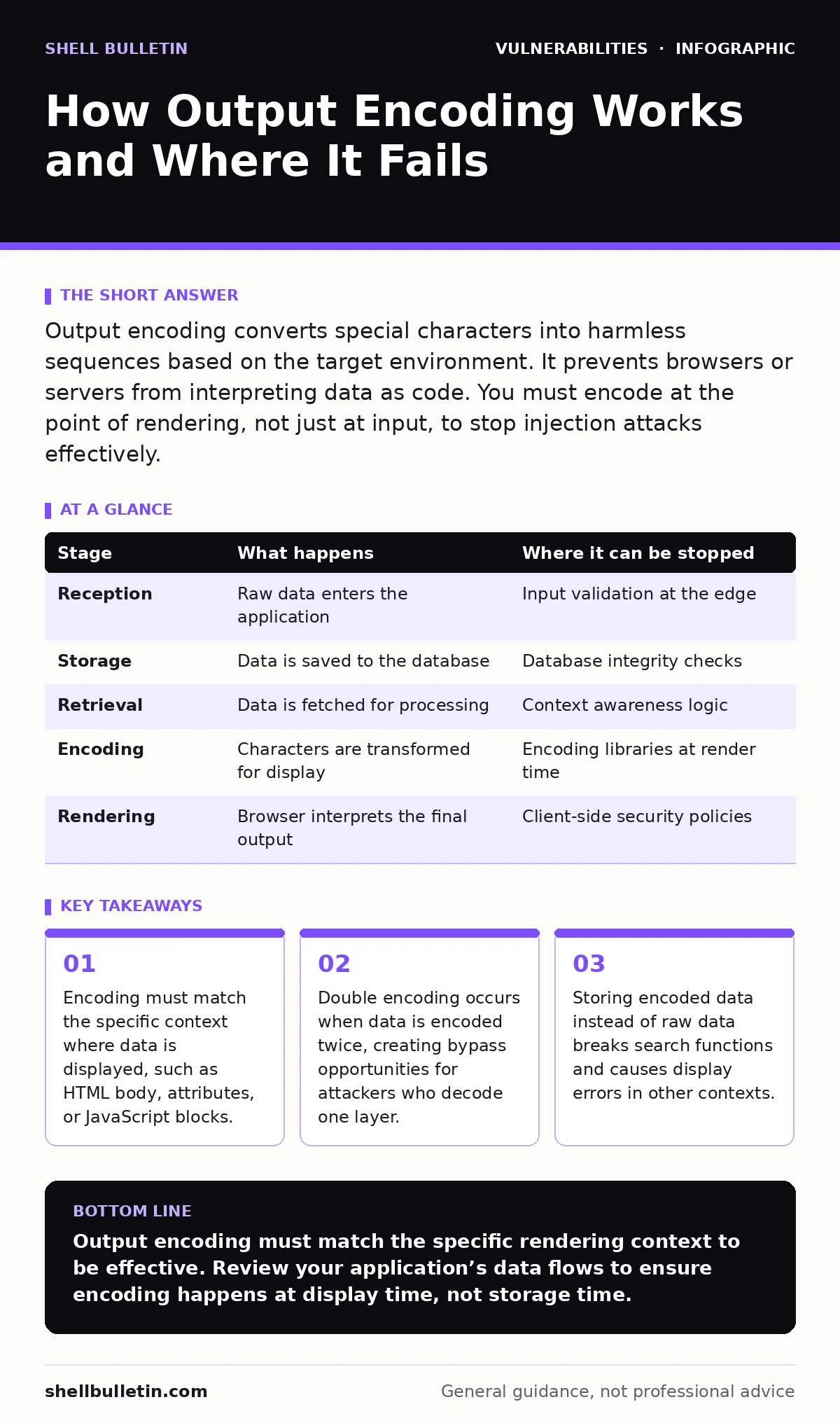
Output encoding converts special characters into harmless sequences based on the target environment. It prevents browsers or servers from interpreting data as code. You must encode at the point of rendering, not just at input, to stop injection attacks effectively.
The Core Mechanism of Character Translation
Output encoding is the process of converting special characters into a safe representation that the target system interprets as data, not executable code. When an application receives user input, it often contains characters like angle brackets or quotes that have special meaning in HTML or JavaScript. The system must translate these characters so they appear visually identical but lose their technical power.
This translation happens through character escaping. The system replaces a dangerous character with a sequence that represents it. For example, an opening angle bracket becomes a text string that renders as a bracket but does not start a tag. This ensures the browser displays the character as intended without executing hidden instructions.
Stage 1: Data Reception and Storage
When a user submits data, the application receives it as a raw stream of bytes. At this stage, the system should store the data exactly as received, without modification. Altering data during storage creates problems when that data needs to be used in a different context later.
Suppose a user enters a product review with special formatting characters. If the server encodes these characters before saving them to the database, the stored value no longer matches the original input. This mismatch causes issues when the data is retrieved for processing or display in a non-web environment.
| Stage | What happens | Where it can be stopped |
|---|---|---|
| Reception | Raw data enters the application | Input validation at the edge |
| Storage | Data is saved to the database | Database integrity checks |
| Retrieval | Data is fetched for processing | Context awareness logic |
| Encoding | Characters are transformed for display | Encoding libraries at render time |
| Rendering | Browser interprets the final output | Client-side security policies |
Stage 2: Context Determination
Before encoding, the application must determine where the data will appear. This context dictates which characters are dangerous. A character that is safe in an HTML body might be dangerous inside a JavaScript variable or a CSS style attribute.
Identifying the context is the most difficult part of output encoding. Many developers assume HTML encoding is sufficient for all cases. This assumption fails when data moves into attributes, URLs, or event handlers. Each context has a different set of reserved characters that require specific escaping rules.
Stage 3: The Encoding Process
Once the context is known, the application applies the correct encoding scheme. HTML entity encoding replaces characters like < and > with < and >. JavaScript encoding escapes quotes and backslashes to prevent string termination.
This step happens at the moment the data is prepared for output, not when it is stored. Encoding at storage time is a common mistake that leads to data corruption. By waiting until render time, you ensure the data remains flexible and usable across different parts of the application.
Stage 4: Rendering and Interpretation
The final stage involves the browser or client software interpreting the encoded data. The rendering engine converts the escape sequences back into visual characters. The user sees the original text, but the underlying code structure remains intact and secure.
If the encoding was incorrect for the context, the browser may interpret part of the data as code. This allows an attacker to inject scripts that run in the victim's browser. Correct encoding ensures that the visual output matches the intent without altering the execution flow.
Hidden Costs of Poor Implementation
Output encoding is not a one-time fix. It requires consistent application across all features of a software system. Developers often miss edge cases where data is passed through multiple layers before display. Each layer may apply its own encoding, leading to double encoding.
Double encoding occurs when data is encoded twice. An attacker can exploit this by sending pre-encoded data that bypasses the first filter. When the application decodes one layer for display, the remaining encoded characters become active again. This subtle flaw undermines the entire security posture.
Limits of Output Encoding Alone
Output encoding protects against injection attacks where data is confused for code. It does not protect against logic errors or business rule violations. An attacker might submit validly encoded data that still causes financial loss or data leakage through legitimate application features.
Encoding also does not fix underlying design flaws. If an application relies on user input for critical decisions without proper validation, encoding alone is insufficient. You must combine output encoding with input validation and a secure software development lifecycle to create effective defenses.
Maintaining Security Over Time
Applications evolve, and new features often introduce new contexts for data display. A feature that initially displayed data in a text block might later move it into a dynamic chart or a PDF generator. Each new context requires a review of the encoding strategy.
Regular vulnerability scanning helps identify areas where output encoding might be missing or misapplied. However, automated tools often miss complex context-switching scenarios. Manual code reviews remain necessary to ensure that every data path is handled correctly.
Integration with Broader Security Practices
Output encoding works best when integrated with other security measures. Input validation reduces the attack surface by rejecting obviously malicious data early. However, validation cannot replace encoding because it cannot anticipate every possible attack vector.
Keeping dependencies updated ensures that the libraries used for encoding are free from known bugs. Many encoding libraries have had flaws that allowed bypasses. Using outdated libraries introduces risk even if your application logic is sound. Refer to security advisories to stay informed about these issues.
Final Considerations for Implementation
Implementing output encoding requires discipline and consistency. Every place where data from users appears on a screen or in a response must go through the encoding process. Missing even one instance can expose your users to risk.
Testing is critical. You must test each data flow with various character sets and special symbols. Automated tests can help, but manual testing with crafted inputs often reveals subtle context-switching errors that tools miss. This diligence protects your users and your reputation.
Key takeaways
- Encoding must match the specific context where data is displayed, such as HTML body, attributes, or JavaScript blocks.
- Double encoding occurs when data is encoded twice, creating bypass opportunities for attackers who decode one layer.
- Storing encoded data instead of raw data breaks search functions and causes display errors in other contexts.
Output encoding must match the specific rendering context to be effective. Review your application’s data flows to ensure encoding happens at display time, not storage time.
Frequently asked questions
Does output encoding prevent all types of injection attacks?
No. It primarily prevents code injection by separating data from commands. It does not stop attacks that exploit logical flaws or business rule violations.
Should I encode data when it enters the application?
No. Encode data only when it is about to be displayed or sent to a different system. Storing encoded data causes corruption and display issues later.
What happens if I use the wrong encoding for the context?
The browser may interpret part of the data as code, allowing attackers to inject scripts. Each context like HTML, JavaScript, or CSS requires specific escaping rules.
Can automated tools find all output encoding errors?
Automated tools are helpful but often miss complex context-switching scenarios. Manual code review and thorough testing are still necessary to catch subtle bypasses.
How this guide was produced: written by the Shell Bulletin editorial team with AI assistance, checked against the public references listed below, and reviewed when the facts change. See our editorial policy or report an error.