Honeytokens Explained: 6 Misunderstandings That Ruin Detection
Honeytokens are silent tripwires that detect data exfiltration and credential theft without requiring network monitoring or active defense systems.

Honeytokens are hidden data markers that trigger alerts when accessed. They are not decoy servers or fake passwords. Misusing them as visible traps or placing them in low-risk areas creates noise. Proper deployment requires embedding them in sensitive documents and databases to catch insider threats and lateral movement before data leaves the network.
Misreading: Honeytokens are decoy servers or fake accounts
Correct reading: Honeytokens are not infrastructure. They are static data markers embedded in files, databases, or configuration settings. A decoy server is a network node designed to look like a real asset. A honeytoken is a piece of information, such as a fake API key, a dummy credit card number, or a specific string of text inside a PDF.
When an attacker reads or copies this data, the system logs the event. This distinction matters because you do not need to manage a server to deploy a honeytoken. You only need to manage the data itself. The mechanism relies on the assumption that legitimate users never access this specific hidden data. If they do, you have a false positive or a policy violation.
Imagine a spreadsheet containing customer records. You insert a row with a fake phone number and a unique identifier. No legitimate employee calls that number. If the identifier appears in access logs or is copied to a USB drive, you know an unauthorized party accessed the sheet. This is detection by data access, not by network traffic. It complements network traffic analysis by providing context about what was stolen, not just that something moved.
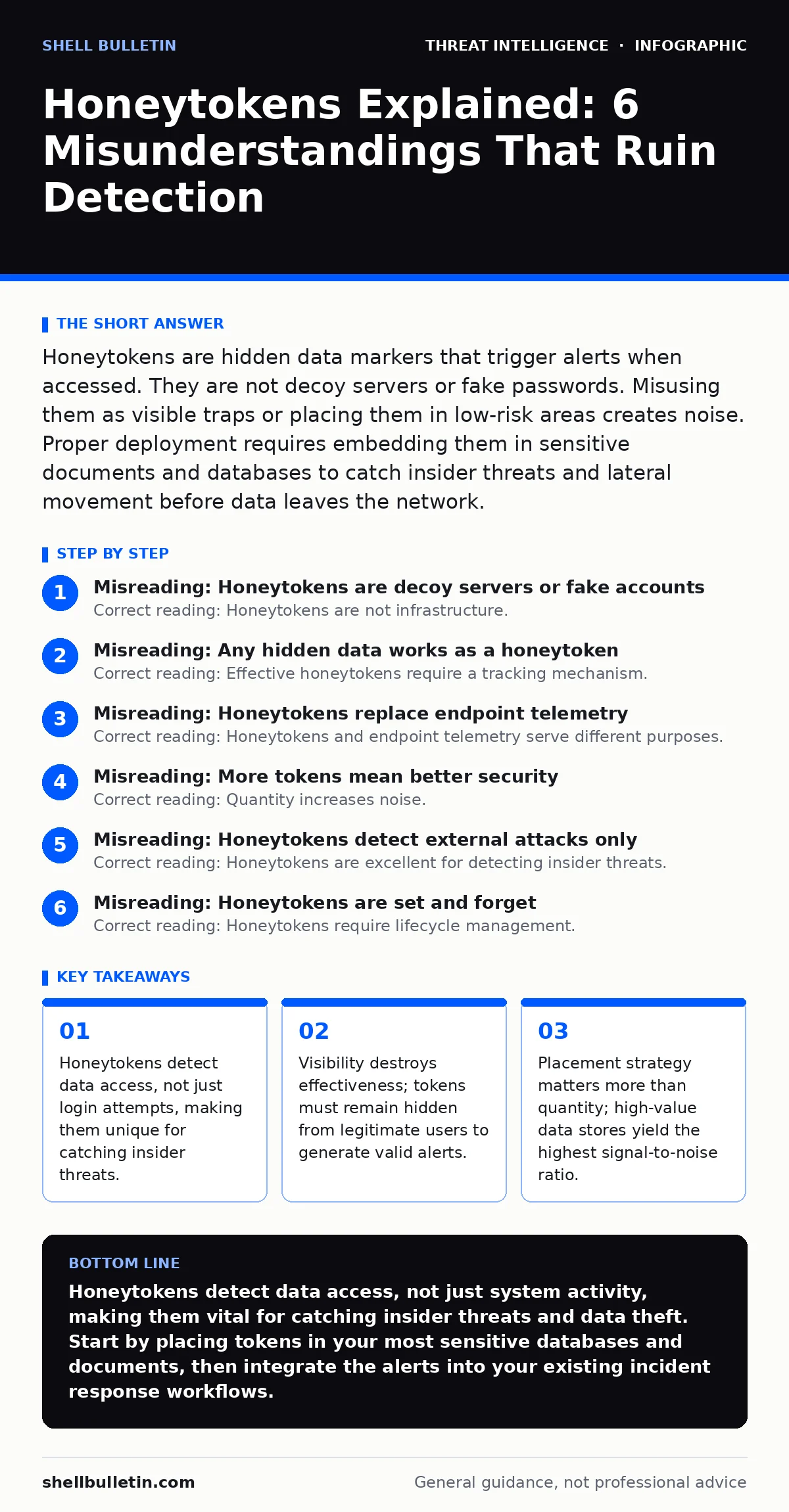
Misreading: Any hidden data works as a honeytoken
Correct reading: Effective honeytokens require a tracking mechanism. Simply hiding a file is not enough. The token must be linked to an alerting system. This system could be a local script, a Security Information and Event Management (SIEM) rule, or a dedicated service. The token needs a unique identifier that does not appear elsewhere in your environment. If the identifier is common, legitimate processes might trigger it. You must ensure the token is distinct. The tracking system monitors for the presence or usage of that unique identifier. Without a way to detect the interaction, the token is invisible to your defense team. It becomes a ghost that serves no purpose.
The cost of a token is the maintenance of its uniqueness. Over time, systems change. Backups might restore old data. Scripts might parse all files. You must verify that your monitoring rules still work. This requires periodic validation. You should test the token by accessing it yourself and confirming the alert fires. This validation step is often skipped, leading to silent failures where the token exists but the detection pipeline is broken. This is a hidden cost of passive defense.
Misreading: Honeytokens replace endpoint telemetry
Correct reading: Honeytokens and endpoint telemetry serve different purposes. Endpoint telemetry records system events like process creation, file modifications, and network connections. It tells you what the machine did. Honeytokens tell you what data was accessed. They are complementary. An attacker might use living-off-the-land attacks to hide their activity from standard telemetry. They might use legitimate tools to copy files. Endpoint telemetry might show a legitimate user copying a file. Honeytokens reveal that the copied file contained sensitive, hidden data. This adds a layer of intent detection. You see not just the action, but the value of the target.
You cannot rely on honeytokens for full visibility. They only detect access to the specific data they protect. They do not monitor the rest of the system. You still need endpoint telemetry to see malware execution or unusual process behavior. Think of honeytokens as specific pressure pads on a floor. They tell you if someone stepped on the safe. They do not tell you if someone is breaking the window. Both sensors are needed for a complete picture of the environment.
Misreading: More tokens mean better security
Correct reading: Quantity increases noise. If you place tokens everywhere, you increase the chance of false positives. Legitimate users might accidentally access a token if it is placed poorly. For example, placing a token in a shared template document that everyone uses will trigger alerts constantly. This leads to alert fatigue. Analysts will ignore the alerts because they become routine. The signal is lost in the noise. You must place tokens strategically. Focus on high-value data. These are the assets an attacker targets. Customer databases, intellectual property, and financial records are prime candidates. Low-value data does not justify the monitoring overhead.
Strategic placement requires understanding your business data flow. You need to know where sensitive data lives and who should access it. This is a data classification exercise. If you do not know your data, you cannot place tokens effectively. Random placement is a waste of resources. It creates a false sense of security. You think you are covered, but you are only generating noise. The goal is high-fidelity alerts. One alert that confirms a breach is worth more than a hundred false positives.
Misreading: Honeytokens detect external attacks only
Correct reading: Honeytokens are excellent for detecting insider threats. External attackers often move slowly and carefully. They may spend weeks inside a network before exfiltrating data. During this time, they may access sensitive files. Honeytokens detect this access. Insider threats are harder to detect because they have legitimate credentials. They can access files without triggering access control violations. Honeytokens bypass this limitation. They do not care about credentials. They care about data access. If an insider copies a file containing a honeytoken, the alert fires. This is a critical capability for organizations facing insider risk.
Imagine an employee who is disgruntled. They start copying files to a personal drive. Standard access controls allow this because they have permission. Endpoint telemetry might show file copy events, but not the content. A honeytoken inside the copied file reveals the theft. This makes honeytokens a powerful tool for insider threat detection. They provide evidence of data exfiltration that other tools might miss. This is a non-obvious benefit. Many organizations focus only on external threats and ignore this internal visibility gap.
See also: Dark Web Search Engines: How to Detect Local Access
Misreading: Honeytokens are set and forget
Correct reading: Honeytokens require lifecycle management. They degrade over time. Systems change. Users change. Permissions change. A token that was hidden might become visible due to a configuration error. A token that was unique might be duplicated in a backup. You must review and rotate tokens periodically. Rotation involves creating new tokens and decommissioning old ones. This ensures the tokens remain unique and hidden. It also prevents attackers from learning the token structure. If an attacker finds one token, they might look for others with similar patterns. Rotation breaks this pattern.
This maintenance is a trade-off. Passive detection is low effort, but not zero effort. You must budget time for token management. Include it in your incident response runbooks. Define how you handle a token trigger. Who investigates? What is the escalation path? Without a process, the alert is useless. You must integrate token alerts into your existing workflows. This integration requires coordination between security and IT teams. It is not a solo effort. The value of honeytokens depends on the response to their alerts.
Key takeaways
- Honeytokens detect data access, not just login attempts, making them unique for catching insider threats.
- Visibility destroys effectiveness; tokens must remain hidden from legitimate users to generate valid alerts.
- Placement strategy matters more than quantity; high-value data stores yield the highest signal-to-noise ratio.
Honeytokens detect data access, not just system activity, making them vital for catching insider threats and data theft. Start by placing tokens in your most sensitive databases and documents, then integrate the alerts into your existing incident response workflows.
Frequently asked questions
Do honeytokens slow down system performance?
No. Honeytokens are static data. They do not run code or consume processing power. The only overhead is the monitoring system that checks for their access. This overhead is negligible compared to full endpoint telemetry or network inspection.
Can attackers detect and remove honeytokens?
Sophisticated attackers might find them if they search thoroughly. However, removing all tokens is difficult because they are embedded in data. You can mitigate this by using many unique tokens and rotating them regularly. This makes complete removal impractical for the attacker.
Are honeytokens legal to use?
Generally, yes. They are passive monitoring tools. They do not interfere with user activity or install malicious software. However, you should consult legal counsel to ensure compliance with local privacy laws, especially if monitoring employee activity. Transparency in your security policy is recommended.
How do honeytokens differ from honeypots?
Honeypots are decoy systems that attract attackers. Honeytokens are decoy data items. Honeypots require network infrastructure and maintenance. Honeytokens require data embedding and monitoring. Honeytokens are easier to deploy and less likely to be discovered by casual attackers.
How this guide was produced: written by the Shell Bulletin editorial team with AI assistance, checked against the public references listed below, and reviewed when the facts change. See our editorial policy or report an error.