Data Residency Defined: Why Physical Location Dictates Your Security Posture
Data residency dictates that the physical server holding your information must remain within specific legal borders, creating a hidden operational burden that most teams ignore.

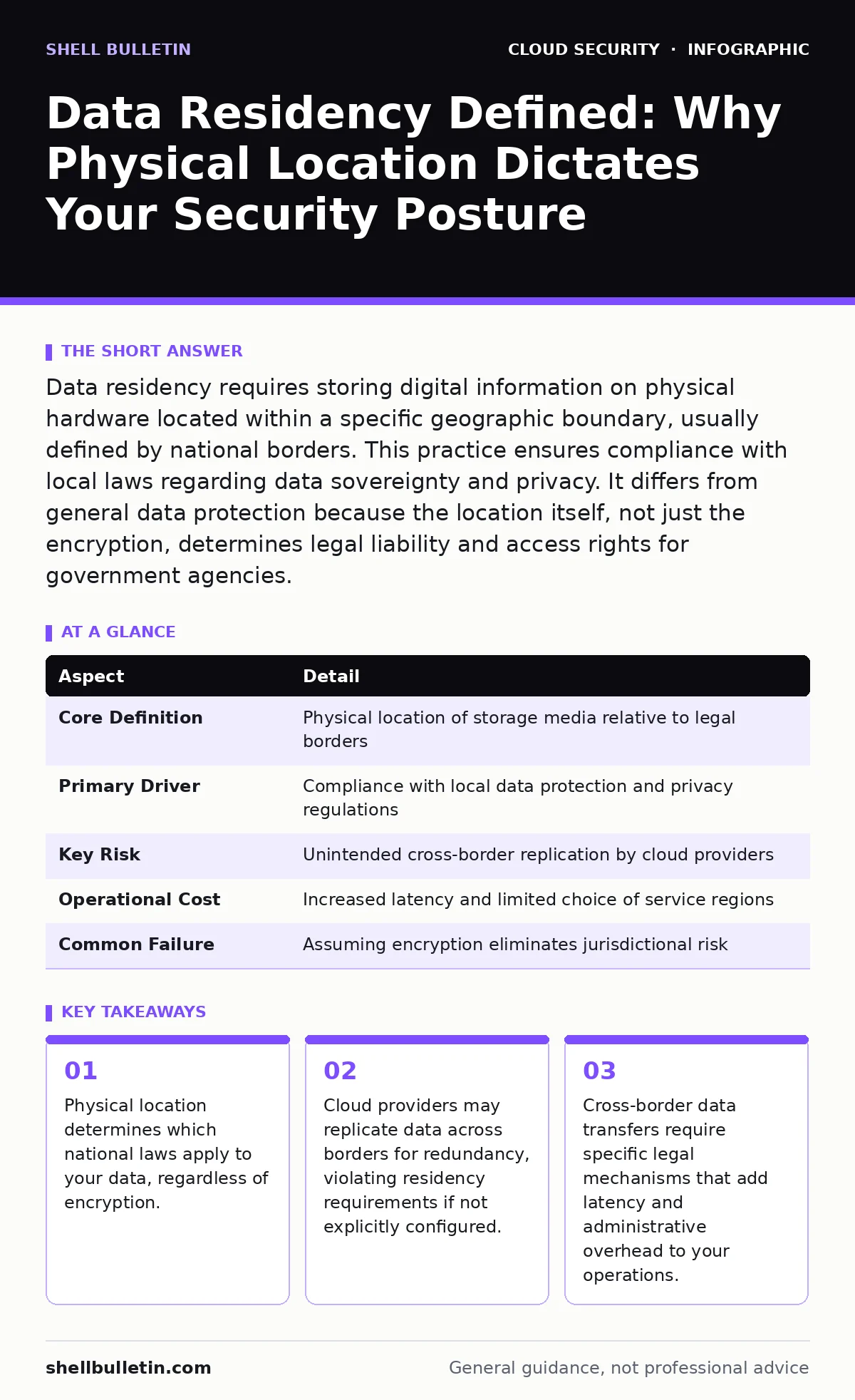
Data residency requires storing digital information on physical hardware located within a specific geographic boundary, usually defined by national borders. This practice ensures compliance with local laws regarding data sovereignty and privacy. It differs from general data protection because the location itself, not just the encryption, determines legal liability and access rights for government agencies.
The Postal Service Analogy
Imagine sending a confidential letter. You can seal it in an envelope and encrypt its contents with a complex code. However, if you drop that letter into a mailbox in a foreign country, the postal service of that nation can legally inspect, hold, or read it under their laws. Data residency is the rule that dictates which mailbox your digital letter must enter. It is not about how secure the envelope is. It is about where the envelope physically sits.
Many people confuse this with data sovereignty. Sovereignty is the legal framework governing the data. Residency is the physical constraint. You can have strong sovereignty laws, but if your data resides in a server farm outside the jurisdiction, those laws may not protect you from foreign access.
At a Glance: Residency Mechanics
| Aspect | Detail |
|---|---|
| Core Definition | Physical location of storage media relative to legal borders |
| Primary Driver | Compliance with local data protection and privacy regulations |
| Key Risk | Unintended cross-border replication by cloud providers |
| Operational Cost | Increased latency and limited choice of service regions |
| Common Failure | Assuming encryption eliminates jurisdictional risk |
How the Term Emerges in Practice
The concept of data residency arises from the intersection of international law and global infrastructure. Nations view data as a strategic asset. They legislate that certain types of information, such as health records or financial transactions, must stay within their borders. This is not just about privacy. It is about national security and economic control.
When you select a cloud region, you are making a legal choice, not just a technical one. A region in Virginia is subject to United States laws. A region in Frankfurt is subject to German and European Union laws. The cloud provider builds the servers, but the local government holds the keys to legal access. You must understand that the provider’s terms of service cannot override national legislation.
Daily Operations and Hidden Costs
In day-to-day operations, data residency dictates where you can deploy applications. You cannot simply choose the cheapest or fastest region. You must map your data flows to legal boundaries. This creates a hidden cost in application architecture. You may need to build separate instances for different regions to ensure data does not accidentally cross borders during replication or backup.
This fragmentation complicates disaster recovery. If your primary region goes offline, you cannot automatically failover to a region in another country if your residency requirements forbid it. You must maintain idle capacity in a compliant region, which increases costs. This is a trade-off between resilience and compliance.
Consider the impact on ephemeral infrastructure. These are temporary resources that spin up and down automatically. If a worker node is created in a non-compliant zone, even for seconds, you may violate residency policies. You must enforce strict placement constraints in your orchestration tools to prevent this drift.
What People Usually Get Wrong
A common misconception is that encryption solves residency problems. Encryption protects the content of the data from unauthorized viewing. It does not change the legal jurisdiction of the storage device. If a server in a country with broad surveillance laws holds your encrypted data, that government can still seize the server and demand the keys. They may also compel the cloud provider to hand over metadata, which reveals who accessed the data and when.
Another error is assuming that "cloud neutrality" protects you. Cloud providers are subject to the laws of the countries in which they operate. They cannot refuse a valid legal request from a local government. Your data is not in "the cloud." It is in a specific building, owned by a specific company, in a specific country.
See also: DevSecOps vs DevOps: How to Integrate Security Without Slowing Delivery · What Is Immutable Infrastructure: A Static Security Model
The Impact on Network Architecture
Data residency forces you to rethink your network design. You may need to implement private endpoints to ensure that traffic between your applications and the data store never traverses the public internet. This reduces the attack surface but adds complexity to your routing tables.
You must also consider how zero trust network access interacts with residency. Zero trust verifies every request, regardless of origin. However, if a user in one country tries to access data residing in another, you must ensure the transmission path complies with both jurisdictions. This often requires building dedicated, geographically constrained access paths.
For organizations using containers, container runtime security must account for where the container image is stored and executed. If the image registry is in a different region than the runtime environment, you introduce another jurisdictional boundary. Each hop between regions is a potential compliance failure point.
Avoiding Configuration Drift
Cloud environments are dynamic. Resources move. Data replicates. Without rigorous controls, your architecture will drift away from your residency requirements. This is where cloud misconfigurations become dangerous. A simple mistake in a storage bucket policy can expose data to public access or replicate it to an unauthorized region.
You should automate compliance checks. Use infrastructure-as-code templates that enforce region constraints. Do not rely on manual verification. The scale of cloud deployments makes human error inevitable.
Reviewing CIS Benchmarks can help identify settings that inadvertently allow cross-border data movement. These benchmarks provide established best practices for securing cloud environments. Aligning your configurations with these standards reduces the risk of accidental non-compliance.
The Broader Security Context
Data residency is one layer of your security strategy. It works in tandem with other controls. For example, multi-cloud security strategies often involve distributing workloads across different providers to avoid vendor lock-in. However, this increases the complexity of managing residency requirements, as each provider has different region maps and compliance certifications.
You must also guard against exposed Kubernetes dashboards. If your orchestration platform is publicly accessible, an attacker could manipulate your deployments to move data to a non-compliant region. Securing the control plane is as important as securing the data itself.
Key takeaways
- Physical location determines which national laws apply to your data, regardless of encryption.
- Cloud providers may replicate data across borders for redundancy, violating residency requirements if not explicitly configured.
- Cross-border data transfers require specific legal mechanisms that add latency and administrative overhead to your operations.
Frequently asked questions
Does encrypting my data satisfy data residency requirements?
No. Encryption protects the content of the data but does not change the legal jurisdiction of the physical server storing it. Local laws still apply to the hardware and the provider.
What is the difference between data residency and data sovereignty?
Data residency refers to the physical location where data is stored. Data sovereignty refers to the body of laws that governs that data based on its location. Residency is the physical act; sovereignty is the legal consequence.
Can I store data in multiple countries to improve performance?
You can, but only if each jurisdiction allows it and you have the necessary legal agreements in place. Storing data in multiple countries increases compliance complexity and requires strict controls to prevent accidental cross-border transfers.
How do I check if my cloud provider is compliant with residency laws?
Review the provider’s compliance documentation and service level agreements. Verify the specific physical locations of availability zones and ensure that default replication settings do not move data outside your required borders.
How this guide was produced: written by the Shell Bulletin editorial team with AI assistance, checked against the public references listed below, and reviewed when the facts change. See our editorial policy or report an error.