Multi-Cloud Security Mechanics: How Identity Bridges Cloud Silos
Multi-cloud security fails when it treats providers as separate entities rather than a unified identity fabric that enforces policy across all environments simultaneously.
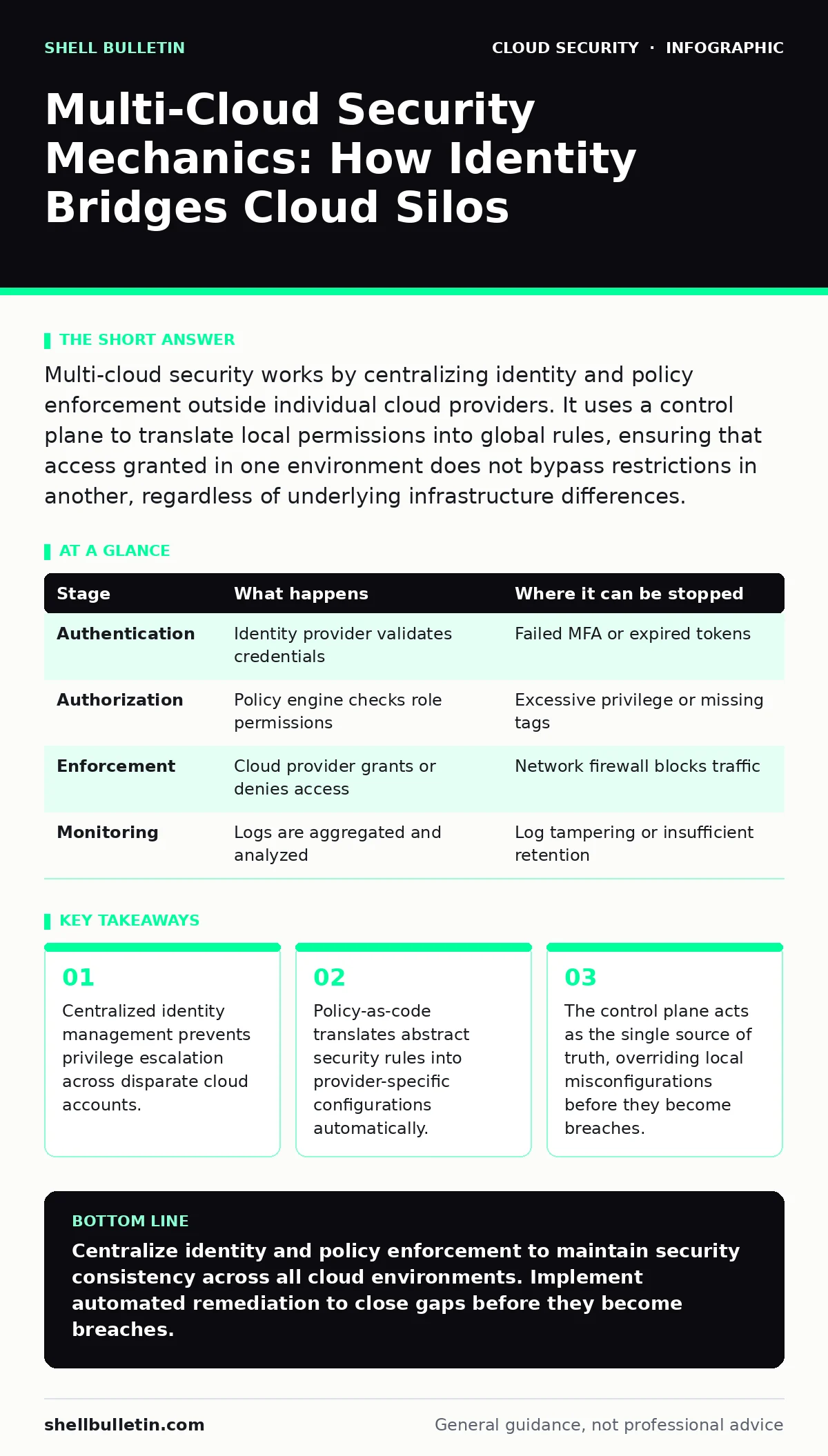
Multi-cloud security works by centralizing identity and policy enforcement outside individual cloud providers. It uses a control plane to translate local permissions into global rules, ensuring that access granted in one environment does not bypass restrictions in another, regardless of underlying infrastructure differences.
The Control Plane Architecture
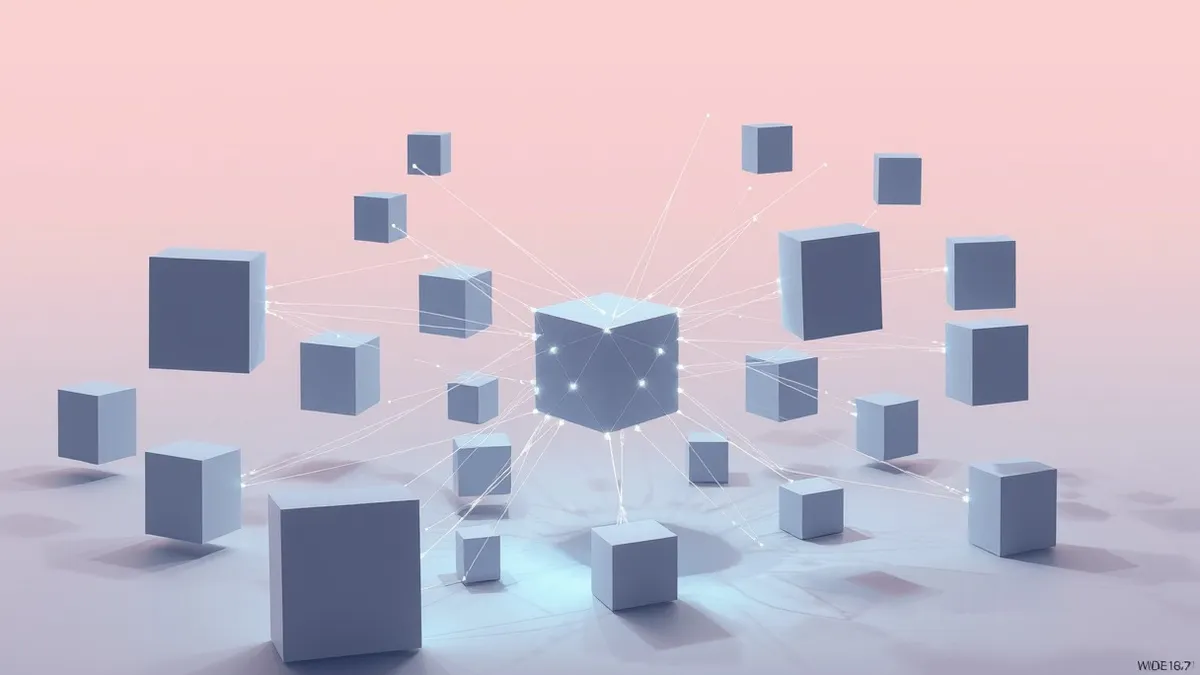
Multi-cloud security does not rely on patching individual services within each provider. Instead, it depends on a control plane that sits above the infrastructure. This layer observes resources across all environments and enforces rules that local systems cannot see. You build this layer to manage identity, network traffic, and data protection uniformly.
The control plane connects to each cloud provider via application programming interfaces. It reads the current state of your resources and compares it against your defined policies. If a resource violates a rule, the control plane can alert you or automatically remediate the issue. This separation ensures that security logic remains consistent even as underlying cloud technologies change.
Identity and Access Federation
Access control is the foundation of multi-cloud security. You must implement identity federation to allow users and services to authenticate once and access resources across multiple clouds. This mechanism uses standards like Security Assertion Markup Language to transfer trust between identity providers.
Without federation, you create separate credentials for each cloud account. This fragmentation leads to orphaned accounts and inconsistent permission levels. By centralizing identity, you ensure that when a user leaves the organization, their access is revoked everywhere simultaneously. This reduces the window of opportunity for attackers who exploit stale credentials.
Stage 1: Authentication Request
The process begins when a user or service requests access to a resource. The request hits the identity provider first, not the cloud resource. The identity provider verifies the user’s credentials against its database. It checks for multi-factor authentication status and other conditional access rules.
| Stage | What happens | Where it can be stopped |
|---|---|---|
| Authentication | Identity provider validates credentials | Failed MFA or expired tokens |
| Authorization | Policy engine checks role permissions | Excessive privilege or missing tags |
| Enforcement | Cloud provider grants or denies access | Network firewall blocks traffic |
| Monitoring | Logs are aggregated and analyzed | Log tampering or insufficient retention |
If authentication fails, the request drops immediately. No token is issued, and no further processing occurs. This step prevents brute-force attacks from reaching the application layer. It also ensures that only verified identities enter the security boundary.
Stage 2: Policy Evaluation
Once authenticated, the system evaluates the request against your security policies. These policies define who can do what, where, and when. The policy engine translates these high-level rules into specific checks for each cloud provider. For example, a rule might state that production databases must never be publicly accessible.
This translation is complex because each cloud provider uses different terminology. One provider might call it a security group, while another calls it a network ACL. The policy engine maps your universal rule to these local concepts. If the local configuration does not match the policy, the engine flags a violation.
Stage 3: Enforcement and Remediation
After evaluation, the system enforces the decision. If the request is allowed, the cloud provider grants access. If denied, the request is blocked. In some architectures, the control plane can also remediate misconfigurations automatically. This means it can change settings to comply with policy without human intervention.
Automated remediation reduces response time to near zero. It prevents small mistakes from becoming large incidents. However, it requires careful tuning to avoid disrupting legitimate operations. You must define clear boundaries for what the system can change automatically versus what requires human approval.
Continuous Compliance Monitoring
Security is not a one-time setup. It requires continuous monitoring to detect drift. Resources change over time as teams update configurations or deploy new services. The control plane constantly scans these resources to ensure they remain compliant.
This scanning happens at regular intervals. It compares the actual state of resources against the desired state defined in your policies. If a resource drifts from compliance, the system generates an alert. This allows you to address issues before they are exploited.
Hidden Costs and Edge Cases
Multi-cloud security introduces complexity that can hide risks. The first hidden cost is the skill gap. Teams must understand the security models of multiple providers. This increases training time and the likelihood of configuration errors.
The second hidden cost is latency. Every request must pass through the identity and policy layers. This adds milliseconds to response times. In high-frequency trading or real-time applications, this delay can be significant. You must balance security rigor with performance requirements.
A common edge case involves workload identity. Services often need to access other services across clouds. Managing these service-to-service credentials is difficult. If a service account is compromised, it can move laterally across environments. You must treat service identities with the same rigor as human identities.
Integrating Related Security Practices
Multi-cloud security does not exist in a vacuum. It must integrate with other security practices to be effective. For instance, cloud misconfigurations are the leading cause of breaches. Your control plane must detect and correct these errors automatically.
You should also consider data residency requirements. Different regions have different laws regarding where data can be stored. Your security policies must enforce these geographic constraints across all clouds. Failure to do so can result in legal penalties and loss of customer trust.
Additionally, ephemeral infrastructure complicates security. Containers and serverless functions are created and destroyed rapidly. Traditional security tools often miss these short-lived resources. Your control plane must be able to inspect and secure resources from the moment they are instantiated.
See also: DevSecOps vs DevOps: How to Integrate Security Without Slowing Delivery · What Is Immutable Infrastructure: A Static Security Model
Limits of the Approach
No security model is perfect. Multi-cloud security has inherent limits. It cannot protect against vulnerabilities within the cloud providers themselves. If a provider suffers a breach, your control plane may not be able to stop it.
It also cannot protect against insider threats who have legitimate access. If an employee has the authority to change policies, they can bypass the controls. You must implement separation of duties and audit trails to mitigate this risk.
Finally, the approach relies on accurate logging. If logs are incomplete or tampered with, the control plane cannot detect violations. You must ensure that logging is enabled and protected across all environments. This often requires additional tools and processes.
Key takeaways
- Centralized identity management prevents privilege escalation across disparate cloud accounts.
- Policy-as-code translates abstract security rules into provider-specific configurations automatically.
- The control plane acts as the single source of truth, overriding local misconfigurations before they become breaches.
Centralize identity and policy enforcement to maintain security consistency across all cloud environments. Implement automated remediation to close gaps before they become breaches.
Frequently asked questions
How do I handle service-to-service authentication in a multi-cloud setup?
Use mutual TLS or short-lived tokens issued by a central identity provider to verify service identities without storing long-term credentials.
Can multi-cloud security slow down my application performance?
Yes, the additional layers for identity verification and policy checks add latency. Optimize by caching tokens and using local policy agents where possible.
What happens if the control plane goes down?
Implement a fail-open or fail-closed strategy based on your risk tolerance. Most systems default to deny access if the control plane is unreachable to prevent unauthorized entry.
Do I need different security tools for each cloud provider?
No, use tools that support multiple providers via standard APIs. This reduces complexity and ensures consistent policy enforcement across all environments.
How this guide was produced: written by the Shell Bulletin editorial team with AI assistance, checked against the public references listed below, and reviewed when the facts change. See our editorial policy or report an error.