Password Spraying vs Brute Force: The Critical Difference Explained
Password spraying avoids account lockouts by using one common password against many users, whereas brute force exhaustively tests many passwords against a single account.

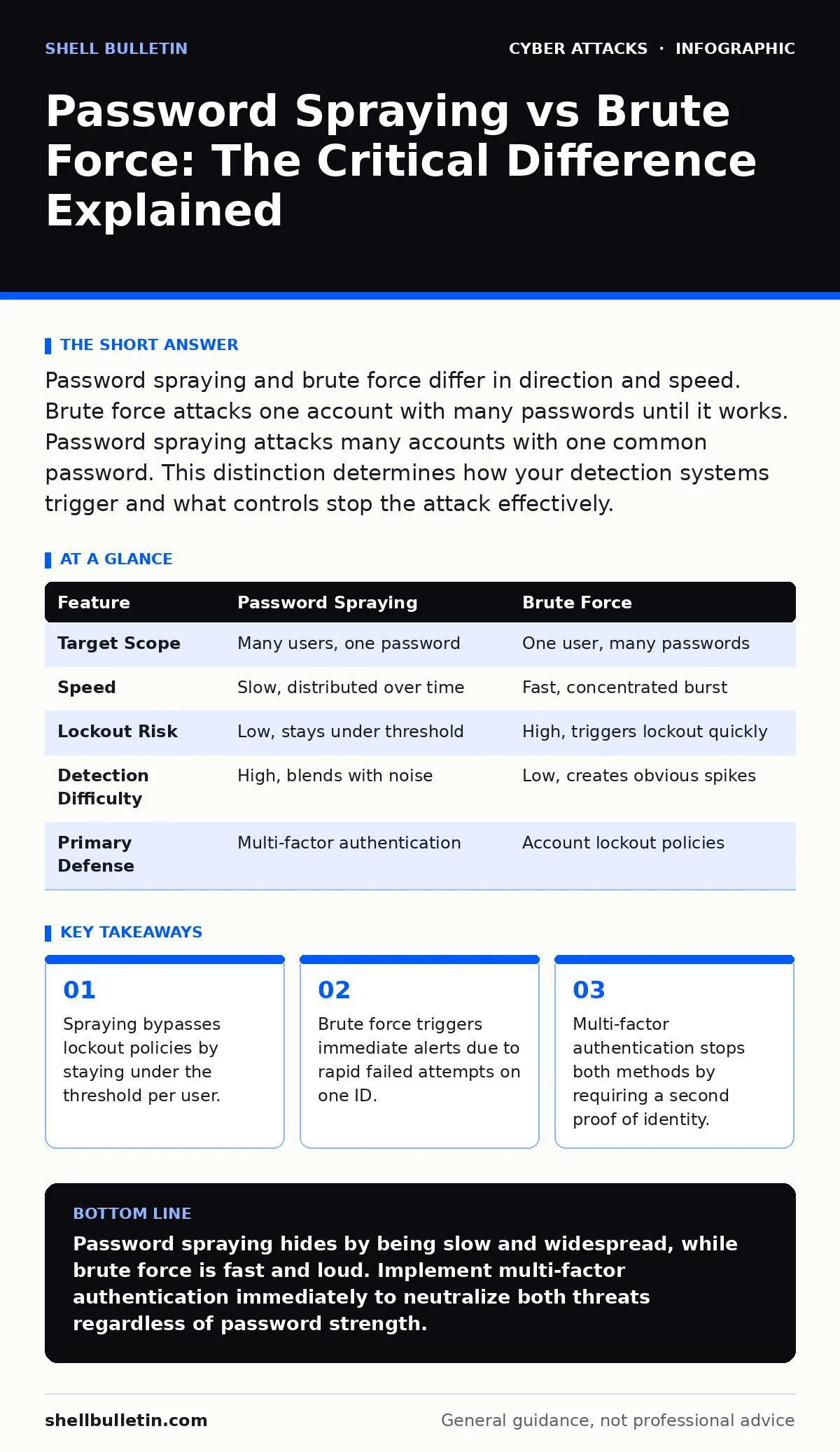
Password spraying and brute force differ in direction and speed. Brute force attacks one account with many passwords until it works. Password spraying attacks many accounts with one common password. This distinction determines how your detection systems trigger and what controls stop the attack effectively.
What is the difference between password spraying and brute force?
Password spraying targets many user accounts with a single common password, while brute force targets one account with many password variations. This structural difference changes how the attack appears to security tools. Brute force generates a high volume of failures for one username, making it easy to spot. Spraying generates a low volume of failures across many usernames, hiding in normal noise. Understanding this difference helps you configure alerts that catch both behaviors without creating false positives.
How does password spraying avoid detection?
Spraying works by distributing attempts thinly across your user base. Attackers use one weak password, such as "Summer2023" or "Welcome1", against hundreds of accounts. Most systems lock an account only after 3 or 5 failed attempts from the same source. Spraying ensures no single user hits that limit. The attacker moves slowly, perhaps waiting minutes between attempts. This low-and-slow approach mimics legitimate users who forget passwords. Your logs show scattered failures rather than a concentrated burst, which often falls below default alert thresholds.
Why is brute force easier to detect?
Brute force relies on volume against a specific target. An automated tool tries thousands of password combinations against one username in seconds. This creates a clear spike in failed login attempts for that specific account. Security information and event management systems flag this pattern immediately. The account often locks out before the attacker succeeds. Because the noise is concentrated, it stands out against the background of normal activity. Detection rules for brute force are standard and effective because the signal is strong and localized.
| Feature | Password Spraying | Brute Force |
|---|---|---|
| Target Scope | Many users, one password | One user, many passwords |
| Speed | Slow, distributed over time | Fast, concentrated burst |
| Lockout Risk | Low, stays under threshold | High, triggers lockout quickly |
| Detection Difficulty | High, blends with noise | Low, creates obvious spikes |
| Primary Defense | Multi-factor authentication | Account lockout policies |
What conditions make spraying more dangerous?
Spraying becomes highly effective when users reuse simple passwords. If your organization allows "Password1" or has weak complexity requirements, spraying succeeds quickly. It also thrives in environments with no multi-factor authentication. Without a second factor, the correct password grants full access. Large organizations with thousands of users provide a wider net for attackers. The probability that at least one user has the guessed password increases with the number of targets. This statistical advantage makes spraying a preferred method for initial access.
When does brute force still succeed?
Brute force succeeds when users have weak, short passwords that are easy to guess. If a user chooses "123456", a brute force tool finds it in seconds. It also works when attackers have partial knowledge of the password, such as the first few characters. This is called a dictionary attack, which uses lists of common words and variations. Brute force is less common now because most systems enforce complexity and lockouts. However, it remains a threat for systems that lack these basic controls or have misconfigured lockout thresholds that are too high.
How do you defend against password spraying?
Multi-factor authentication is the most effective defense against spraying. Even if an attacker guesses the password, they cannot log in without the second factor. This second factor is usually a code from an app or a hardware token. You should also enforce complex password policies that prevent common words. Regular password rotation helps, but users often choose variations of the same weak password. Instead, focus on detecting unusual login locations or times. If a user logs in from a new country, require re-authentication. This adds friction for attackers without blocking legitimate users.
What are the limits of account lockout policies?
Lockout policies stop brute force but fail against spraying. If you lock an account after 3 failures, a sprayer will fail once per account and move on. The attacker does not trigger the lockout. To mitigate this, you can implement global lockouts. This locks the IP address or source after a certain number of failures across any account. However, this can cause issues if many legitimate users share an IP, such as in a large office or using a mobile network. You must balance security with usability to avoid blocking your own staff.
How does this relate to other attack vectors?
Password spraying is often the first step in a larger campaign. Once an attacker gains access, they may move laterally to other systems. This is why network segmentation is critical. It limits the damage by isolating different parts of your network. Attackers might also use the stolen credentials for account takeover, accessing sensitive data or sending malicious emails. They could use the access to deploy malware or exfiltrate information. Understanding that spraying is an entry point helps you prioritize defenses that protect the entire system, not just the login screen.
What advanced monitoring techniques help?
Advanced monitoring looks for patterns rather than just volume. You should analyze the ratio of failed to successful logins. A sudden increase in failures across many accounts is a red flag. Machine learning models can identify anomalies in login behavior, such as logins at unusual hours or from unfamiliar devices. You should also monitor for credential reuse across different services. If a user logs into a third-party app with the same password, and that app is breached, your system is at risk. Integrating logs from all authentication sources gives a complete picture.
Why is user behavior still a factor?
Technical controls can fail if users act unpredictably. Users often write down passwords or share them with colleagues. They might bypass multi-factor authentication by saving codes or approving requests they did not initiate. This is why security awareness training remains necessary. Users need to understand why they should not reuse passwords and how to recognize suspicious login requests. However, relying solely on user behavior is risky. Technical defenses must be the primary line of defense, with user training as a supportive layer.
How do you recover from a spraying attack?
If you detect a spraying attack, you must act quickly. First, block the source IP addresses or accounts involved. Second, force a password reset for any accounts that may have been compromised. Check for unusual activity in those accounts, such as data exports or new device logins. Review your logs to determine the scope of the attack. Did the attacker gain access to any accounts? If so, isolate those systems immediately. Finally, update your detection rules to catch similar patterns in the future. Continuous improvement is key to staying ahead of attackers.
Key takeaways
- Spraying bypasses lockout policies by staying under the threshold per user.
- Brute force triggers immediate alerts due to rapid failed attempts on one ID.
- Multi-factor authentication stops both methods by requiring a second proof of identity.
- Complex passwords protect against brute force but not against reused weak ones.
Password spraying hides by being slow and widespread, while brute force is fast and loud. Implement multi-factor authentication immediately to neutralize both threats regardless of password strength.
Frequently asked questions
Can two-factor authentication stop password spraying?
Yes, multi-factor authentication stops password spraying because the attacker only has the password, not the second factor required to complete the login.
Is password spraying illegal?
Unauthorized access to computer systems is illegal in most jurisdictions. Password spraying is a method used to gain unauthorized access, making it a criminal act.
How often should I change passwords to prevent spraying?
Frequent password changes are less effective than using complex, unique passwords and multi-factor authentication. Changing passwords too often leads to weaker choices.
Does using a password manager help against spraying?
Yes, password managers generate unique, complex passwords for every account. This ensures that even if one password is guessed, it cannot be used elsewhere.
How this guide was produced: written by the Shell Bulletin editorial team with AI assistance, checked against the public references listed below, and reviewed when the facts change. See our editorial policy or report an error.