How Private Endpoints Work: Mechanism, Limits, and Hidden Costs
Private endpoints route traffic through a deterministic private network path, bypassing the public internet to eliminate exposure from unsecured cloud databases.

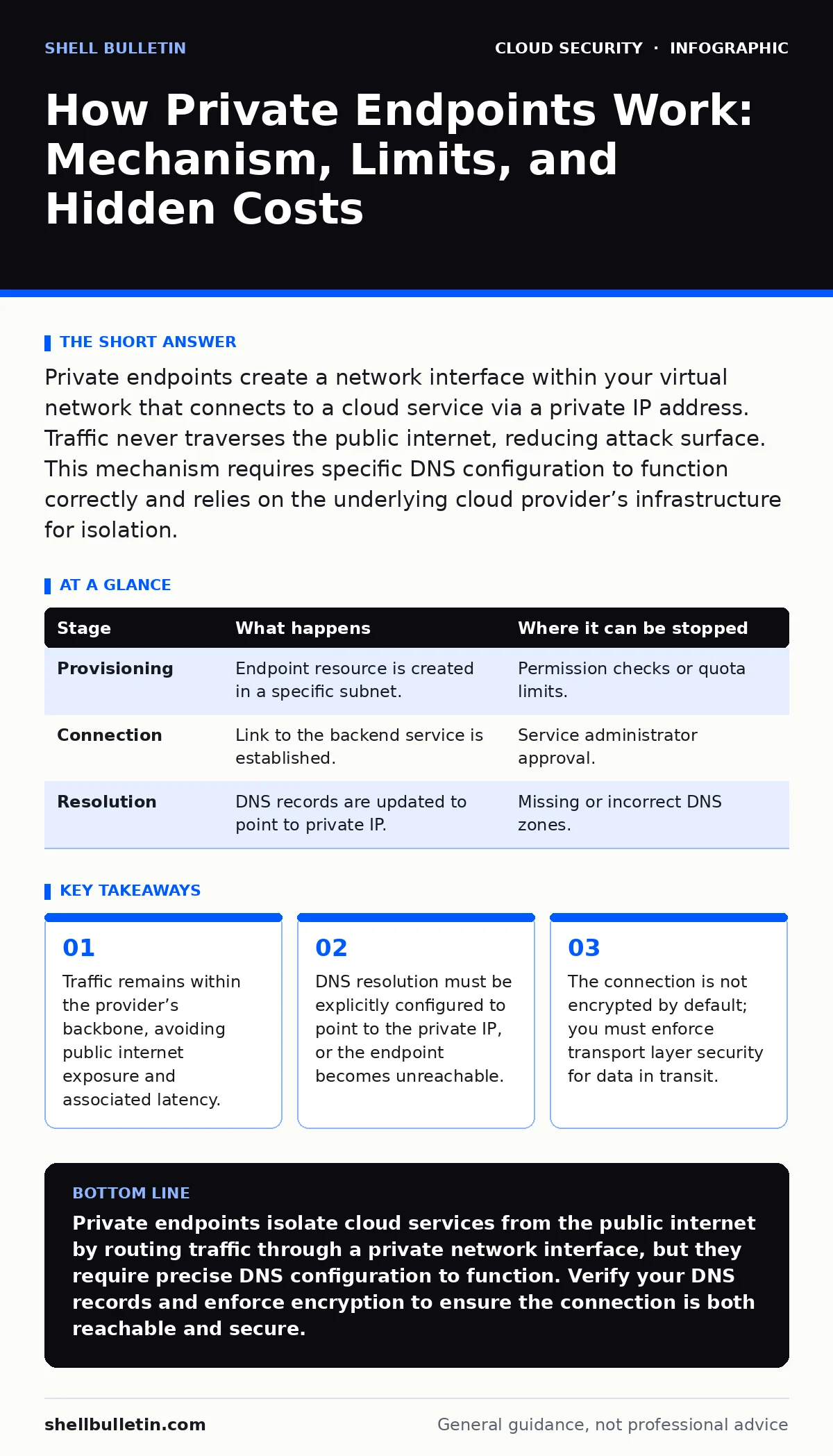
Private endpoints create a network interface within your virtual network that connects to a cloud service via a private IP address. Traffic never traverses the public internet, reducing attack surface. This mechanism requires specific DNS configuration to function correctly and relies on the underlying cloud provider’s infrastructure for isolation.
The Core Mechanism of Private Connectivity
Cloud services typically expose functionality through public IP addresses accessible via the internet. This default configuration creates a large attack surface. Private endpoints change this model by placing a network interface inside your virtual network. This interface uses a private IP address from your address space.
When your workload sends traffic to a cloud service, the request targets this private interface. The traffic then travels over the cloud provider’s internal backbone network. It never touches the public internet. This design reduces the risk of interception and makes the service invisible to external scanners.
The mechanism relies on three components: the private endpoint resource, the underlying service connection, and DNS configuration. Each component must align correctly for the connection to succeed. Misalignment in any part results in connectivity failure, not a security breach.
Stage 1: Resource Provisioning
You begin by creating a private endpoint resource in your management console. This action defines the target cloud service, such as a storage account or database instance. You specify the subnet where the network interface will reside. This subnet must belong to a virtual network that your workloads can access.
The cloud provider validates that you have permission to connect to the target service. If permissions are missing, the creation fails immediately. This step ensures that only authorized networks can attempt to establish the connection. It does not yet allow data transfer.
| Stage | What happens | Where it can be stopped |
|---|---|---|
| Provisioning | Endpoint resource is created in a specific subnet. | Permission checks or quota limits. |
| Connection | Link to the backend service is established. | Service administrator approval. |
| Resolution | DNS records are updated to point to private IP. | Missing or incorrect DNS zones. |
Stage 2: Service Linkage
Once the endpoint resource exists, the system attempts to link it to the backend service. This step creates a logical connection between your virtual network and the cloud service’s infrastructure. The service provider assigns a private IP address to the endpoint interface.
This address is drawn from the IP range of the subnet you selected. It is not a public IP address. The backend service now recognizes your virtual network as a trusted source. However, the service administrator may need to approve this connection manually.
If approval is pending, the endpoint exists but cannot pass traffic. This state is a common source of confusion during deployment. You must wait for the connection status to change to active before proceeding.
Stage 3: DNS Resolution
The final and most critical step is configuring Domain Name System resolution. Your workloads use domain names to locate services, not IP addresses. If you do not update DNS records, your workloads will continue to resolve the service’s public IP address.
Traffic sent to the public IP will bypass the private endpoint entirely. It will travel over the public internet, negating the security benefits. You must create a private DNS zone for the service’s domain. Then, add an A record that maps the domain name to the private IP address of the endpoint.
This configuration ensures that when your application requests "datastore", it receives the private IP. The traffic then routes through the private endpoint. Without this step, the endpoint is effectively invisible to your applications.
Limits and Operational Costs
Private endpoints are not a silver bullet. They provide network isolation but do not encrypt data by default. You must still enforce transport layer security to protect data in transit. This adds computational overhead to your workloads.
The mechanism also introduces complexity in DNS management. If you have multiple regions or services, maintaining private DNS zones becomes tedious. Errors in these zones can cause widespread connectivity failures. Debugging these issues requires deep knowledge of DNS propagation and resolution order.
Furthermore, private endpoints can be expensive. You pay for the endpoint resource itself, plus the data transfer costs within the private network. In some cases, moving data through a private endpoint is more costly than using the public internet. You must calculate these costs before widespread adoption.
Integration with Security Frameworks
Private endpoints fit into a broader security strategy. They complement zero trust network access by ensuring that only authorized networks can reach services. They also support data residency requirements by keeping traffic within specific geographic regions.
However, they do not replace identity management. You must still use workload identity to authenticate requests. Without proper identity checks, any resource in your virtual network can access the endpoint. This is a common misconfiguration that leads to privilege escalation.
Regular audits are necessary to ensure that endpoints are only connected to necessary services. Unused endpoints should be removed to reduce cost and attack surface. This practice aligns with CIS Benchmarks recommendations for cloud security.
Common Pitfalls in Deployment
One frequent error is assuming that creating the endpoint is sufficient. As noted, DNS configuration is mandatory. Another error is ignoring the subnet’s network security groups. If the subnet blocks outbound traffic, the endpoint cannot function.
You must also consider the impact on existing applications. Some legacy applications may hardcode public IP addresses. These applications will fail to connect when you switch to private endpoints. You must update these applications or maintain dual connectivity, which increases complexity.
See also: DevSecOps vs DevOps: How to Integrate Security Without Slowing Delivery · What Is Immutable Infrastructure: A Static Security Model
Conclusion on Network Design
Private endpoints shift the security boundary from the perimeter to the network interface. This shift reduces exposure but increases operational complexity. You must manage DNS, permissions, and costs carefully.
The mechanism is powerful when used correctly. It prevents exposure from unsecured cloud databases and other public-facing services. However, it requires ongoing maintenance and monitoring. Neglecting DNS updates or identity checks can undermine the entire security posture.
Use private endpoints as part of a layered defense strategy. Combine them with strong identity management, encryption, and regular audits. This approach ensures that your cloud services remain secure and accessible to authorized users only.
Key takeaways
- Traffic remains within the provider’s backbone, avoiding public internet exposure and associated latency.
- DNS resolution must be explicitly configured to point to the private IP, or the endpoint becomes unreachable.
- The connection is not encrypted by default; you must enforce transport layer security for data in transit.
Private endpoints isolate cloud services from the public internet by routing traffic through a private network interface, but they require precise DNS configuration to function. Verify your DNS records and enforce encryption to ensure the connection is both reachable and secure.
Frequently asked questions
Do private endpoints encrypt data automatically?
No, private endpoints only provide network isolation. You must enable encryption at the application or transport layer to protect data in transit.
Can I use private endpoints for services outside my cloud provider?
No, private endpoints are specific to each cloud provider. You cannot create a private endpoint for a service hosted on a different platform or on-premises.
What happens if I delete the private endpoint?
Traffic will revert to the public internet if DNS records still point to the public IP. If DNS is not updated, the service becomes unreachable.
Are private endpoints more expensive than public access?
Yes, you pay for the endpoint resource and internal data transfer. Costs vary by provider and region, but they are generally higher than public access.
How this guide was produced: written by the Shell Bulletin editorial team with AI assistance, checked against the public references listed below, and reviewed when the facts change. See our editorial policy or report an error.