SAML Authentication Bypass: How Attackers Skip Login Steps
SAML token validation failures allow attackers to forge identity assertions, bypassing credential checks by exploiting trust in external identity providers.

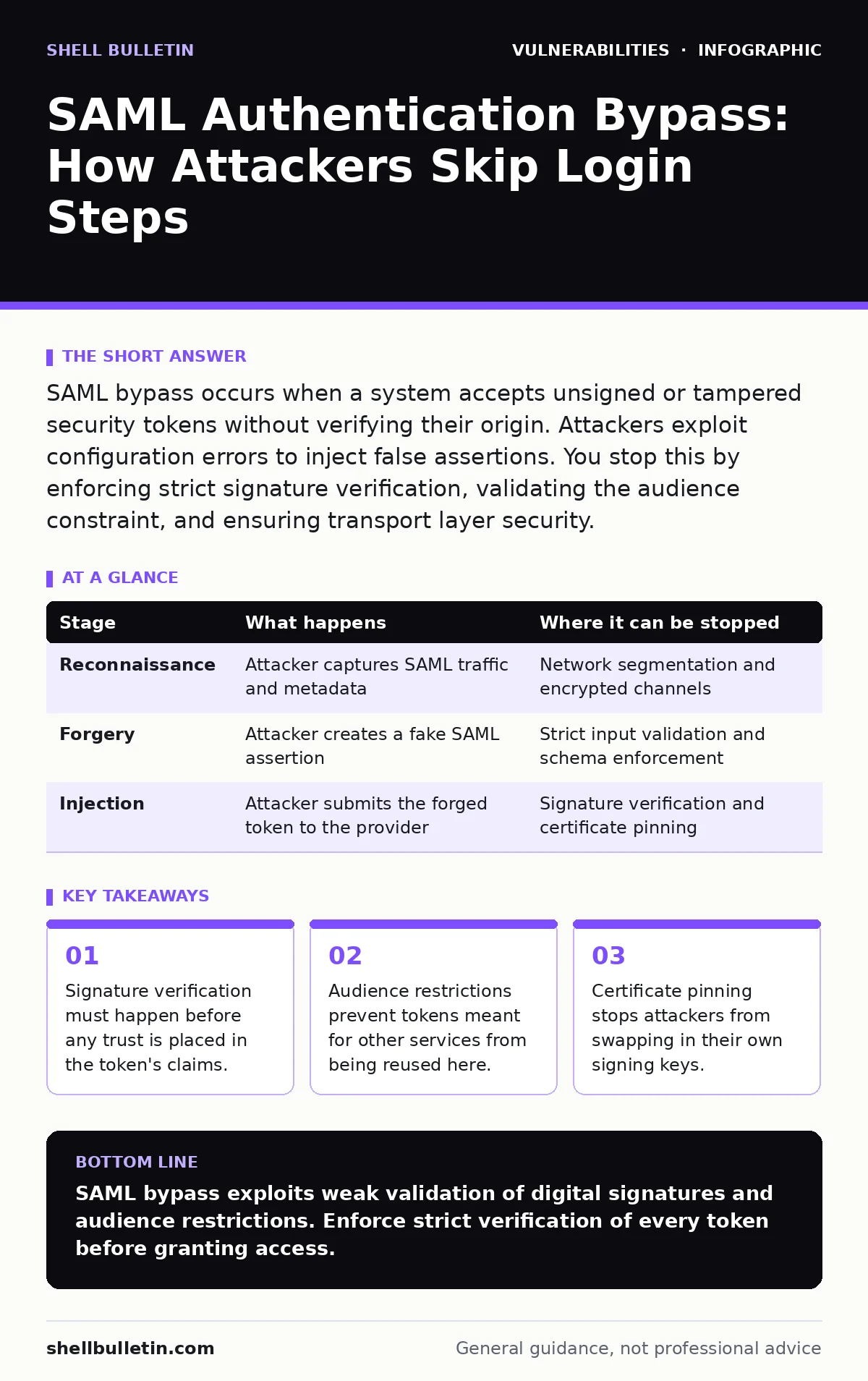
SAML bypass occurs when a system accepts unsigned or tampered security tokens without verifying their origin. Attackers exploit configuration errors to inject false assertions. You stop this by enforcing strict signature verification, validating the audience constraint, and ensuring transport layer security.
The Trust Assumption in SAML
Security Assertion Markup Language (SAML) relies on a chain of trust between an identity provider and a service provider. The identity provider issues a digital token after verifying user credentials. The service provider accepts this token as proof of identity. This architecture shifts the authentication burden away from the application.
This shift creates a single point of failure in the validation logic. If the service provider trusts the token structure without verifying its cryptographic integrity, the entire authentication process collapses. The system assumes the token is genuine because it looks correct. This assumption is the foundation of most bypass attempts.
Stage 1: Reconnaissance and Discovery
The attacker begins by observing the SAML flow. They intercept the communication between the browser and the service provider. This reveals the endpoint URLs and the format of the SAML response. The attacker identifies the identity provider's metadata, including the public keys used for signing.
This stage relies on the visibility of the protocol. SAML responses are often transmitted in HTTP POST requests. These requests are visible to anyone with network access or browser inspection tools. The attacker maps the entry points for injection. They note which parameters are required for the service provider to process the login.
Stage 1: Mapping the Attack Surface
The attacker documents the specific XML structure expected by the service provider. They identify the fields for user identity, roles, and expiration times. This mapping allows them to craft a fake token that mimics the legitimate structure. The goal is to understand what the service provider expects to see.
| Stage | What happens | Where it can be stopped |
|---|---|---|
| Reconnaissance | Attacker captures SAML traffic and metadata | Network segmentation and encrypted channels |
| Forgery | Attacker creates a fake SAML assertion | Strict input validation and schema enforcement |
| Injection | Attacker submits the forged token to the provider | Signature verification and certificate pinning |
Stage 2: Token Forgery and Manipulation
With the structure known, the attacker crafts a malicious SAML assertion. They modify the user identifier to match a privileged account. They may also extend the expiration time to ensure the token remains valid. The critical step is handling the digital signature. If the service provider does not enforce signatures, the attacker omits them entirely.
If signatures are enforced, the attacker may exploit weak cryptographic algorithms. They might use a known private key if the identity provider has published it insecurely. Alternatively, they may exploit a flaw in the signature validation library. This allows them to create a token that appears signed but was not.
Stage 3: Exploiting Validation Logic
The attacker submits the forged token to the service provider's assertion consumer service. The provider parses the XML and extracts the claims. The bypass succeeds if the provider skips any validation step. Common failures include ignoring the digital signature, accepting tokens from untrusted issuers, or failing to check the audience restriction.
The audience restriction specifies which service provider the token is intended for. If this check is missing, a token issued for Service A can be used to log into Service B. This is a form of token reuse. The attacker exploits the lack of context-aware validation. The system trusts the content without verifying the context.
Stage 4: Session Establishment and Access
Once the service provider accepts the forged assertion, it creates a session. The user is logged in with the privileges claimed in the token. The attacker now has access to the application. They may escalate privileges further if the token includes role claims. The session behaves like a legitimate login, making detection difficult.
The attacker can now perform actions allowed by the granted role. This might include viewing sensitive data, modifying configurations, or accessing administrative functions. The breach is complete because the application never challenged the identity again. The initial trust decision dictates the entire session.
Interruption Points and Mitigation
You can interrupt this process at multiple stages. The most effective point is during token validation. Enforcing strict signature verification ensures the token was issued by the trusted identity provider. You must verify the signature against the public key in the identity provider's metadata. Do not trust tokens without valid signatures.
Audience restriction validation is another critical control. The service provider must check that the token is intended for it. This prevents cross-service token reuse. Implementing certificate pinning ensures the service provider only accepts tokens signed by specific keys. This stops attackers from swapping in their own keys.
The Hidden Cost of Configuration
SAML configuration is complex and error-prone. Administrators often prioritize functionality over security. They may disable signature verification for testing and forget to re-enable it. They may accept tokens from any issuer to simplify integration. These shortcuts create persistent vulnerabilities.
The cost of these misconfigurations is high. A single bypass can compromise the entire application. The attacker gains access without needing to crack passwords. This undermines the purpose of multi-factor authentication. The system becomes vulnerable to identity forgery regardless of credential strength.
Integration with Secure Practices
You must integrate SAML security into your broader development practices. This requires coordination between security and development teams. The secure software development lifecycle includes reviewing authentication logic before deployment. This ensures that validation rules are correct and enforced.
Testing for SAML bypass is not always covered in standard security scans. You need specific tests for signature validation and audience checks. Security regression testing helps ensure that updates do not break these controls. Regular audits of identity provider configurations also reduce risk.
Beyond SAML: Related Risks
Understanding SAML bypass helps you recognize similar patterns in other protocols. Host header injection can manipulate how applications process requests. This technique can bypass security controls that rely on the host header for validation. Similarly, cross-site scripting (XSS) can steal session tokens or SAML assertions.
PHP object injection can manipulate internal data structures. This might affect how tokens are processed or validated. Buffer overflow vulnerabilities in legacy systems can crash services or allow code execution. While distinct from SAML, these flaws highlight the importance of input validation.
Risk-based vulnerability management helps prioritize these issues. You should assess the impact of a SAML bypass versus other risks. This ensures you allocate resources effectively. Fortinet FortiGate vulnerabilities are an example of how infrastructure flaws can expose authentication services.
Final Verification Steps
Always verify the identity provider's metadata regularly. Changes to public keys must be monitored and approved. Automated checks can alert you to unexpected changes. This ensures that your trust anchors remain valid. Do not assume static configurations are secure forever.
Implement logging for all authentication events. Record details of SAML assertions and validation results. This aids in detecting anomalies. If a token fails validation, log the reason. This data helps you identify attack patterns and improve defenses.
Key takeaways
- Signature verification must happen before any trust is placed in the token's claims.
- Audience restrictions prevent tokens meant for other services from being reused here.
- Certificate pinning stops attackers from swapping in their own signing keys.
SAML bypass exploits weak validation of digital signatures and audience restrictions. Enforce strict verification of every token before granting access.
Frequently asked questions
Can SAML tokens be replayed by attackers?
Yes, if the service provider does not check timestamps or use nonces. Implementing strict time limits and unique identifiers prevents replay attacks.
Does multi-factor authentication stop SAML bypass?
No, MFA secures the initial login at the identity provider. If the token validation at the service provider is flawed, MFA does not prevent bypass.
How do I know if my SAML implementation is vulnerable?
Test with forged tokens and check if signature verification is enforced. Review configuration logs and conduct penetration testing focused on authentication.
Is SAML inherently insecure?
No, SAML is secure when implemented correctly. The risk comes from misconfiguration and weak validation logic in the service provider.
How this guide was produced: written by the Shell Bulletin editorial team with AI assistance, checked against the public references listed below, and reviewed when the facts change. See our editorial policy or report an error.