DNS Amplification Attack Mitigation: Stop Traffic Flooding Your Network
Blocking inbound traffic from open resolvers prevents attackers from using your infrastructure to flood targets with amplified data streams.

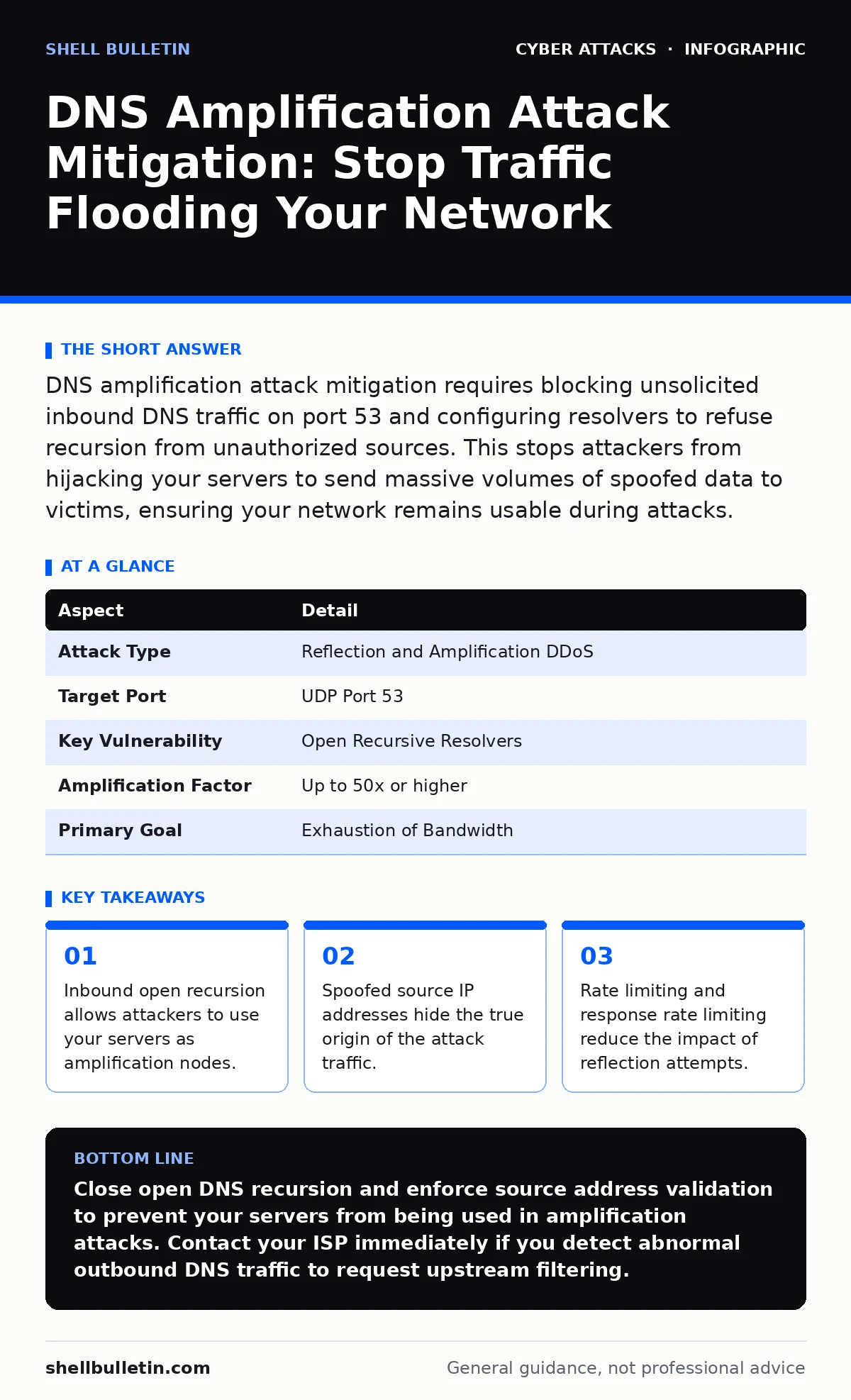
DNS amplification attack mitigation requires blocking unsolicited inbound DNS traffic on port 53 and configuring resolvers to refuse recursion from unauthorized sources. This stops attackers from hijacking your servers to send massive volumes of spoofed data to victims, ensuring your network remains usable during attacks.
How DNS Amplification Attacks Work
A DNS amplification attack is a distributed denial-of-service method where an attacker sends small queries to open DNS servers while spoofing the victim's IP address. The server responds with large amounts of data directly to the victim, overwhelming their connection.
Imagine you ask a librarian for a single book title. The librarian sends you a 100-page catalog instead. Now imagine thousands of people doing this simultaneously, but they all claim to be you. Your mailbox overflows. This is the core mechanism. The attacker sends a tiny query, often just 30 bytes, requesting all records for a domain. The response can be thousands of bytes. This ratio creates the amplification effect.
The attacker spoofs the source IP address in the packet header. This trick makes the DNS server believe the request came from the victim. The server follows standard protocol and sends the large response to the spoofed address. The victim receives traffic they never requested. The attacker remains hidden behind the legitimate DNS infrastructure.
| Aspect | Detail |
|---|---|
| Attack Type | Reflection and Amplification DDoS |
| Target Port | UDP Port 53 |
| Key Vulnerability | Open Recursive Resolvers |
| Amplification Factor | Up to 50x or higher |
| Primary Goal | Exhaustion of Bandwidth |
Why Open Recursion Matters
Recursion is the process where a DNS server looks up a domain name on behalf of a client. It queries root servers, then top-level domain servers, until it finds the answer. This service is necessary for internal networks but dangerous when exposed to the public internet.
If your DNS server accepts recursive queries from any IP address, it is an open resolver. Attackers scan the internet for these open ports. They build a list of servers willing to do work for free. Your server becomes a weapon in their arsenal. You do not control the traffic volume, but your server generates it.
This misconfiguration is common in small business networks. Administrators often copy settings from large enterprise environments without understanding the security implications. A server that answers queries for the entire internet is a liability. It consumes your bandwidth and reputation. It also helps attackers hide their own location.
The Hidden Cost of Spoofing
Internet Protocol (IP) packets contain source and destination addresses. In a normal conversation, you send a packet to me, and I reply to your address. Attackers break this trust by forging the source address. This is called IP spoofing.
Because the response comes from a legitimate DNS server, it looks like normal traffic to the victim. Firewalls often allow inbound DNS responses because DNS is essential for internet connectivity. The victim cannot easily distinguish between a legitimate lookup and an attack packet. The volume is the only clear signal.
This spoofing also protects the attacker. Tracing the attack back to the sender is difficult because the packets originate from many different DNS servers worldwide. The victim sees traffic from Google, Cloudflare, and various university servers. The real attacker sends only tiny queries from a single machine. The asymmetry makes attribution nearly impossible.
What People Usually Get Wrong
Many administrators believe that installing a firewall stops this attack. A standard firewall blocks known bad IPs. It does not stop traffic from legitimate DNS servers. The traffic looks clean because it comes from trusted infrastructure. Blocking all DNS traffic would break your internet access. This is not a viable solution.
Another common mistake is focusing only on outbound traffic. Administrators monitor what leaves their network. They forget that their servers are generating the attack traffic. The harm is done by the response packets, not the initial queries. You must secure the server that generates the response, not just the network that receives the query.
Some believe that using a Content Delivery Network (CDN) solves the problem. A CDN can absorb some traffic, but it does not fix the root cause. If your DNS servers are still open, attackers will find them. The CDN masks the symptoms but leaves the vulnerability intact. You must address the DNS configuration directly.
DNS Amplification Attack Mitigation
The most effective form of DNS amplification attack mitigation is source address validation. This technique, known as BCP38 or ingress filtering, drops packets that claim to come from an IP address not assigned to the sender. If your network enforces this, attackers cannot spoof your IP address. Other networks should also enforce it.
You must also disable open recursion. Configure your DNS server to accept recursive queries only from trusted internal networks. External queries should be refused or forwarded to a public resolver. This ensures your server does not do work for strangers. It reduces your attack surface significantly.
Implement response rate limiting (RRL) on your DNS server. This feature detects when a single IP address receives too many responses in a short time. The server then slows down or drops subsequent responses to that address. This limits the damage even if spoofing occurs. It is a defense-in-depth measure.
- Disable recursion for external IP addresses.
- Enable ingress filtering on your edge router.
- Configure response rate limiting on DNS software.
Impact on Business Continuity
These attacks target availability. They do not steal data or compromise credentials. The goal is to make your website or service unreachable. For a small business, downtime means lost revenue and damaged reputation. Customers cannot complete purchases. Employees cannot access cloud services.
The attack can last for hours or days. Cleaning up requires technical expertise. You may need to contact your internet service provider to filter traffic at the network level. This process takes time. During this window, your business is offline. The financial impact extends beyond the immediate outage.
This type of attack is distinct from account takeover or OAuth consent phishing. Those attacks steal access. This attack blocks access entirely. Understanding the difference helps you prioritize defenses. You need different controls for data theft versus service disruption.
Complementary Security Measures
Securing your DNS is one part of a broader strategy. You should also consider network segmentation to isolate critical servers. If one segment is overwhelmed, others may remain functional. This limits the blast radius of any attack.
Understanding DDoS protection services can help. Some providers offer scrubbing centers that filter malicious traffic before it reaches your network. This is useful if you cannot implement local filtering effectively. It adds a layer of resilience against large-scale attacks.
Be aware of DNS hijacking as a related threat. While amplification floods traffic, hijacking redirects users to malicious sites. Both exploit the DNS system but in different ways. Securing your DNSSEC implementation helps prevent hijacking. It adds a layer of cryptographic verification to DNS responses.
Do not neglect eavesdropping attacks on your internal network. While DNS amplification is external, internal threats can provide attackers with the information they need to target you. Encrypting internal traffic reduces the risk of data leakage that could aid an attack.
Key takeaways
- Inbound open recursion allows attackers to use your servers as amplification nodes.
- Spoofed source IP addresses hide the true origin of the attack traffic.
- Rate limiting and response rate limiting reduce the impact of reflection attempts.
Close open DNS recursion and enforce source address validation to prevent your servers from being used in amplification attacks. Contact your ISP immediately if you detect abnormal outbound DNS traffic to request upstream filtering.
Frequently asked questions
Can a home router stop a DNS amplification attack?
Most home routers do not support ingress filtering or response rate limiting. They can block inbound traffic on port 53, which helps, but they cannot prevent your connected devices from being used if they run open DNS services.
Does HTTPS protect against DNS amplification?
No. HTTPS encrypts web traffic between a browser and a server. DNS amplification targets the DNS protocol itself, which operates at a different layer. Encryption does not stop the volume of spoofed DNS responses.
How do I know if my DNS server is open to recursion?
You can use online tools that test for open resolvers. If your server responds to queries for external domains from an unknown IP address, it is likely open. Configure it to restrict recursion to your private IP ranges only.
Is DNSSEC a mitigation for amplification attacks?
DNSSEC adds security to DNS responses by verifying their authenticity. It does not reduce the volume of traffic or prevent spoofing. It helps prevent cache poisoning but does not stop bandwidth exhaustion from amplification.
How this guide was produced: written by the Shell Bulletin editorial team with AI assistance, checked against the public references listed below, and reviewed when the facts change. See our editorial policy or report an error.